Ties of Common Kindred
This Dunlap broadside is one word shorter than the rest
In May 1975, ahead of the 200th anniversary of the Declaration of Independence, the Library of Congress hosted as many surviving copies of John Dunlap’s first printing of the Declaration as could travel to Washington, D.C. Twenty-one Dunlap broadsides were then known—a few more have been identified since then—and seventeen were brought together for examination by Frederick R. Goff, the longtime chief of the library’s Rare Book Division.
In the library’s preservation laboratory, a large table with a light box was set up, overlaid with a grid. This enabled Goff to take accurate measurements of each broadside, document how the margins had been trimmed over time, and track the chain lines and watermarks in the paper. Photography of each broadside allowed for the negatives to be layered and compared. Goff was able to identify two states of the Dunlap printing: essentially, a slight shift in the placement of the imprint with Dunlap’s name showed that a number of broadsides were printed before the text shifted. In the first state, the “P” of “Philadelphia” is located directly under the comma, but in the second state, the “P” is located below the “N” of Charles Thomson’s name.

Examples of the first state (above, Beinecke Library, Yale University) and second state (below, Library of Congress)
Among the seventeen Dunlap broadsides that Frederick Goff examined was the one from the Beinecke Rare Book & Manuscript Library at Yale University. The Beinecke Library’s copy falls into the first state identified by Goff, meaning that it was one of the first broadsides printed, before the imprint shifted. In the printed report of his examination, Goff noted that the paper measured 0.13 millimeters in thickness and had been “folded once horizontally and thrice vertically.” He noticed four small holes in the paper, as well. On the back, there was a handwritten label identifying the printing as the “Declaration of Independance.”
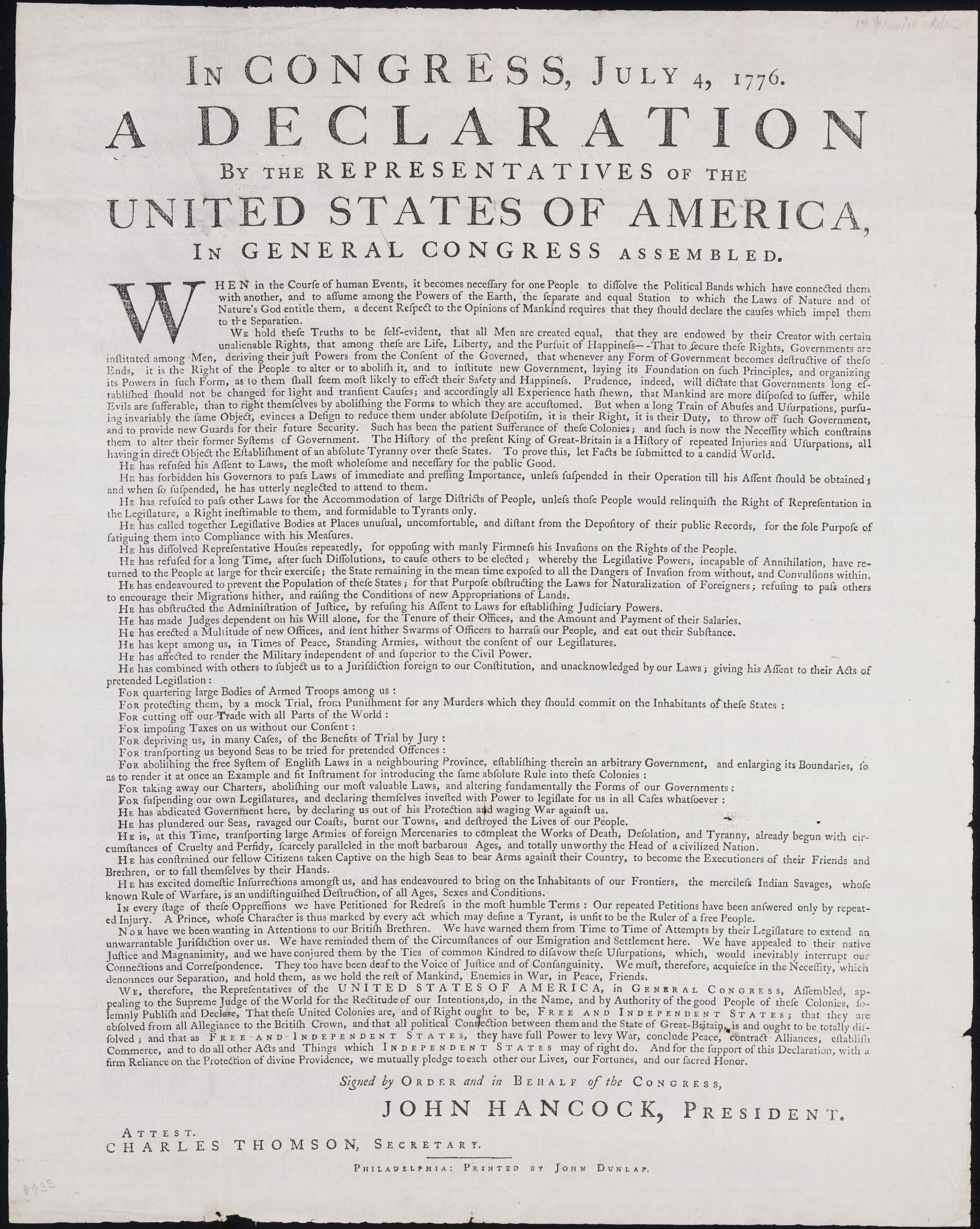
John Dunlap, Broadside of the Declaration of Independence, July 4–5, 1776, Beinecke Library, Yale University
Despite Frederick Goff’s detailed comparisons, he missed something important about the broadside on loan from the Beinecke Library. This Dunlap broadside is one word shorter than the rest. In the penultimate paragraph of the Declaration of Independence, the line that should read “we have conjured them by the Ties of our common Kindred” is lacking the word “our.” This means that the rest of the line appears slightly off, as well, though there are no obvious gaps in the spacing of the type. Somehow, despite Goff’s scrutiny, this error escaped his notice.
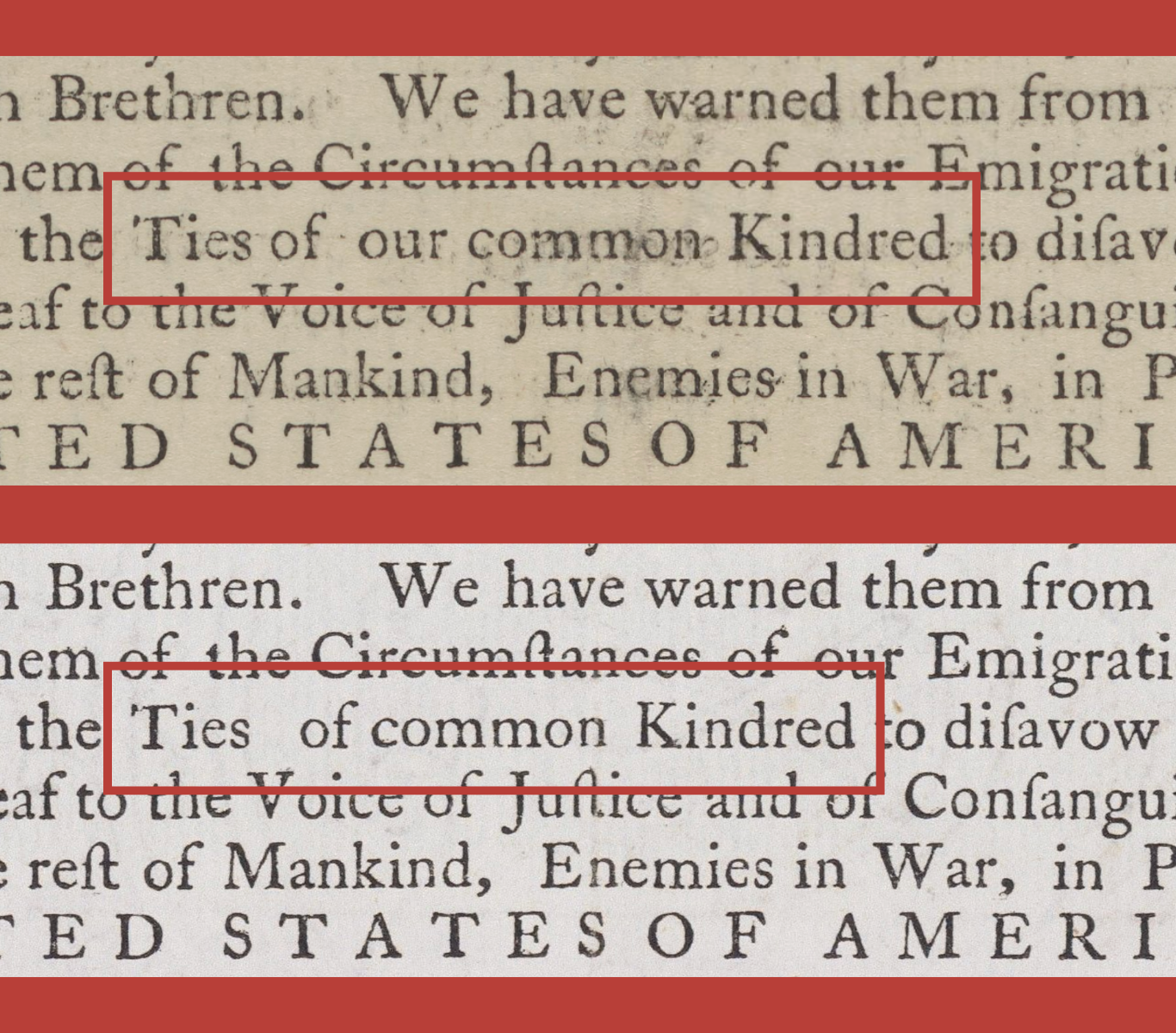
Comparison of penultimate paragraph with complete phrase (New York Public Library) and missing word (Beinecke Library, Yale University)
The Beinecke Library’s broadside might provide a clue about John Dunlap’s printing process. The word would not have been intentionally removed—it must have fallen out of the typesetting while the press was in use. No other Dunlap broadsides lacking the word “our” survive, which might suggest that the mistake was quickly caught and corrected. Perhaps, when the “our” was added back in, the imprint also shifted, creating the two states that Frederick Goff noticed in 1975.
This broadside offers an important reminder that a single copy cannot represent an entire printing. There is important evidence on every copy of the Declaration of Independence, from pieces of type that were damaged during the printing process, to ink residue from broadsides being stacked while the paper was still wet, to handwritten names and notes. When the Library of Congress assembled Dunlap broadsides for examination in 1975, there was an understanding that only by bringing these different copies together could their distinctions be identified and analyzed. Although the missing “our” was overlooked, other important characteristics of John Dunlap’s printing came to light which have informed decades of research as well as valuation.
Where to See It Online: Beinecke Library, Yale University