A Thousand Things to Communicate
Peter Timothy was a busy man
In June 1777, Peter Timothy wrote a letter to Benjamin Franklin. Timothy was in Charleston, South Carolina and Franklin was in France, advocating for the United States. Although Franklin’s career had shifted to diplomacy, he had started out in printing. In fact, shortly after the Timothy family had emigrated from the Dutch Republic to British North America, Franklin had sent them to Charleston so that Peter’s father, Lewis, could establish a newspaper for South Carolina. Lewis Timothy died a few years later and his wife, Elizabeth, took over the business before handing it over to their son, Peter.
The 1777 letter to Benjamin Franklin makes one thing clear: Peter Timothy was a busy man. He had “a Thousand Things to communicate to his Friend; but so incessantly has he been engaged in public Affairs for full Four Years” that he had no time to write. Whenever he tried to address Franklin, “he was always at a Loss where to begin or where he should end, and has been there by constantly discouraged.”
Peter Timothy was a printer, but during the American Revolution, he wore a few other hats, as well. As he described to Franklin, he was “both a Member of and Secretary of the Congresses, General Committee, Charles-Town Committee; Chairman, (and did all the Business) of the Committee of Observation and Inspection, in such a Manner as too many well remember; and also Secretary to the Councils of Safety, who, while they existed, sat Day and Night, without a single Day’s intermission—continually in Motion from Congress to Committee, from Committee to Council, from Council to Inspection, and so on.”
Timothy’s political service and printing business in South Carolina intersected in 1776 because he had the latest information about the war, including the British interest in the port of Charleston. Worried that, if the British forces took control of Charleston, they would also take control of his press. Timothy disassembled it. But, after the Continental Congress declared independence, he reassembled his press to print the news.
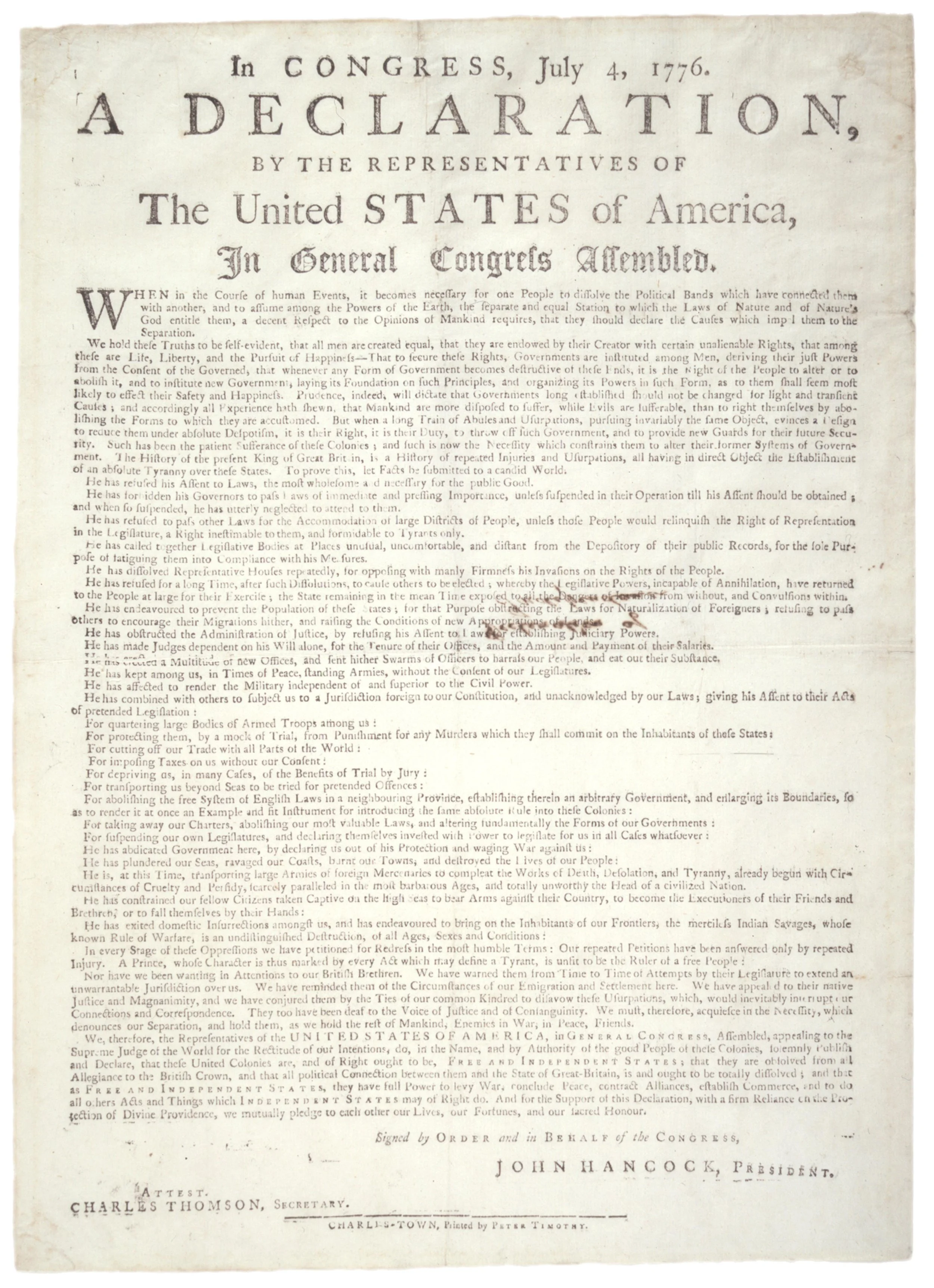
Peter Timothy, Broadside of the Declaration of Independence, August 1776, Gilder Lehrman Institute of American History
Only one copy of Peter Timothy’s broadside of the Declaration of Independence survives, though he probably printed more. It took a month for the Declaration to travel from Philadelphia to Charleston, which meant that Timothy printed his broadsides in the first few days of August. He used a design very similar to John Dunlap’s broadsides, with a wide title above the text organized in a single column.
The Continental Army successfully defended Charleston in 1776, but when the British forces eventually occupied Charleston in 1780, Peter Timothy was arrested and imprisoned in St. Augustine in the British colony of East Florida. When he was released in a prisoner exchange, he was not allowed to return to Charleston. Timothy died in 1782 off the coast of Delaware while attempting to sail to the Caribbean. In an echo of what had happened after his father’s death, Peter’s widow, Ann, took over the printing business and then handed it over to their son.
In 1785, after Benjamin Franklin returned from France to the United States, Ann Timothy wrote a letter to him from Charleston. She did not mention that she had taken over her late husband’s business. But, “Sensible of the high esteem in which Mr. Timothy justly held the honour of your friendship,” she wrote to Franklin, “I endeavour to excite in my son an emulation of what is great and noble, while I charge him never to suffer his conduct to be unworthy of the illustrious name he bears.” Her son’s name was Benjamin Franklin Timothy. In Peter Timothy’s 1777 letter to Franklin, he had sent greetings from “Mrs. T. and little Ben,” who was five years old. After the death of his father and the accomplishments of his namesake during the founding of the United States, Ann Timothy was anxious for her son to live up to his name.
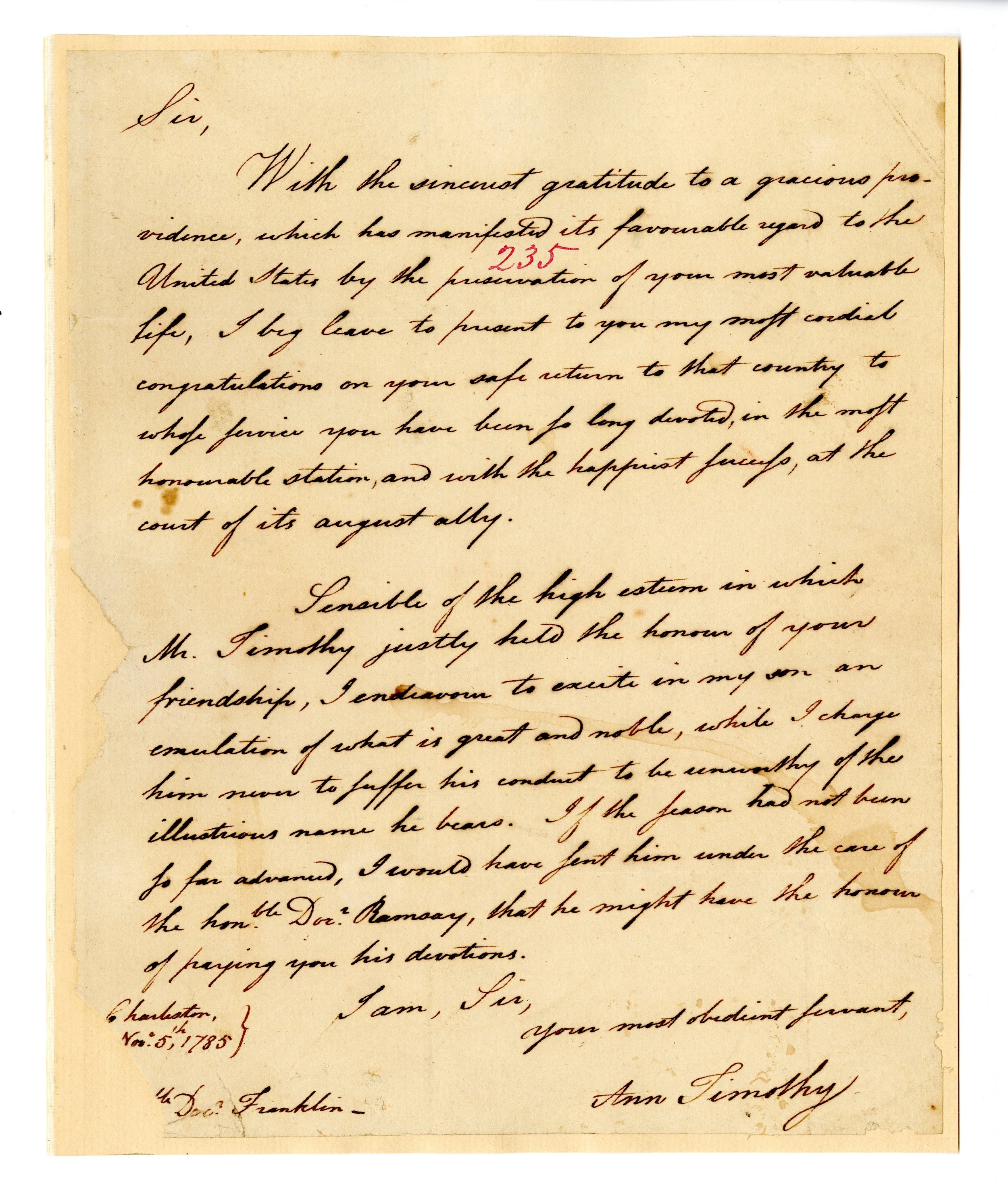
Ann Timothy to Benjamin Franklin, November 5, 1785, American Philosophical Society
Where to See It Online: Gilder Lehrman Institute of American History