Road Trip
Thanks to Norman Lear, this Dunlap broadside went from hidden to hyper-visible
In 1989, an amateur collector purchased a painting for $4 at an antiques market in Adamstown, Pennsylvania. Folded up inside the back of the frame, he found one of John Dunlap’s broadsides of the Declaration of Independence, printed on July 4–5, 1776. The unnamed collector ditched the painting and held onto the Declaration. After consideration, he called Sotheby’s, and their experts were amazed by the folded piece of paper, inscribed on the back, “Declaration of American Independence. July 4, 1776.”
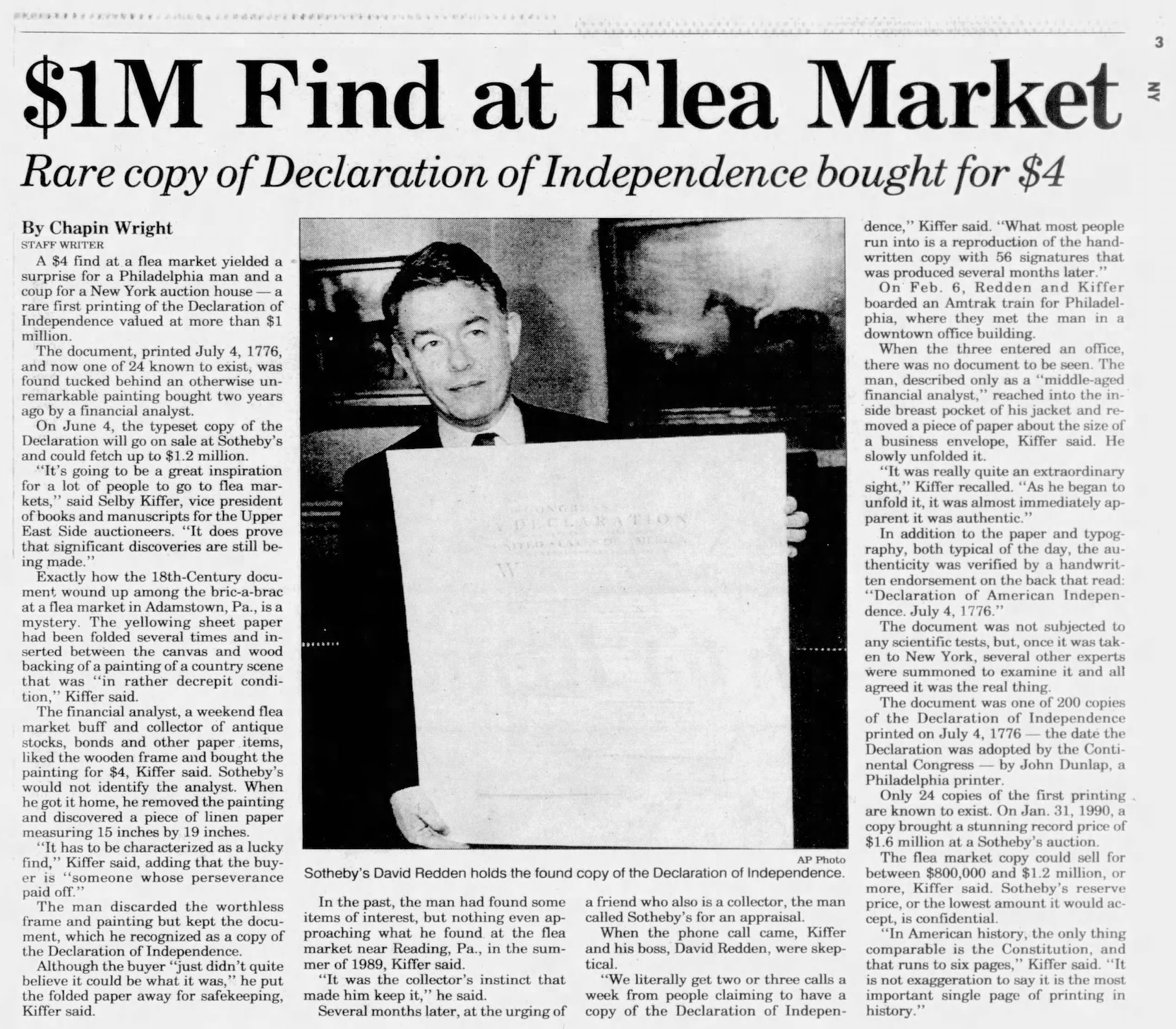
Newsday, April 3, 1991, Newspapers.com
On June 4, 1991, the Dunlap broadside was auctioned at Sotheby’s and was expected to fetch a price around $1 million. Instead, the broadside that was unwittingly purchased for $4 two years earlier sold for $2.42 million. The buyer, Donald Scheer of Visual Equities, Inc., described the price tag as “a bargain” and said he felt “very proud to own this American treasure.”
This was the story that launched a thousand phone calls and emails from people thinking they, too, had found a special copy of the Declaration. What Sotheby’s Selby Kiffer said in 1991 remains true today: “what most people run into is a production of the handwritten copy with 56 signatures that was produced several months later.” It remains unclear when or why the Dunlap broadside was put in the painting frame, or where it traveled before it ended up at the Adamstown market.
The Dunlap broadside that was sold at auction in 1991 returned to Sotheby’s in 2000, with a higher estimate, between $4–6 million. It caught the attention of television producer Norman Lear and his wife, Lyn, who partnered with internet entrepreneur David Hayden to purchase the broadside. Their winning bid of $7.4 million plus the auction house’s commission brought the total price to $8.14 million, smashing the record for an internet auction. When Lear saw the Dunlap broadside in person shortly before the auction, it brought tears to his eyes, and he thought, “this ought to be the people’s document.”
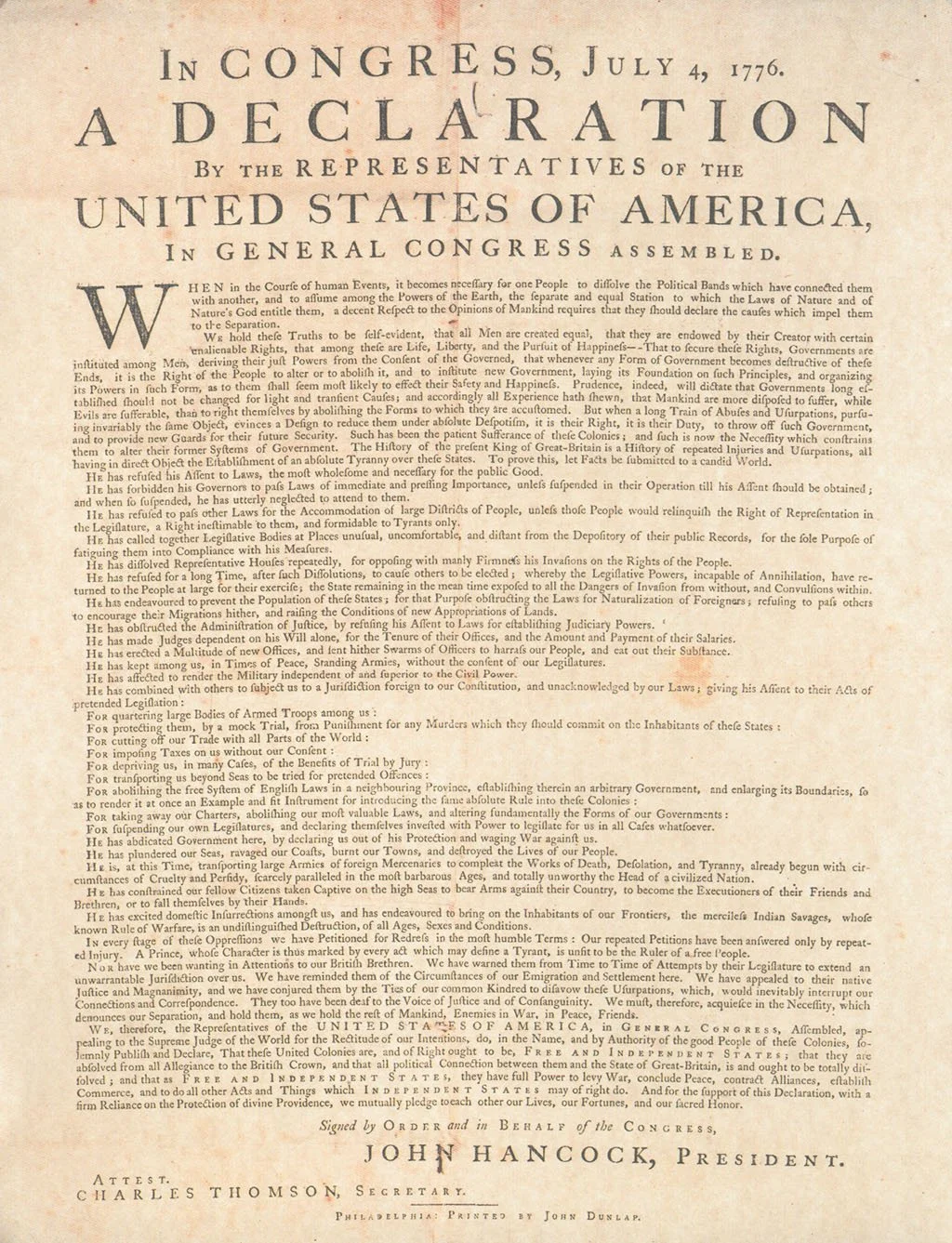
John Dunlap, Broadside of the Declaration of Independence, July 4–5, 1776, Declaration of Independence Road Trip
Thanks to Norman Lear, this Dunlap broadside went from hidden to hyper-visible. He quickly announced plans for the Declaration of Independence Road Trip, which kicked off on July 4, 2001. It would bring the Dunlap broadside to all 50 states. Lear was particularly interested in getting young people to pay attention to the Declaration, and he launched Declare Yourself, a nonpartisan youth initiative to register young voters.
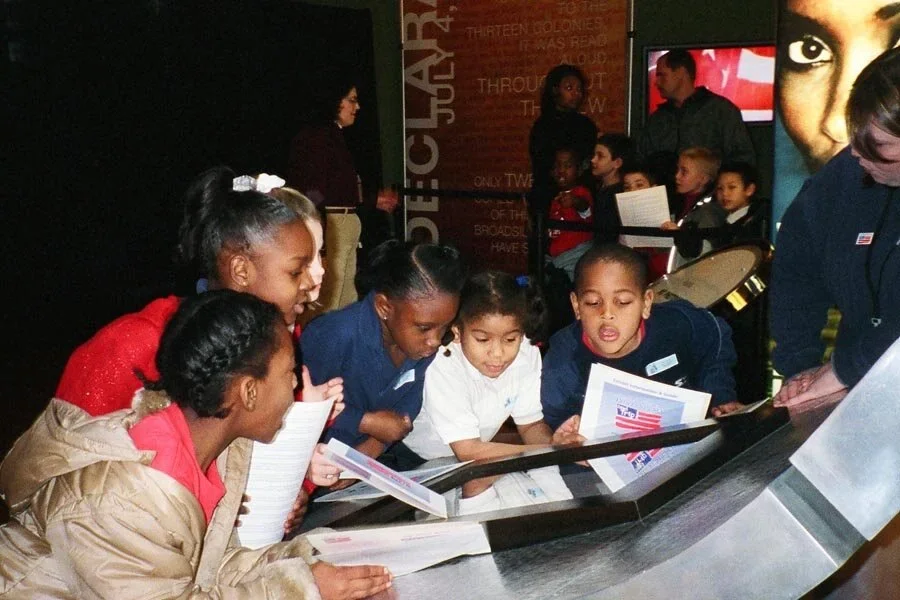
Declaration of Independence Road Trip
The Declaration of Independence Road Trip traveled across the United States to venues large and small, from local libraries to the Winter Olympics in Salt Lake City. Lear and Rob Reiner also co-executive produced a reading of the Declaration inside Independence Hall featuring some of the biggest actors of the early 2000s.
As Norman Lear said in July 2000, “ninety-nine percent of all Americans will never see this document.” Through his road trip initiative, his broadside became perhaps the most-viewed copy of Dunlap’s first printing.
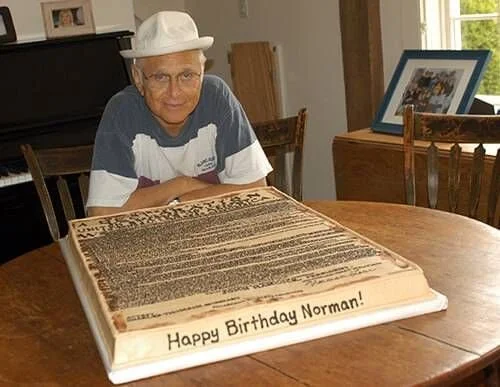
Norman Lear, pictured with a Dunlap broadside birthday cake