The Other Mary
Mary Say’s treatment of the Declaration would have shocked Mary Katharine Goddard
Mary Katharine Goddard was the first woman to print the Declaration of Independence under her own name, in her Baltimore newspaper. But she was not the only woman—or even the only Mary.
On Ave Maria Lane near St. Paul’s Cathedral in London, Charles Green Say printed several newspapers, including the Gazetteer and New Daily Advertiser and the General Evening Post. He died on June 29, 1775. His will stipulated that his newspapers should be printed in his wife’s name, if she wanted to do so. As of July 20, the Gazetteer was no longer “Printed by C. SAY,” but rather, “Printed by M. SAY.”
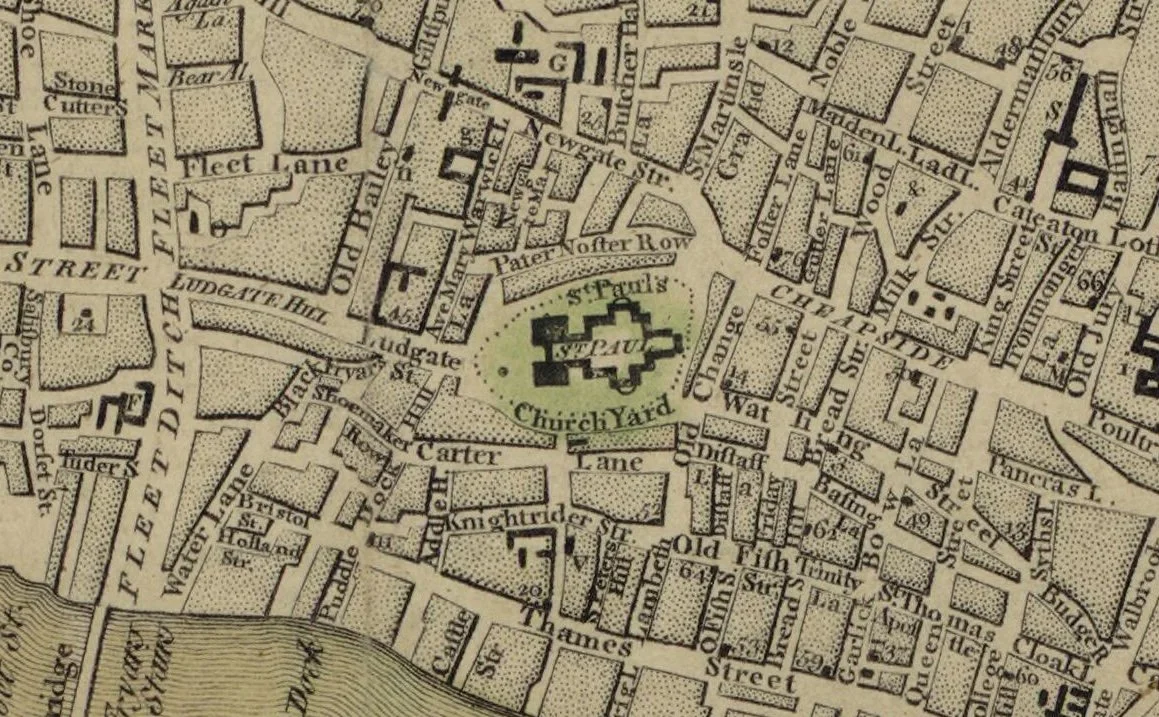
The London Guide (Detail), 1767, BNF
A little over a year later, Mary Say printed the Declaration of Independence in her newspapers on August 17, 1776. Mary Say’s treatment of the Declaration would have shocked Mary Katharine Goddard. How much of a direct hand she had in the printing process is unclear, since she was the named printer of multiple newspapers and there were proprietors funding each enterprise. But it was her name on the publications, and the decisions made in the Gazetteer and the General Evening Post show two strategies for disseminating the Declaration in London, where printers could be punished for printing libel against the king.
In the General Evening Post, the Declaration of Independence was printed in full, except for a few strategically censored words. “The history of the present king of Great Britain” was printed as “The history of the present — of G— B——.” Similarly, the words “Prince” and “ruler” were abbreviated as “P—” and “r—r.”
The Declaration looked different in the Gazetteer. First, in the literal sense, the Declaration only took up about two thirds a column, whereas it filled one and a half columns in the General Evening Post. The opening sentences of the Declaration concluded with “Such has been the patient sufferance of these Colonies, and such is now the necessity which constrains them to alter their former systems of government.” Rather than printing the sentence about the “history of the present king of Great Britain” or the list of grievances about him, there was the following summary:
[Here they enumerated their several grievances, the substance of which have repeatedly appeared in all the public prints, and then proceed as follows:]
True, the Continental Congress had published grievances about British rule before. But the reason for skipping over the bulk of the document was less about presenting readers with something they had seen before, and more about protecting the printer.
The strategy employed in the Gazetteer avoided any mention of King George III while still delivering the essential information that the colonies had declared independence. Censoring and excerpting the Declaration did not correlate with support for the king. But, other pieces of news in Say’s newspapers indicate an ongoing effort to push back against the British ministry’s administration of the war, as well as delegitimize the authority of the Continental Congress and the fight for independence.
In the same issue of the Gazetteer as the Declaration, there was an essay “Addressed to our modern Patriots” from “Sempronius,” a pen name perhaps inspired by the character of a Roman senator in Joseph Addison’s Cato. This “Sempronius” called out the “patrons of American liberty and freedom” in Great Britain. “You know their being independent will hurt us, and, indeed, all Europe in the end,” he wrote. “If ambition be your pursuit,” he insisted, “it cannot be gratified by your being under Mr. John Hancock,” because “the meanness of his birth and the vileness of the cause will disgrace you; and whatever honour you get there by joining him, you will lose among your fellow-subjects here.”
Another essay in that same issue, addressed to the printer of the Gazetteer, was supposedly written by “AN American, and a friend to the liberties of his country,” who wanted “the avowed friends of American rights, in England, to declare what lengths they will go in support of the common cause.” With seeming knowledge of the final phrase in the Declaration of Independence, this writer asked, “is it necessary to remind that noble band of disinterested patriots, that their honor is pledged to support with their lives and fortunes the independent freedom of America?” Politicians who held such support should “instantly dispose of their estates,” “remit the value to the honourable Congress,” and “join the Provincial army.”
It was not unusual for women on either side of the Atlantic to be in printing offices. Wives, daughters, and sisters of male printers worked alongside female servants to keep printing businesses going and, in many cases, these women were highly skilled. But when printed products appeared under a woman’s name, it increased public awareness of their contributions, as well as public scrutiny. The newspaper printed in Mary Katharine Goddard’s name celebrated the Declaration of Independence. Five weeks later, the newspapers printed in Mary Say’s name muddled the Declaration, delivering the news while removing some of the context.