Longing
The words, “Remember the Ladies,” have inspired generations of women
On March 31, 1776, Abigail Adams began to write a letter to her husband. She complained, “I wish you would ever write me a Letter half as long as I write you.” She begged for updates on the war. She described what she had heard about Boston since the British evacuation. “I feel very differently at the approach of spring to what I did a month ago,” Adams noted. “We knew not then whether we could plant or sow with safety, whether when we had toild we could reap the fruits of our own industery, whether we could rest in our own Cottages, or whether we should not be driven from the sea coasts to seek shelter in the wilderness.” But, since the evacuation, she felt “as if we might sit under our own vine and eat the good of the land.
Abigail Adams knew that the British were not gone for good. She sympathized “with those who are trembling least the Lot of Boston should be theirs.” She was thinking about the future. “I long to hear that you have declared an independency,” Adams wrote. She knew that her husband was one of the strongest advocates for independence in the Continental Congress. She hoped that, sooner rather than later, a majority of the delegates would agree with him.
Abigail Adams was longing for a Declaration, but she knew that was not the only document independence would require. Adams was also thinking about the “new Code of Laws” which she expected the Congress would need for the colonies after independence from Great Britain. She wrote to her husband, who would be at the center of the decision-making: “I desire you would Remember the Ladies, and be more generous and favourable to them than your ancestors. Do not put such unlimited power into the hands of the Husbands. Remember all Men would be tyrants if they could. If perticuliar care and attention is not paid to the Ladies we are determined to foment a Rebelion, and will not hold ourselves bound by any Laws in which we have no voice, or Representation.” Acknowledging that she had a more positive relationship with her husband than many women experienced, she reminded him, “that your Sex are Naturally Tyrannical is a Truth so thoroughly established as to admit of no dispute.”
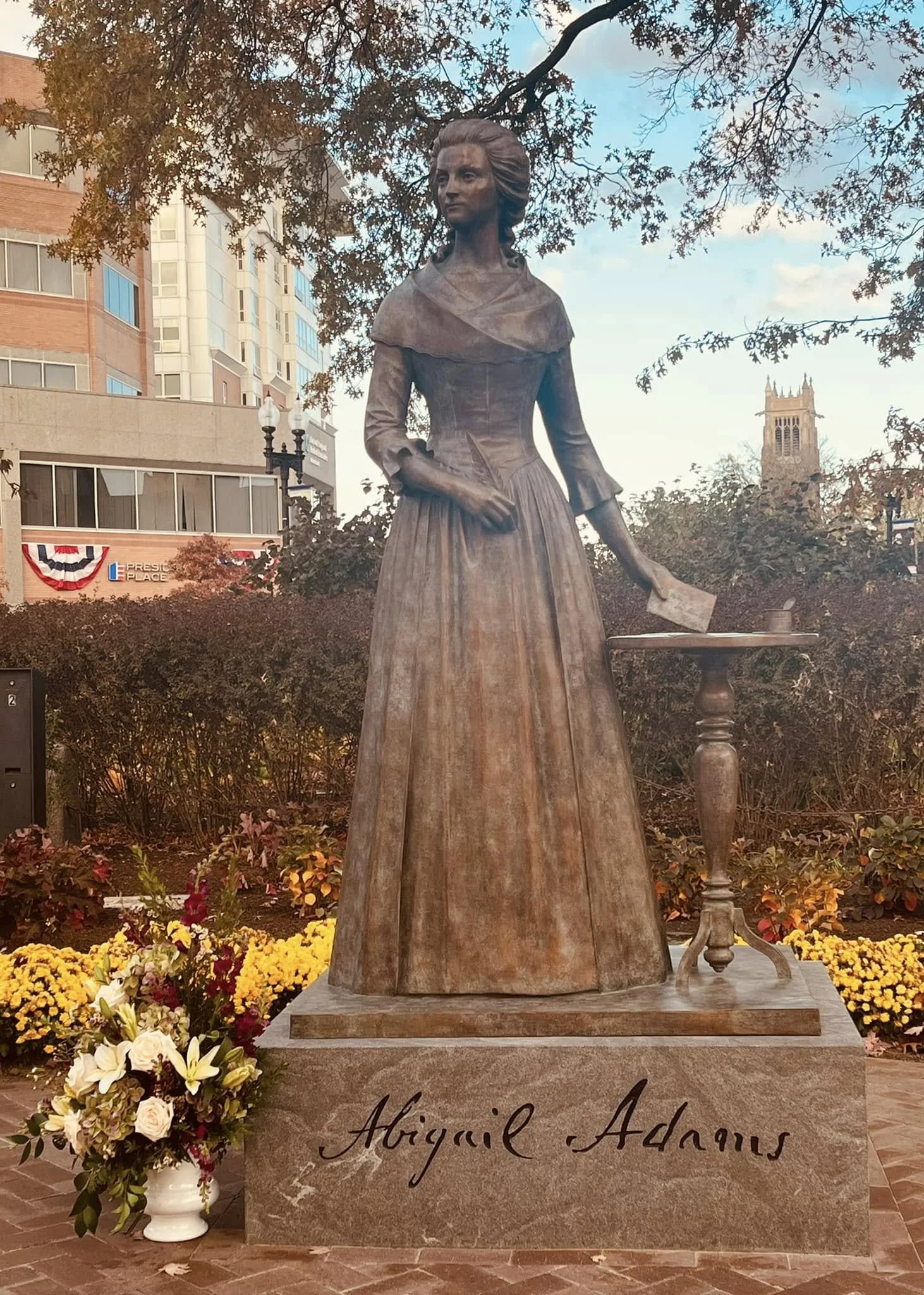
Statue of Abigail Adams in Quincy, Massachusetts
The words, “Remember the Ladies,” have inspired generations of women. Abigail Adams could not have known their impact—in fact, in the very next letter she wrote to her husband, she added a postscript: “I wish you would burn all my Letters.” Thankfully, her correspondence with her husband survives, although John’s response was not particularly sympathetic. While Abigail urged him to think about coverture laws and the limited rights of married women, John wrote, “we know better than to repeal our Masculine systems.”
“As to Declarations of Independency,” he wrote, “be patient.” Six weeks later, on May 15, the Continental Congress published a resolution which John Adams described to Abigail as “a total absolute Independence.” Although this resolution was perceived by Adams and others as a declaration of independence, it did not mark the formal transition from British colonies to the independent United States of America.
On July 7, 1776, John Adams wrote a letter to Abigail explaining that he had “this Moment folded up a Magazine, and an Evening Post and sent it off, by an Express, who could not wait for me to write a single Line.” The most recent issue of the Pennsylvania Evening Post, printed on Saturday, July 6, was the first newspaper printing of the Declaration of Independence. A number of extant copies of the Evening Post survive, though it is unclear if any of them are the copy John sent to Abigail on that Sunday in July 1776.
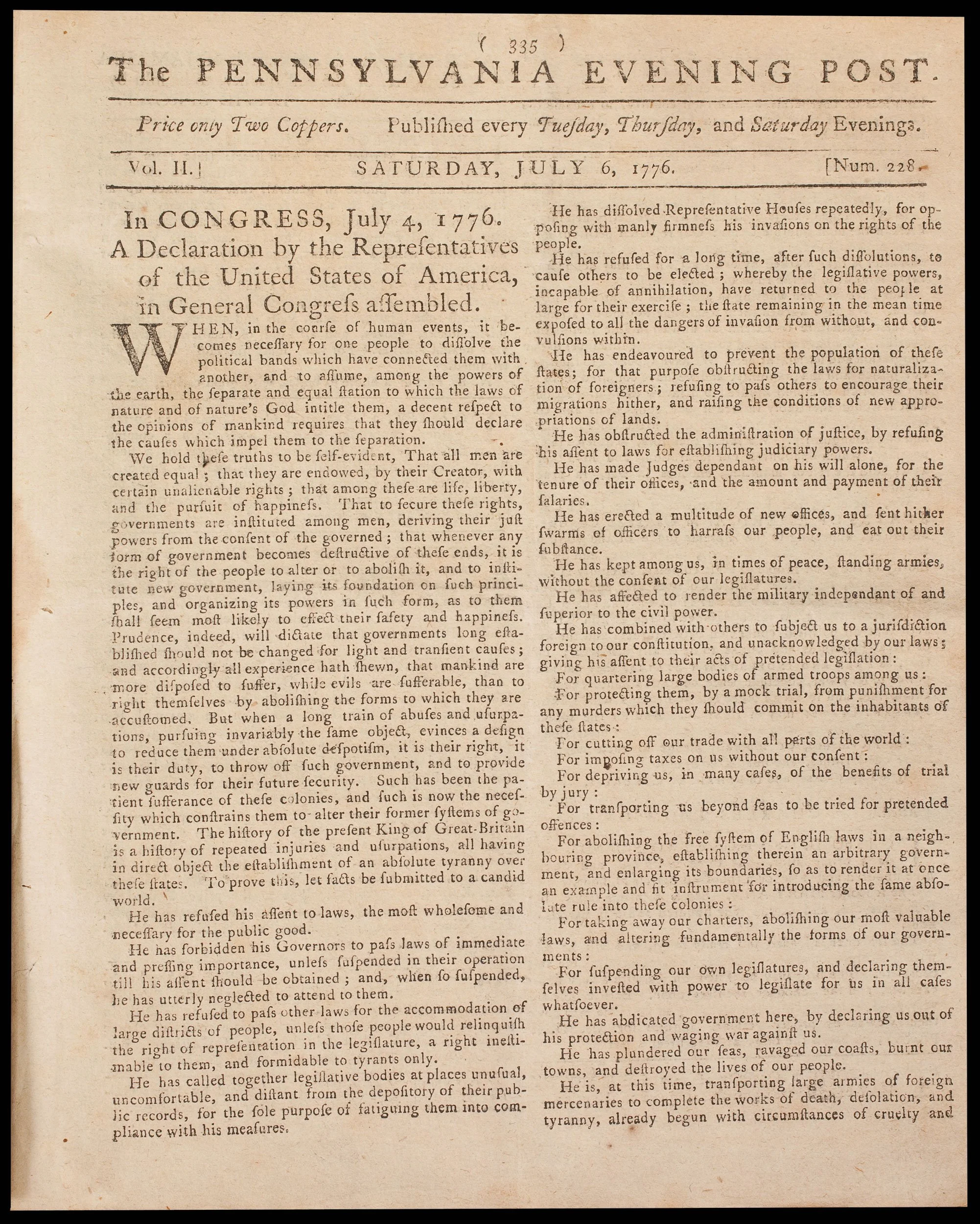
Pennsylvania Evening Post, July 6, 1776, p. 1
Exactly one week later, on Sunday, July 14, Abigail Adams learned about the Declaration of Independence. From her response to her husband, it is clear that she had known what was in the committee draft of the Declaration as compared to the final printed version she received. She wrote, “I cannot but feel sorry that some of the most Manly Sentiments in the Declaration are Expunged from the printed coppy. Perhaps wise reasons induced it.”
Once again, as Abigail Adams considered the Declaration of Independence, she also considered the new code of laws. “May the foundation of our new constitution, be justice, Truth and Righteousness,” she wrote.
To learn more about Abigail Adams’s experience of independence, check out When the Declaration of Independence Was News, Chapter 5, The Reigning Subject: Inoculation and Independence in Massachusetts