Liberty of the Press
Samuel Loudon’s experience of a mob storming his house and burning his pamphlets showed how printers could be held responsible for their products
1776 was a rough year for Samuel Loudon. It started out well, as he launched The New York Packet and the American Advertiser and hoped to find an audience for a newspaper in the ever-shifting political climate. But within months, Loudon experienced violence and displacement.
In his first issue, dated January 4, Loudon printed a candid message to the public. He admitted that launching a newspaper in the winter came with a “disadvantage, as little foreign news is to be expected at this season of the year.” He refused to “amuse his Readers with pompous promises.” Loudon did not have the experience of other printers in New York City. However, he felt that he understood the need for more news sources given the “difficulty of the times.”
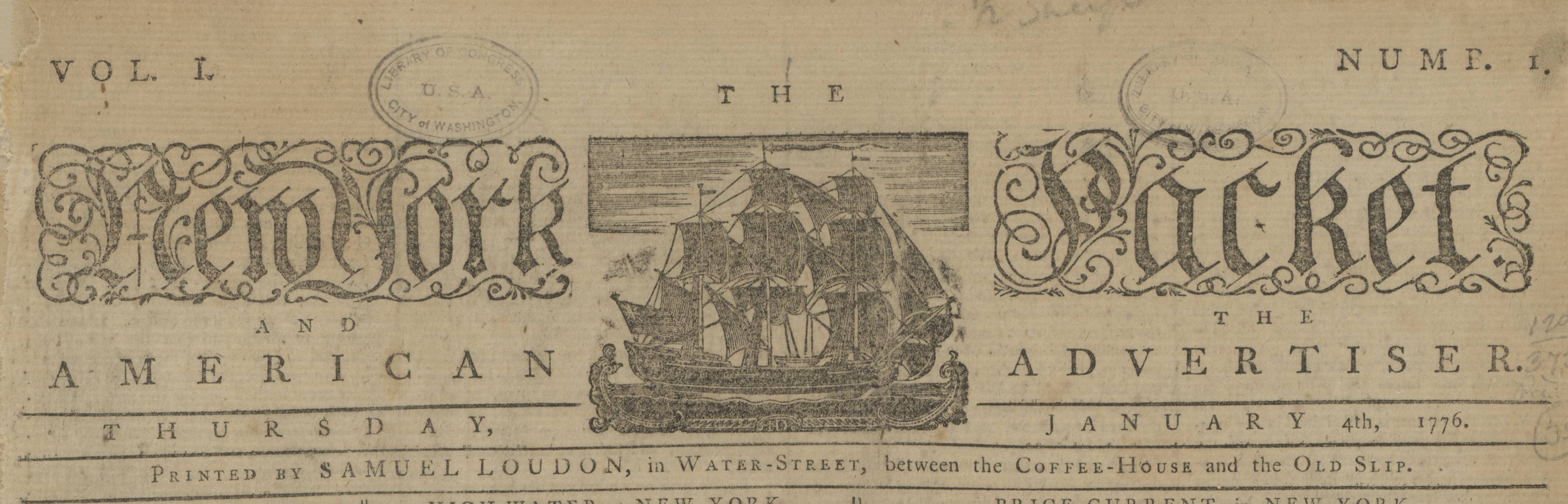
The New York Packet and the American Advertiser, January 4, 1776, p. 1, Library of Congress
In January 1776, nine months into the war with Great Britain, he wanted to “illustrate and animate the glorious cause of Constitutional Liberty, and at the same time pour medicine into the bleeding wounds of the extended empire.” Loudon wished “that the year 1776 may be the happy Æra, in which Peace and Union, on a Constitutional Basis, shall be concluded between Great-Britain and her Colonies.” Like many people, Loudon hoped—at least, publicly—for a reconciliation. But things shifted quickly.
One of the catalysts for independence from Great Britain rather than reconciliation was Thomas Paine’s pamphlet, Common Sense. Samuel Loudon was asked to print another pamphlet, written anonymously by Anglican minister Charles Inglis, which was meant to be a rebuttal of Paine’s arguments. In a petition to the New York Committee of Safety in April 1776, Loudon explained what happened next:
“As a publication of this nature required mature deliberation, I did not decline, nor did the gentleman require me to comply with his proposal till I should be convinced that the manuscript was written with decency, or did not express or even imply any disapprobation of the proceedings of the Honourable Continental Congress, or the glorious cause in defence of which Americans are spending their blood and treasure. Being satisfied as to these particulars, I agreed to print the manuscript on my own account. Having made some progress in printing off the sheets, I advertised the publication of the pamphlet in Mr. Gaines’ Gazette, not imagining that any offence could justly be taken by my fellow citizens. But to my great surprise I soon found that the advertisement had given disgust to some of the inhabitants, who highly resented it. On the evening of the 18th ulto. I received a message to attend on the committee of mechanics. I attended accordingly, and was interrogated by Mr. Christopher Duyckinck, the chairman, who was the author of the manuscript I was printing, and who gave it to me. I told them I did not know the author, and that I got the manuscript from a gentleman of this city whose name, in my opinion, that had no right to demand. Displeased at this reply, they threatened to burn the pamphlets; blaming me in strong terms for printing it. I expostulated with them on the impropriety of condemning a book before they had read it; proposed to send them the sheets that were printed for their perusal, and to refer the whole affair to the Committee of Safety, and abide by their determination. They did not however think it proper to regard any of my proposals, but sent six of their number to my house who nailed and sealed up the printed sheets in boxes, except a few which were drying in an empty house, which they locked and took the key with them. The following evening they returned the key and informed me that they had referred the matter to the general committee of inspection. I attended, and was informed by the chairman, Col. Broome, that a complaint had been preferred against me for printing an answer to the pamphlet entitled Common Sense, and the committee advised me not to persist in publishing it at present, as my personal safety might be endangered. I thanked the committee, and promised to comply with their advice. This availed nothing for my security; for some time after 10 o’clock the same night the before mentioned Mr. Duyckinck, without any commission from committee, attended by a considerable number, to appearance more than forty persons, who rushed into my house; some of them ran up stairs to the printing office, while others guarded the door, and took away the whole impression of said pamphlets, being about 1500, which at a very moderate calculation amounts to £75, they carried them to the commons and there burnt them, as I have been informed.”
Samuel Loudon’s experience of a mob storming his house and burning his pamphlets showed how printers could be held responsible for their products, and could be under serious threat if they refused to give up the names of anonymous writers. He described this “unjustifiable attack on his private property” as “a violent infraction of the liberty of the press.” Loudon gave the committee a list of all the men he knew had taken part in destroying his pamphlets. But he also gave the committee a sense of his feelings about independence. Loudon wrote that, “as the question concerning American independence hath not, to the best of knowledge, been decided by the Continental Congress, nor by any legal subordinate Convention, there can be no criminality in publishing the arguments for and against it; and as it is a question of the greatest importance, it should not be decided before the arguments are fully discussed.” He insisted, “I have always been a steady friend to the liberties of America, and I am resolved to risk my all in their defence, and cheerfully submit to every determination of the Continental Congress, of the Provincial Congress of this Colony, and the general committee of this city, that is not contrary to the dictates of religion, justice and humanity.”
With this threat to press freedom behind him, Samuel Loudon may have felt a sense of relief when he printed the Declaration of Independence in the New York Packet on July 11.
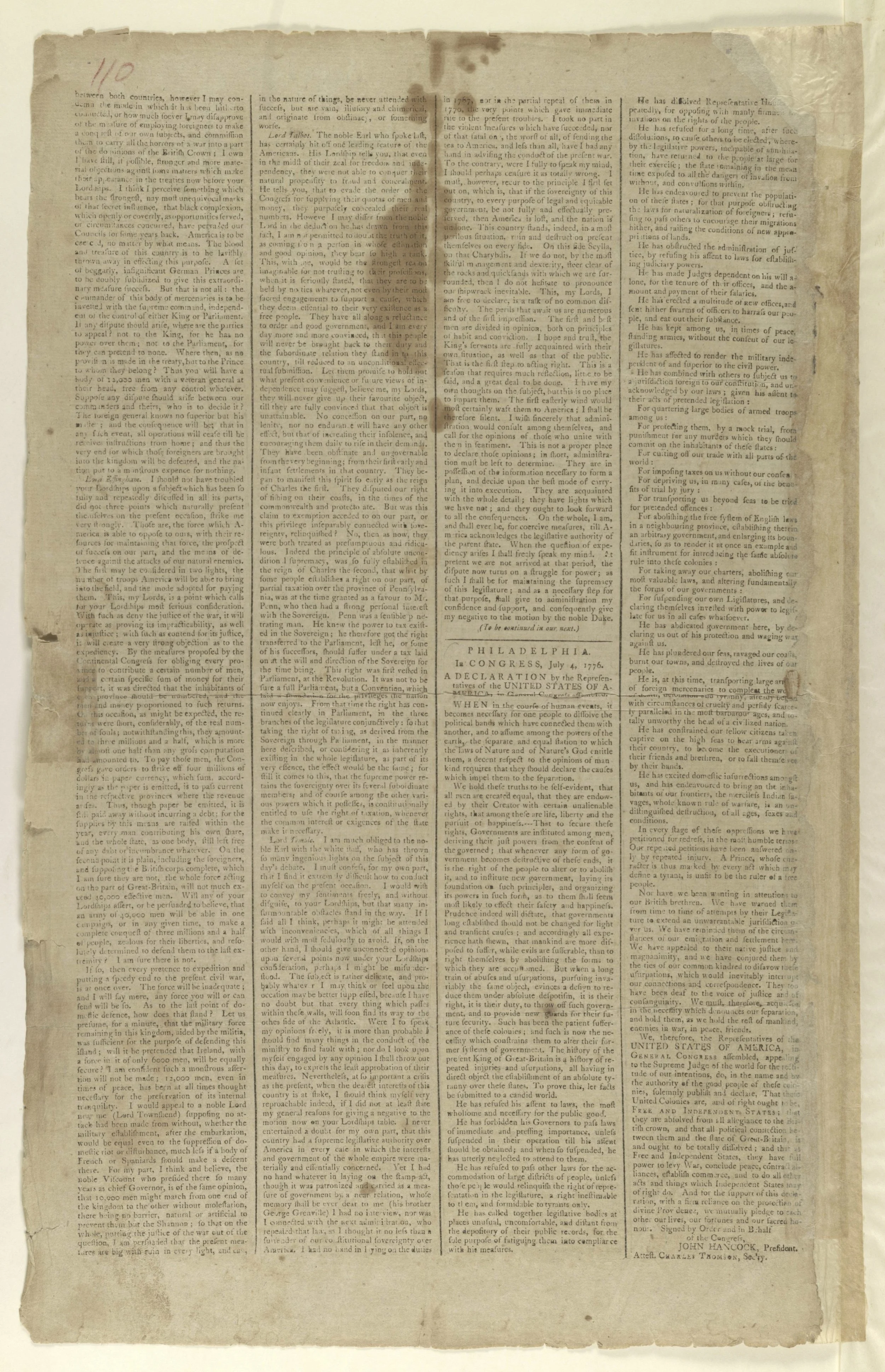
The New York Packet and the American Advertiser, July 11, 1776, p. 2, Library of Congress
The text took up a column and a half of the four skinny columns per page of his newspaper. On the opposite page, Loudon included brief accounts of the reading of the Declaration at the head of the Continental Army on July 9 and the destruction of the statue of the king that evening.
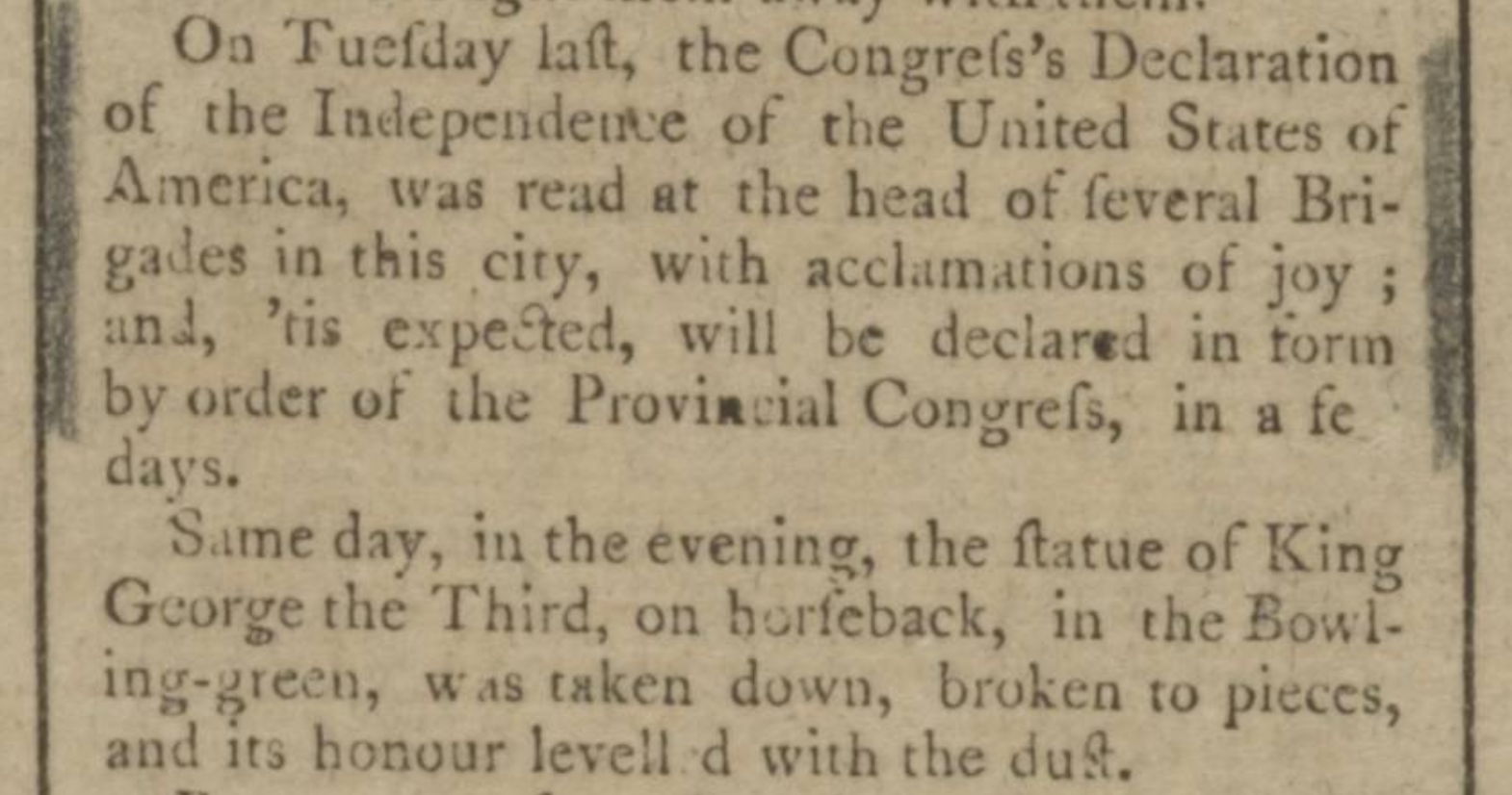
The New York Packet and the American Advertiser, July 11, 1776, p. 3, Library of Congress
Samuel Loudon’s description of what happened in New York was disciplined, especially by comparison to his competitor, John Holt. In Loudon’s words, the gilded statue of King George III on horseback “was taken down, broken to pieces, and its honour levelled with the dust.” Holt, meanwhile, wrote that “the equestrian statue of George III, which Tory pride and folly raised in the year 1770, was, by the Sons of Freedom, laid prostrate in the dirt, the just desert of an ungrateful Tyrant! The lead wherewith this monument was made, is to be run into bullets, to assimilate with the brains of our infatuated adversaries, who, to gain a peppercorn, have lost an Empire.” Perhaps Holt, who printed his newspaper a few days after Loudon, had more time to gather these details, or felt more strongly about the symbolism. Or, perhaps Loudon had experienced his fair share of violence, and did not want to add to the public speculation about who was responsible. His lone comment was that the statue had had “its honour levelled with the dust.”
Where to See It Online: Library of Congress