Collecting
Harbottle Dorr understood the history reflected in the content of the Declaration
In the first issue of the Continental Journal on May 30, 1776, John Gill wrote that he would engage “his utmost fidelity in collecting and printing the newest and best accounts of things that can be obtained.” This promise was tested in the very next issue, when Gill admitted that he had received “divers Rumours and Reports” about a military engagement in Quebec, but had “nothing that we can rely on to give the Public.”
Someone else who wanted to collect the “best accounts” of what was happening during the American Revolution—and used John Gill’s Continental Journal to do so—was Harbottle Dorr, Jr. Dorr was a Boston merchant who, beginning in 1765, retained and annotated local newspapers. He explained his rationale:
“Inasmuch as News Papers in general contain, not only the News of the Day, but often Intelligence of the greatest moment, (and in general are looked upon as authentic, being often resorted to as valuable Records, and perhaps are so more than any other, saving legal Ones:—and as Persons in general are too negligent of preserving them,) and during the period of the Following Papers, Transaction’s of the utmost importance respecting Liberty in general have taken place, and are recorded in them:—I have thought it worth while to collect them, tho’ at considerable expence, and very GREAT Trouble, in hopes that in Future, they may be of some service, towards forming a Political History of this Country, during the shameful and abandoned administration of the despotic Ministers of George the 3d.”
One of the most thoroughly annotated newspapers in his collection is the Continental Journal dated July 18, 1776. The front page is brimming with notes, crammed into every margin and even on a piece of paper covering the masthead. Harbottle Dorr recognized the importance of the Declaration of Independence, which took up two columns of the page. It exemplified his commitment to preserving “not only the News of the Day,” but also “Intelligence of the greatest moment.”
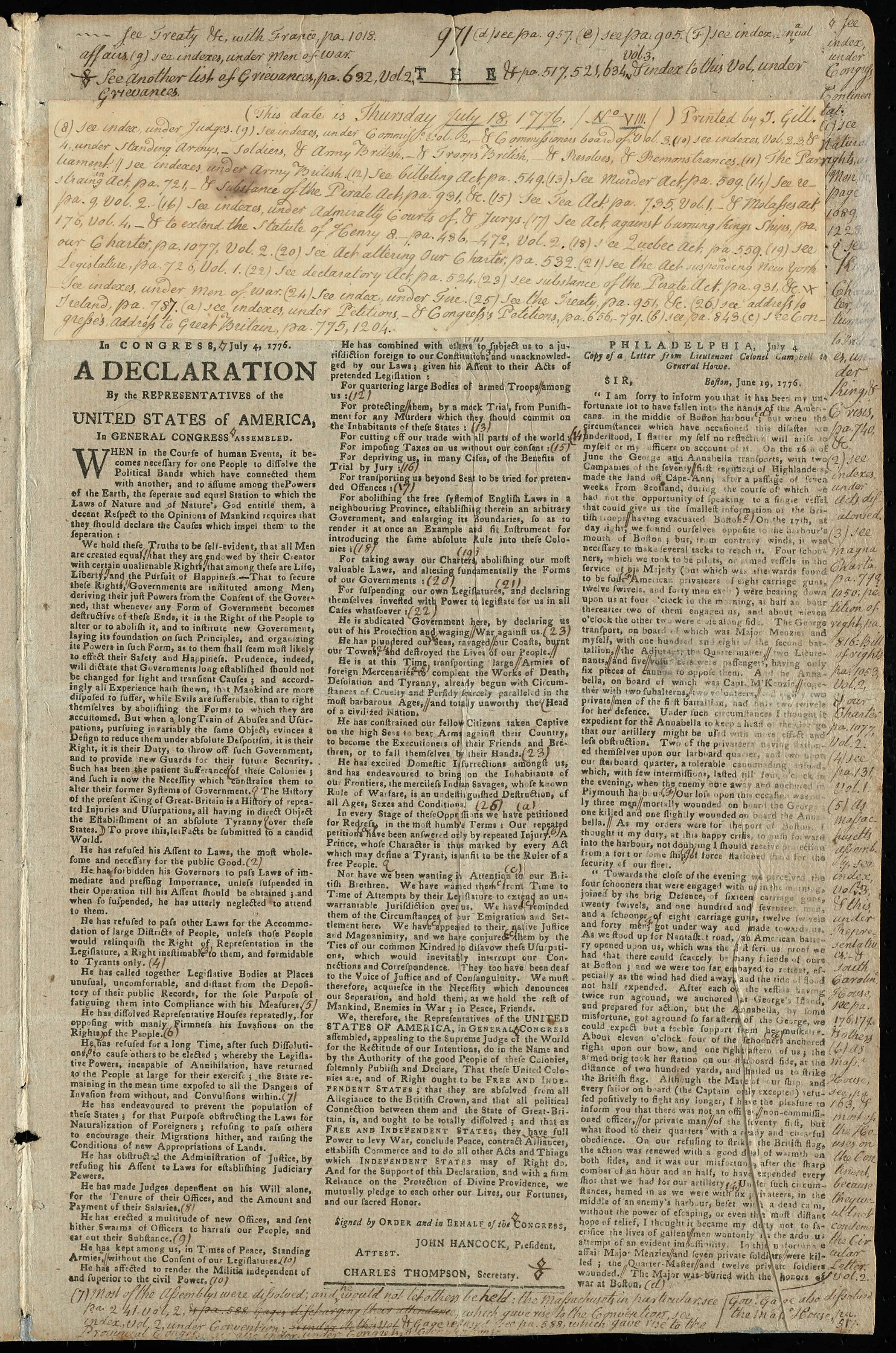
The Annotated Newspapers of Harbottle Dorr: The Continental Journal and Weekly Advertiser, July 18, 1776, Massachusetts Historical Society
The index Dorr created for his newspapers was extensive. He made a diamond next to the mentions of “CONGRESS” in the Declaration of Independence, which referenced the entry for “Congress, Continental.” In the right margin of the front page of the Continental Journal, Dorr started to list out references to other index headings, beginning with “Natural rights,” which corresponded to some of the key words in the second paragraph of the Declaration: “equal,” “Rights,” and “Liberty.” He continued this numbered list along the bottom margin, with corresponding numbers throughout the next. And then, having completely run out of room, he added the paper over the masthead so that he could reach a total of 26 references to various bodies, acts, and injustices.
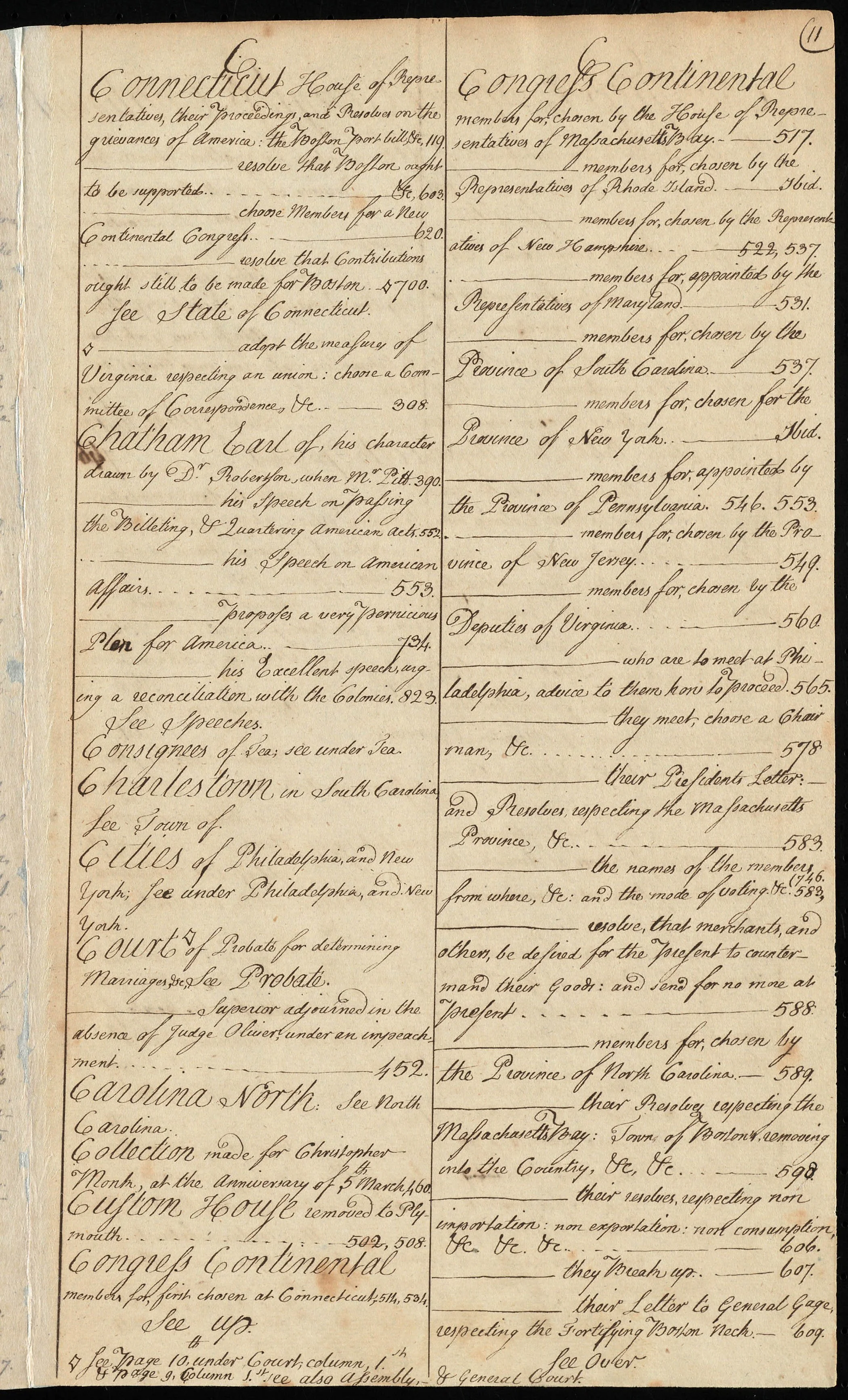
The Annotated Newspapers of Harbottle Dorr: The Continental Journal and Weekly Advertiser, Index, Massachusetts Historical Society
Dorr used his annotations to link different news moments, both before and after July 1776. In December 1778, for example, he added a wavy line to mark the United States’ “full power” to “contract Alliances,” and referenced the Treaties of Amity, Commerce, and Alliance with France in the December 17 issue of the Continental Journal.

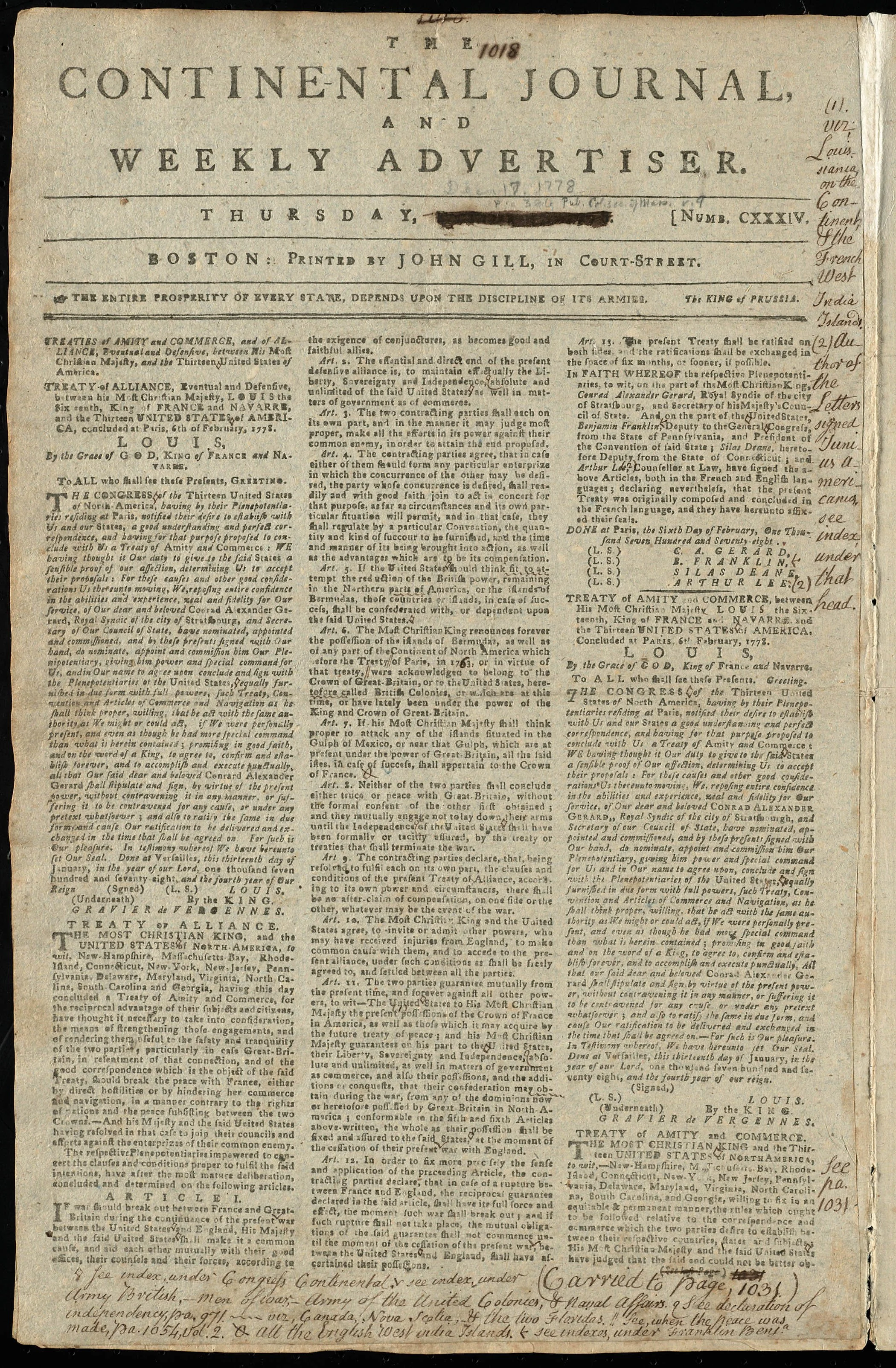
The Annotated Newspapers of Harbottle Dorr: The Continental Journal and Weekly Advertiser, December 17, 1778, Massachusetts Historical Society
Harbottle Dorr understood the history reflected in the content of the Declaration. There were many people in 1776 who closely read and considered the text, from the men who drafted and debated it, to the people tasked with printing or translating it, to the critics of the text who wrote commentaries about it. However, because of his commitment to preserving newspapers as a record of the revolution, Dorr was uniquely positioned to analyze the Declaration and think about the Continental Congress’s decision holistically.
Where to See It Online: The Annotated Newspapers of Harbottle Dorr, Jr., Massachusetts Historical Society