The Mask
The Declaration of Independence was printed in two newspapers in the resort town of Bath, England, in 1776. It appeared in the Bath Journal, printed by John Keene, on Monday, August 19, and the Bath Chronicle, printed by Richard Cruttwell, on Thursday, August 22. However, readers of each of these newspapers experienced the news of independence differently.
The Bath Journal got first access to the news of independence through an express rider, who arrived from London on August 19. The Declaration was printed in full on the back page of that newspaper.
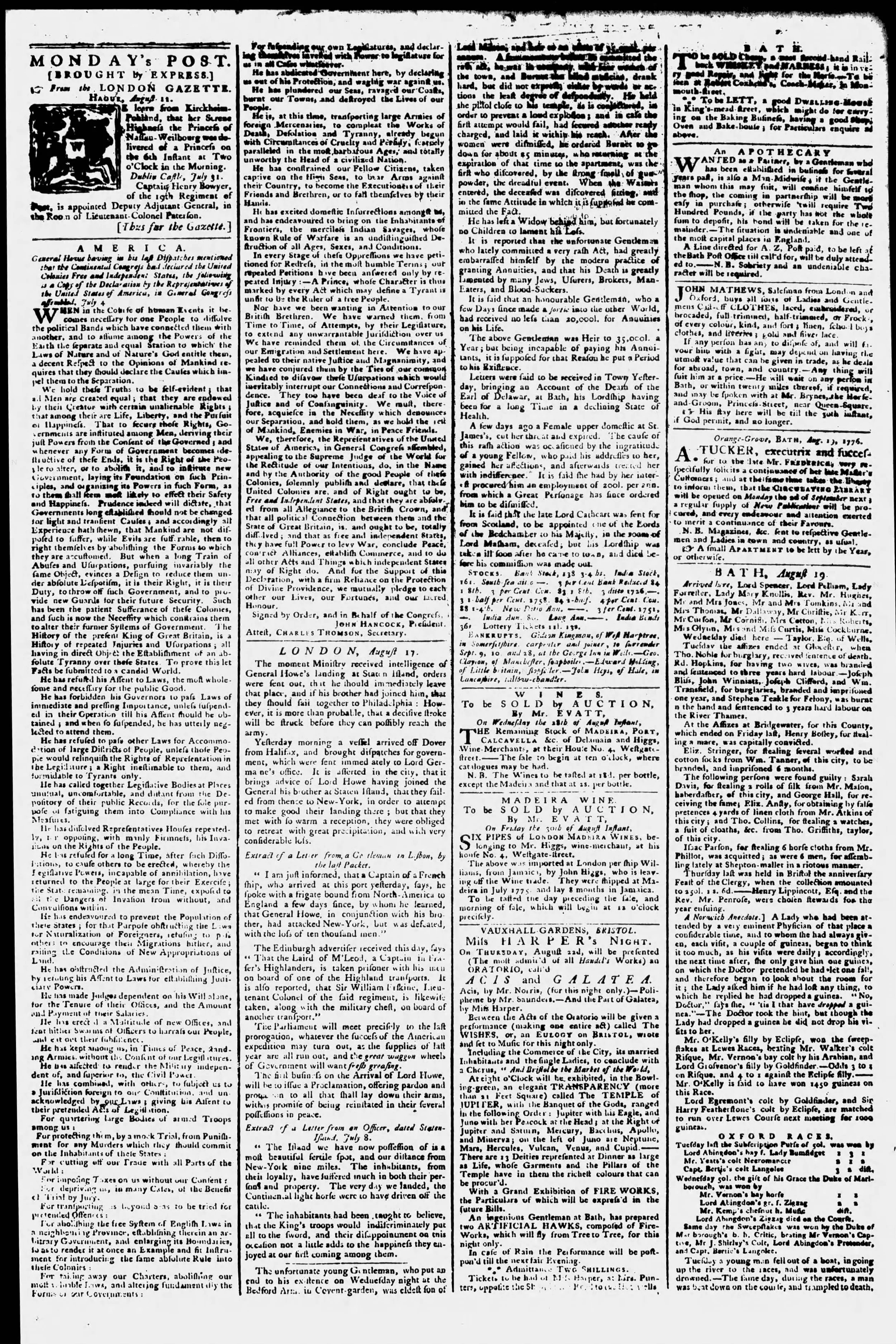
Bath Journal, August 19, 1776, p. 4
Four days later, the Declaration was on the front page of the Bath Chronicle. But a key word was censored. The sentence which began “The History of the present King of Great Britain” in the Bath Journal was presented in the Bath Chronicle as “The history of the present K— of Great-Britain.”
Cruttwell also included a note to his readers following the Declaration:
☞ Our readers will observe that the recital of grievances in the above declaration differs little from those repeatedly published by the Provincial Assemblies; only in this, the Congress have thrown off the mask, and now attribute their oppressions to the K—g himself, and not, as in former addresses, to the Ministry and Parliament.
Here, again, the word “King” was censored. In Bath, some newspaper readers got the full, unbiased Declaration, while others were told what to think of it.
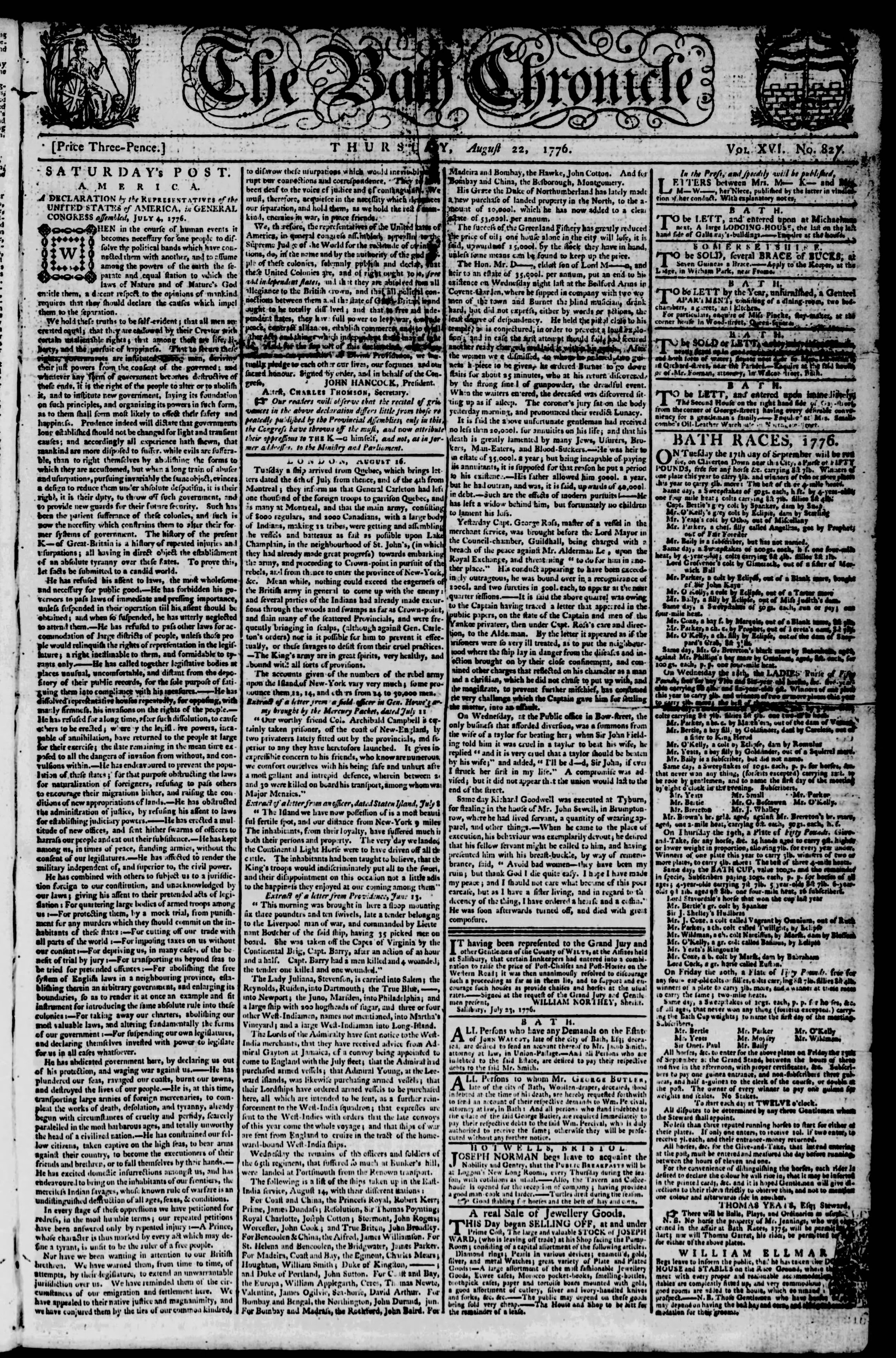
Bath Chronicle, August 22, 1776, p. 1
This idea that the Congress had thrown off the “mask” with the Declaration of Independence was a widespread reaction to the news. For example, Ambrose Serle, secretary to Vice-Admiral Richard Howe, used the same language to describe his frustration at learning about the Declaration after landing at Staten Island on July 12:
The Congress have at length thought it convenient to throw off the Mask. Their Declaration of the 4th. of July, while it avows their Right to Independence, is founded upon such Reasons only, as prove that Independence to have been their Object from the Beginning. A more impudent, false and atrocious Proclamation was never fabricated by the Hands of Man. Hitherto, they had thrown all the Blame and Insult upon the Parliament and ministry: Now, they have the Audacity to calumniate the King and People of Great Britain.
Other British printers chose to skip over the list of grievances entirely, using similar language to the note in the Bath Chronicle to do so. This description of the Declaration as a “recital” of previously published complaints undermined the Congress in two ways. First, it gave the sense that their grievances were not timely or serious. But more importantly, the idea of throwing off the mask suggested that the Congress always wanted to rebel against the king, and that their previous complaints about his ministry and Parliament had concealed their true intention of declaring independence from the British crown.