Amusement
On July 4, after the Continental Congress approved the Declaration of Independence, they resolved that “copies of the declaration be sent to the several assemblies, conventions and committees, or councils of safety, and to the several commanding officers of the continental troops.” The men responsible for carrying out this task were John Hancock, the President of the Congress, and his private secretary, Jacob Rush. He was the younger brother of Dr. Benjamin Rush, who would soon be elected to represent Pennsylvania in the Congress.
On July 5 and 6, Hancock and Rush sat with a stack of fresh broadsides printed by John Dunlap and wrote letters to the provincial governments and committees of safety, and to George Washington. Jacob Rush’s handwriting, though perfectly legible, contrasts with John Hancock’s iconic signature on these letters.
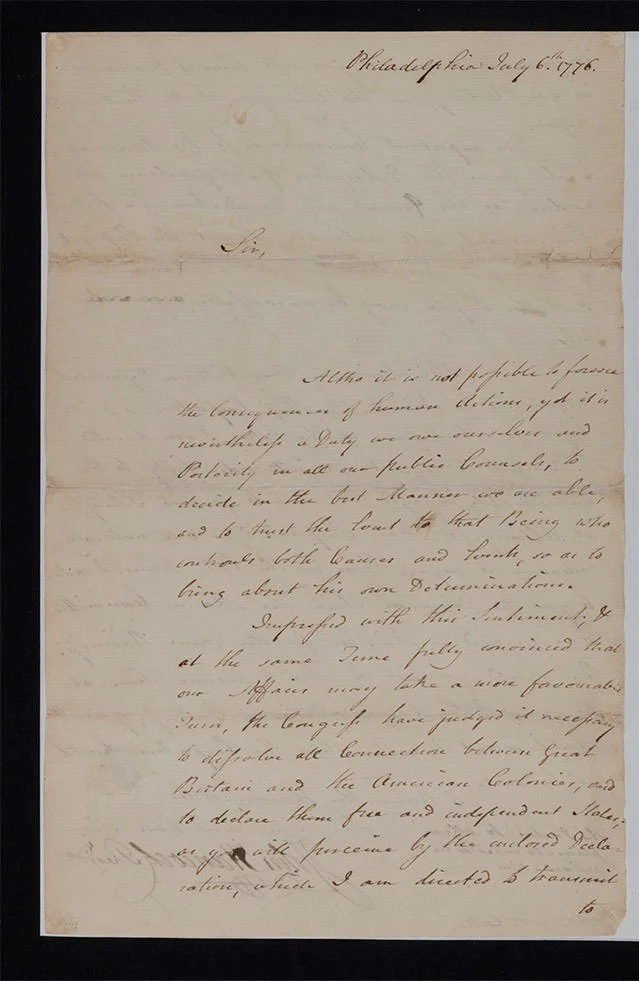
Letter from John Hancock to Nicholas Cooke, July 6, 1776, p. 1, Lilly Library, Indiana University
The specific contents of each letter differ, but there are a few sentences repeated almost exactly for each recipient. Here, Hancock explained the Congress’s decision, and their hope for the future. As he wrote to the governor of Rhode Island, Nicholas Cooke, on July 6, these sentences read:
Altho it is not possible to foresee the Consequences of human Actions, yet it is nevertheless a Duty we owe ourselves and Posterity in all our public Counsels, to decide in the best Manner we are able, and to leave the Event to that Being who controuls both Causes and Events, so as to bring about his own Determinations.
Impressed with this Sentiment, & at the same Time fully convinced that our Affairs may take a more favourable Turn, the Congress have judged it necessary to dissolve all Connection between Great Britain and the American Colonies, and to declare them free and independent States; as you will perceive by the enclosed Declaration.
Hancock instructed the civil and military leaders to have the Declaration “proclaimed…in the Way you shall think most proper” to reach as many people as possible.
In addition to these letters, on July 6, Hancock wrote to John Bradford, the new prize master for the colony-turned-state of Massachusetts. This meant that Bradford was responsible for any seized British ships, treated as “prizes” which were typically sold at auction. Hancock was sending Bradford a specific resolution from the Congress about sending seized arms to General Washington at New York. “And indeed,” Rush wrote on Hancock’s behalf, “this is all I have Time to do now, being in great Haste.” However, Hancock personally added a postscript to the left of his signature: “Inclos’d is a Declaration for your Amusemt.”
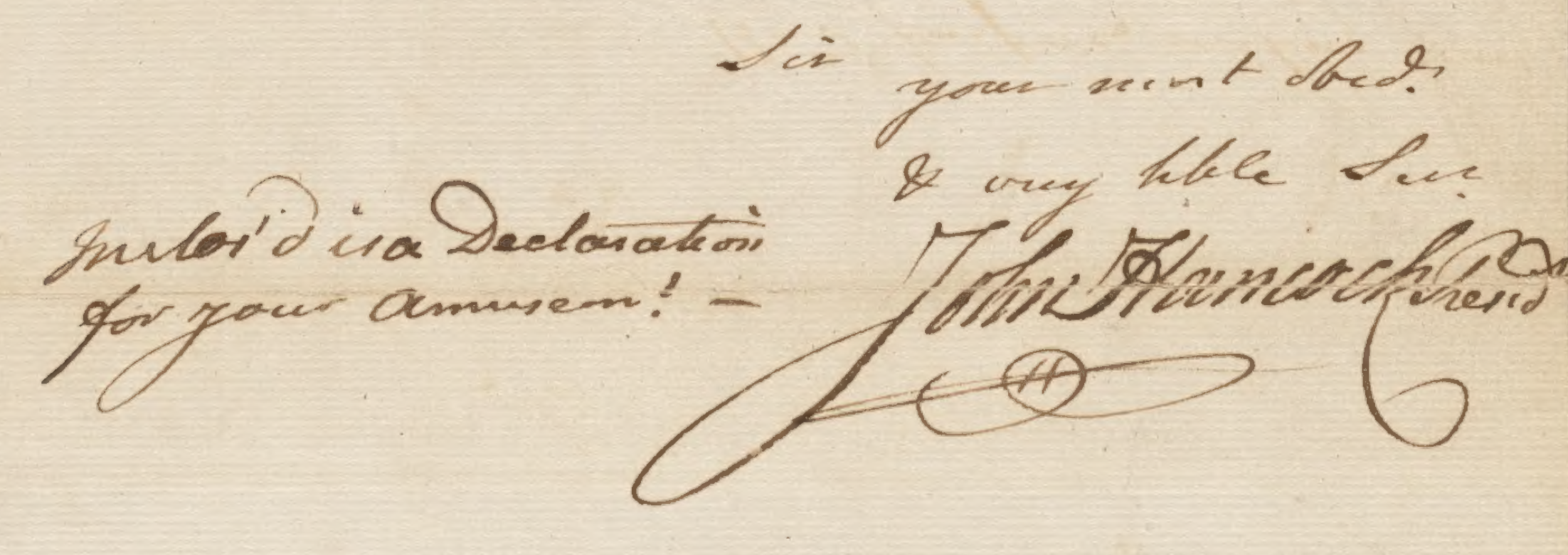
Letter from John Hancock to John Bradford, July 6, 1776, Boston Public Library
In the middle of sending out the Declaration for official purposes, John Hancock sent a copy for amusement. The Dunlap broadside enclosed in this letter is not known to survive. However, Hancock’s letter to Bradford is an important reminder that, when the Declaration was news, it traveled for different reasons. Hancock and other members of the Continental Congress enclosed copies of the Declaration in letters they were sending to family members, friends, and colleagues in their home states. They wanted the Declaration to get to the people responsible for ensuring that the document was proclaimed, but they also wanted the Declaration to get to people who would be interested or even amused by the news.