Pathetic, Aged, Revered
This is the fiftieth and final story behind the Declaration of Independence, and it is time to talk about the image of the Declaration that is in most people’s heads: the handwritten and signed parchment. Although the parchment has the date July 4, 1776, at the top, it was not signed on that day; in fact, it did not yet exist.
The story of the parchment Declaration began in earnest a full two weeks after the Congress voted to approve the text. On Friday, July 19, the Congress resolved, “That the Declaration passed on the 4th, be fairly engrossed on parchment, with the title and stile of ‘The unanimous declaration of the thirteen United States of America,’ and that the same, when engrossed, be signed by every member of Congress.” Two weeks later, on Friday, August 2, the Declaration “being engrossed and compared at the table was signed” by the delegates who were present—a mix of men who had been part of the deliberation and vote on independence and men who had returned to or joined the Congress after July 4. Individuals continued to add their signatures through the fall and, in the case of Thomas McKean of Delaware, perhaps some months or years later.
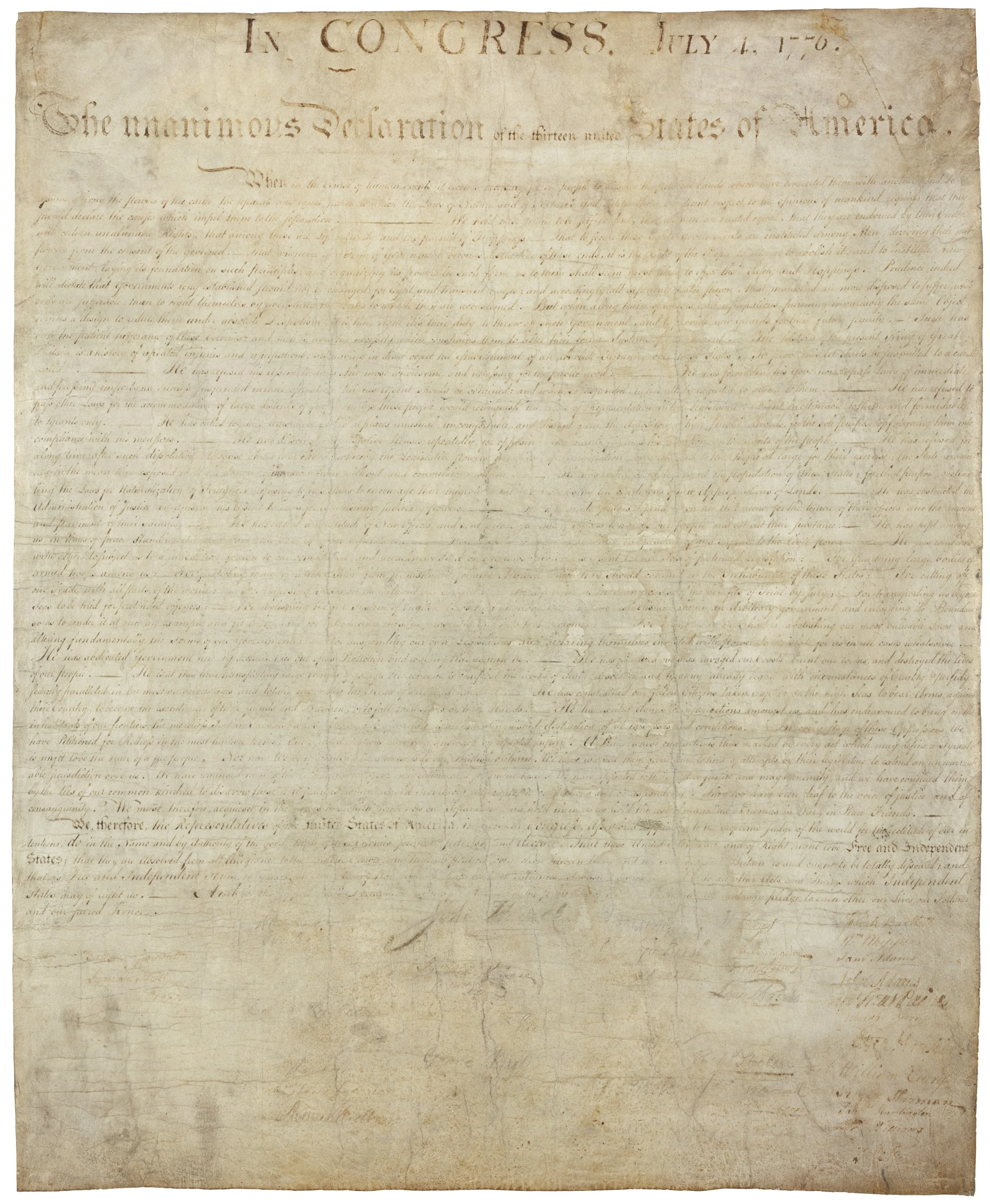
Handwritten and Signed Declaration of Independence, ca. July 1776, National Archives and Records Administration
The parchment Declaration stayed with Charles Thomson, the secretary of the Continental Congress, until the creation of the federal government under the Constitution. At that point, the parchment transferred to the care of the Department of State. After the federal government moved from Philadelphia to Washington, D.C., the parchment returned to Philadelphia only once: in 1876 for the Centennial of the United States.
According to Washington, D.C. newspapers, the parchment left the nation’s capital on Saturday, May 6, 1876, at 9:23 a.m. on board a train bound for Philadelphia. Alonzo Bell, the Chief Clerk of the Department of the Interior, accompanied the Declaration. Initially, the parchment was going to be displayed at the Centennial Exhibition. However, the day before it left Washington, D.C., President Ulysses S. Grant changed the directive so that the Declaration would be delivered to Independence Hall and exhibited there. The Philadelphia Inquirer reported on the arrival of the parchment Declaration: “Mr. Bell was met at the depot by the chairman of the Committee on the Restoration of Independence Hall, where a brief and suitable ceremony took place prior to the placing of the venerable papers in the safe manufactured for the purpose, and located in Independence chamber.” Bell also delivered brief remarks suitable for the moment:
“I am here to-day in obedience to the instructions of the Secretary of the Interior, who has been directed by the President of the United States to deposit in Independence Hall the original Declaration of Independence, which had its birth amid scenes of strife, and it is brought back to-day amid evidences of peace and joy. I would that the signers were here to day that they might behold the fullness of the glory of the nation which they established, and see the completion of the work they strove so hard to maintain.
Let us be thankful, gentlemen, that the spirit inscribed on this page still lives in the hearts of the American people. To this sacred spot tens of thousands will wend their way during the coming season to gaze upon the document and kneel at this shrine of American liberty and to pay homage to the men whose memory we still cherish. Let us rejoice, gentlemen, that the Republic still lives—lives to encircle the globe with good and freedom. Let this document, full of glory, which has returned, like an aged parent, to look upon the glory of the children, breathe a patriotic spirit upon those who see it. Thank God for this Centennial year, and for the hopes which come with it; for the administration of justice under the good President whose name will live in years to come. We should be thankful for the peace that abounds at home and abroad, and for the rekindling of the fires of loyalty and patriotism everywhere.”
On May 9, the Philadelphia Times described the scene when people got the opportunity to see the parchment on display in Philadelphia for the first time in history: “The patriotism of the average American was forcibly attested yesterday by the continual rush to view the ‘only and original’ Declaration of Independence. During the day not less than 8,000 people scrutinized the musty piece of parchment that created such a stir in the world one hundred years ago.” For comparison, during the 250th anniversary on July 4, nearly 10,000 people visited the National Archives, where the parchment Declaration is on view in the Rotunda.
However, not all of the visitors to Independence Hall in 1876 were satisfied. An editorial in the Inquirer signed by “Many Citizens” complained that a group of men from Boston visited Independence Hall “for the special purpose of seeing the original Declaration of Independence,” but “were deprived of that privilege because the doors of the fire-proof safe containing it were closed at half-past three o’clock, and the visitors happened to be five minutes late.” To protect the document, the express order had been given that “the doors of the fire-proof must be closed at half-past three, and no one must see it after that hour,” and these “Citizens” wondered, “why should not the safe be kept open as long as the Hall is open, and thus allow all who visit the sacred spot the opportunity of seeing this interesting document?” Later in July, a man from New York named Michael Sullivan was arrested at Independence Hall. According to newspaper reports, he wanted to sign the parchment Declaration. In fact, the Inquirer claimed that “he thought he could outrival John Hancock’s extensive signature.” He had “chisels and wedges and mallets concealed beneath his clothes.” When he reached the safe containing the Declaration, “he reverently doffed his hat and dropped upon his knees,” and then started chiseling and the back of the safe before officers “pounced upon” him.
The parchment played a key role in the official celebration of the Centennial. On June 26, the mayor of Philadelphia announced that the national commemoration would take place on the morning of July 4 outside Independence Hall, “to consist of the reading of the Declaration of Independence from the original manuscript, and certain other appropriate literary and musical exercises under the auspices of the United States Centennial Commission.” The Times described the “magnificent scene” when Richard Henry Lee, the grandson of the same-named signer, was introduced that morning to read the Declaration from the parchment:
“Mr. Lee is a smallish Virginia man, of a trim figure, and a good solid head of good depth and breadth. He wore a small, military moustache and a tuft of goatee. His complexion was well sun-burnt and he had keen, professional-looking features. As he arose, young, genteel, modest and manly, the audience arose with a cheer. But in another second General Hawley said that his Honor, the Mayor, would now bring forward the original Declaration of Independence. The large, burly figure of Mayor Stokley appeared, with the well-known, faded parchment in rosewood frame. Recognizing this pathetic, aged, revered document, the mighty audience sprang to an ecstasy of joy. The whole multitude arose and cheered for many minutes. Stokley held the dumb thing eloquent silently, and around him stood Mr. Lee, Vice President Ferry and General Hawley. The document was turned from side to side and to the rear, so that the thousands of people on the platform could also see it, and everywhere the roar of gratulation burst forth. Hawley seemed to catch the infection, and, waving his handkerchief, called for nine cheers, leading the response with his nervous arm. Man and boy, woman and child, responded, and the happiest occasion of the day passed off with a glow of universal pleasure.”
Lee might not have been the best choice for this moment. “His reading was heard by perhaps one hundred persons,” the Times claimed, “for his voice was not strong nor his gestures suggestive—but whenever ‘Constitution’ or ‘liberty’ was heard the cheers arose near the stand, and for a long time the air was filled with tumults of applause. In addition to the limitations of Lee’s voice, the parchment had its own limitations. The ink had faded significantly by 1876. Although Lee was depicted as reading from the framed parchment to the crowd, one has to wonder if he had a cheat sheet with the text in a more legible format. Otherwise, perhaps his volume and gestures were lacking because he was straining to read the hazy, handwritten text of the parchment within a heavy wooden frame.
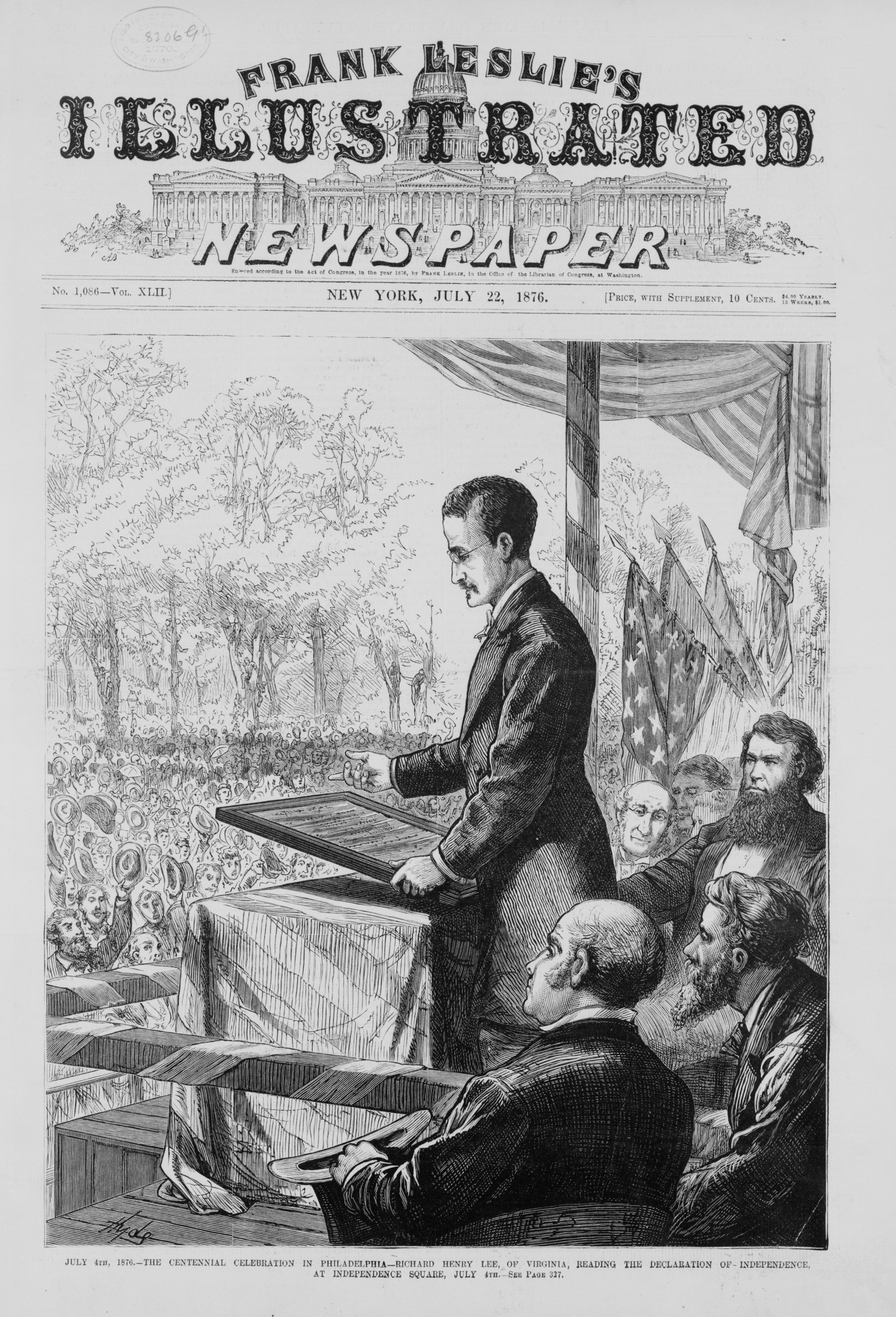
Frank Leslie’s Illustrated Newspaper, July 22, 1876
The reading of the Declaration was followed by “a Brazilian hymn composed for the occasion, at the request of the Emperor,” Dom Pedro II, who was a special guest at the Centennial Exposition. Although slavery had been abolished during the Civil War in the United States, in Brazil, it was not abolished until 1888, making the country the last in the Americas to take this step. Still, the Brazilian emperor was widely regarded in the American press. The Times reported that, “when Richard Henry Lee rose to read the Declaration of Independence, Dom Pedro drew from his pocket a well-worn fac simile of the original document” and “followed the reading sentence by sentence to see that no mistake was made, and loudly applauded the most striking passages.” The Times described Pedro II as “the kind of man likely to make a good impression on North Americans.”
Additionally, the National Woman Suffrage Association made their presence known at the Centennial celebration. In an exclusive interview given to the Times, printed under the headline “THE SNUBBED DECLARATORS,” Matilda Joslyn Gage described how she and Susan B. Anthony approached the front of the dais after Lee finished reading from the parchment Declaration. They presented their own declaration of the rights of the women of the United States to the de facto Vice President, Ferry, “‘who looked paler than he will when he is in his coffin,’” according to Gage. The women’s declaration noted that, “while the nation is buoyant with patriotism, and all hearts are attuned to praise,” women felt left out: “Our faith is firm and unwavering in the broad principles of human rights proclaimed in 1776, not only as abstract truths, but as the corner stones of a republic. Yet we cannot forget, even in this glad hour, that while all men of every race, and clime, and condition, have been invested with the full rights of citizenship under our hospitable flag, all women still suffer the degradation of disfranchisement.”
The parchment’s presence in Philadelphia in 1876 highlighted the challenges that the signers left for future generations. More than any other manuscript or printed copy of the Declaration of Independence, the parchment has become a symbol—something that people continue to adapt, critique, and celebrate in pursuit of human rights.

Paul Stahr, “Retouching an Old Masterpiece,” cover illustration for Life, July 1915