Exeter
Printings of the Declaration of Independence hold tremendous value, even if we are uncertain about their origins
The splashiest copies of the Declaration of Independence in recent years are broadsides printed in New Hampshire in mid-July 1776. One became an NFT, or non-fungible token, in 2021, with an initial offering of 80,000 shares made available to qualified investors for $25 each. One sold at auction in January 2025 for $2.4 million, and another sold at auction a year later and realized $5.7 million, more than double that amount. Then, days before the 250th anniversary of the Declaration, the British National Archives announced that they had uncovered one of these broadsides in the papers of a British ship captain, making it the most recently identified copy of the Declaration. Despite the news headlines and high valuations, there are still things about these broadsides which we do not know for certain.
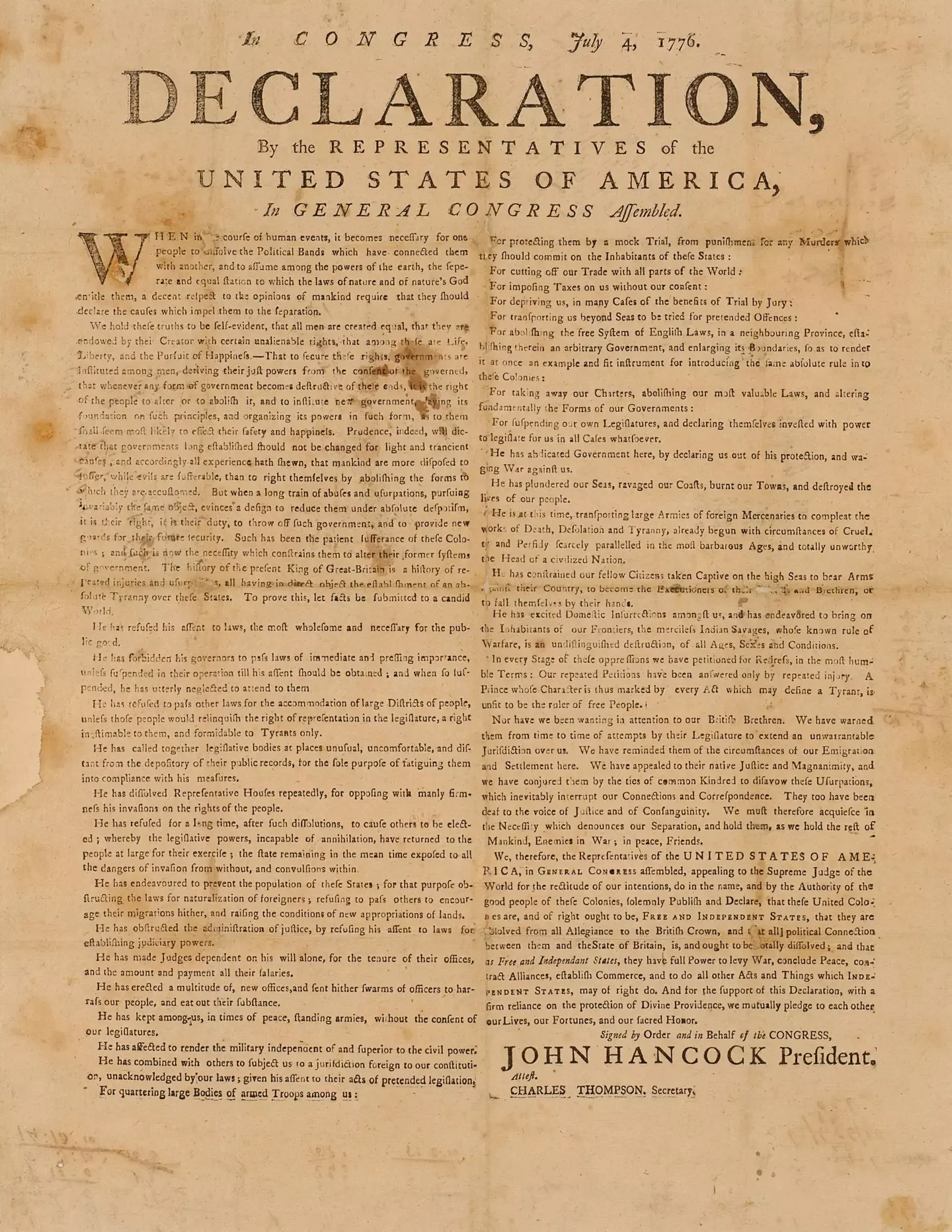
Broadside of the Declaration of Independence, attributed to Robert Luist Fowle, Exeter, NH, ca. July 16–19, 1776 (Sotheby’s)
At first glance, the Exeter broadsides look similar to other early broadside printings of the Declaration of Independence, with the text arranged in two columns. These broadsides lack an imprint—the name and location of the printer who created them. In the absence of definitive information, dealers and librarians have attributed these broadsides to Robert Luist Fowle, a printer in Exeter, New Hampshire. Fowle was the printer of the New Hampshire Gazette, or Exeter Morning Chronicle, and he printed the Declaration in an extraordinary issue of his newspaper on July 16. This has provided an approximate date for the broadsides attributed to him.
There are a few clues within the text of the Declaration that link these broadsides to other New Hampshire printings, including Fowle’s New Hampshire Gazette. One pivotal sentence reads: “A Prince whose Character is thus marked by every Act which may define a Tyrant, is unfit to be the Ruler of free People,” lacking the “a” in what should be “the Ruler of a free People.” In the final paragraph, the Exeter broadsides say “theState of Britain”—missing a space between “the” and “State” and, more importantly, the word “Great.” Fowle’s newspaper printing similarly says “the State of Britain.” These typos show how slight changes to the text can actually serve as evidence of where and when a particular printing might have been created, and what the printer’s source might have been for his new edition.
The printer of these broadsides—whether it was really Fowle or another printer—also made a critical mistake. The first broadsides that came off the press had the printed signature of John “HACOCK,” rather than Hancock. Someone inserted the “N” by hand on the copy at the Beinecke Library at Yale University. The American Antiquarian Society also has one of these broadsides, which Simon Greenleaf deposited there in 1822. In an accompanying letter, Greenleaf wrote that this broadside was “posted up in Newburyport” in 1776 and preserved by his grandfather, “the late Hon. Jonathan Greenleaf.” The younger Greenleaf speculated that the “error in the spelling of Mr. Hancock’s name” showed “the great haste to announce that great event.” But he left no record of who printed the broadsides, or whether they came from Exeter, New Hampshire, about thirty miles north of Newburyport, Massachusetts. Hancock’s name was corrected during the printing process, making the “HACOCK” broadsides even more rare than the “HANCOCK” broadsides.
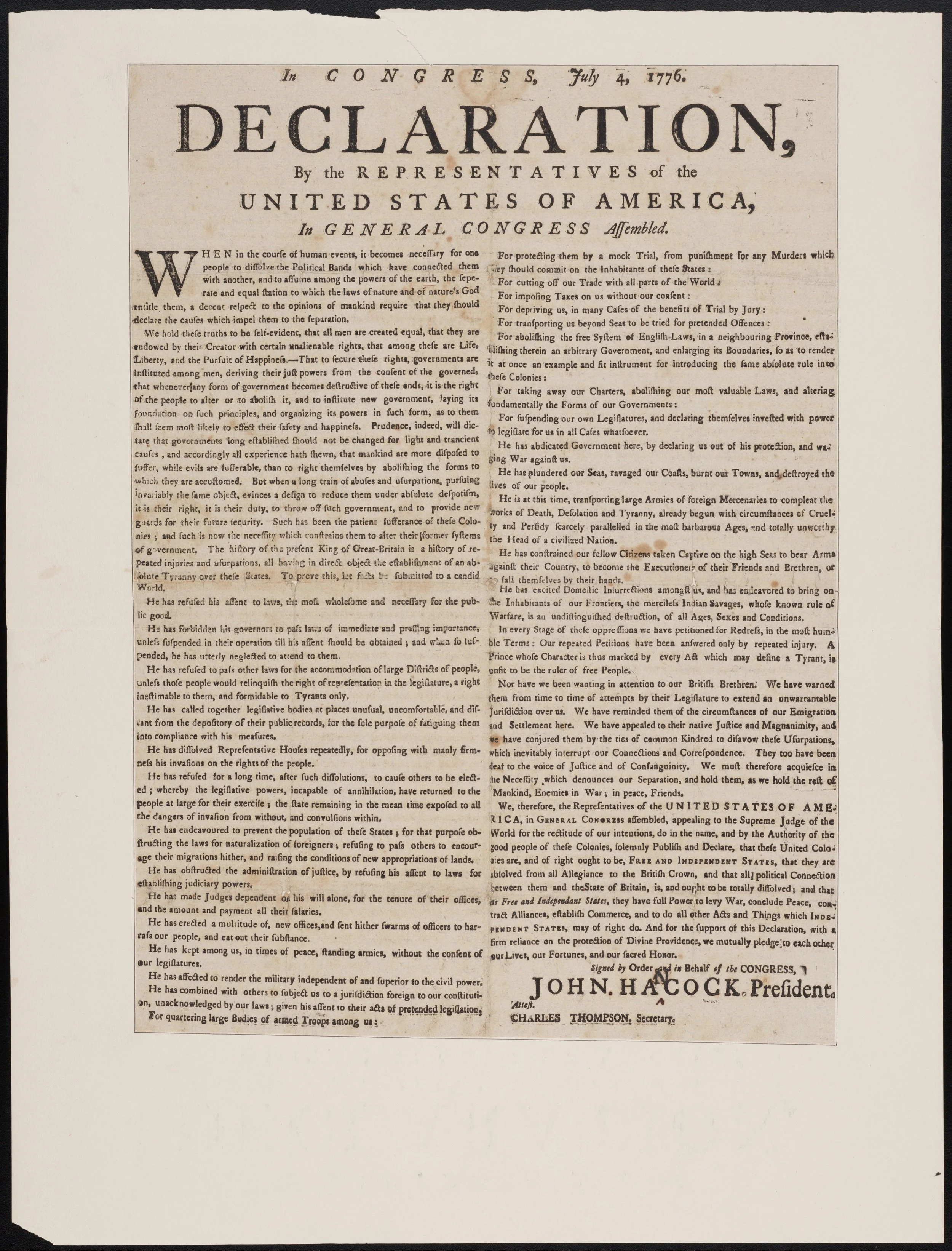
Broadside of the Declaration of Independence, attributed to Robert Luist Fowle, Exeter, NH, ca. July 16–19, 1776 (Yale University Library)
The most recently identified Exeter broadside, uncovered in the Admiralty papers in the British National Archives, also has a Newburyport connection. This broadside was on board the Dalton, a ship which departed Newburyport in October 1776, which was captured off the Iberian Peninsula on Christmas Eve. The captain of HMS Raisonable, Thomas Fitzherbert recorded the Dalton as a ship “with 120 Men, belonging to Newbury Port New England.”
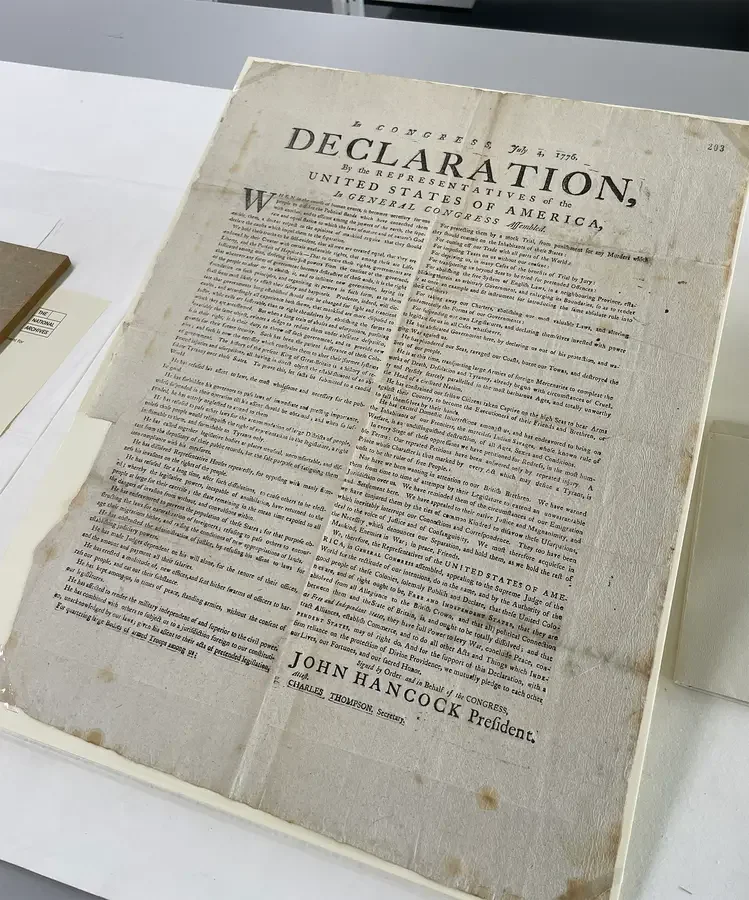
Broadside of the Declaration of Independence, attributed to Robert Luist Fowle, Exeter, NH, ca. July 16–19, 1776 (National Archives)
These broadsides are proof that printings of the Declaration of Independence hold tremendous value, even if we are uncertain about their origins. Some of the Exeter broadsides have stories that were passed down within families or lay hidden in the archives. Others have scant annotations that fail to provide answers about exactly when and where they were printed. The evidence that survives within the text suggests that these broadsides helped the news spread to southern New Hampshire and northern Massachusetts. Perhaps one day, another Exeter broadside will be uncovered which helps illuminate the process further.