Meister von Philadelphia
The Declaration was evidence of one conflict among many in 1776
What do Basra and the Río de la Plata have to do with the Declaration of Independence? They were all part of the same news cycle for the Kayserlich-Privilegirte Hamburgische Neue Zeitung.
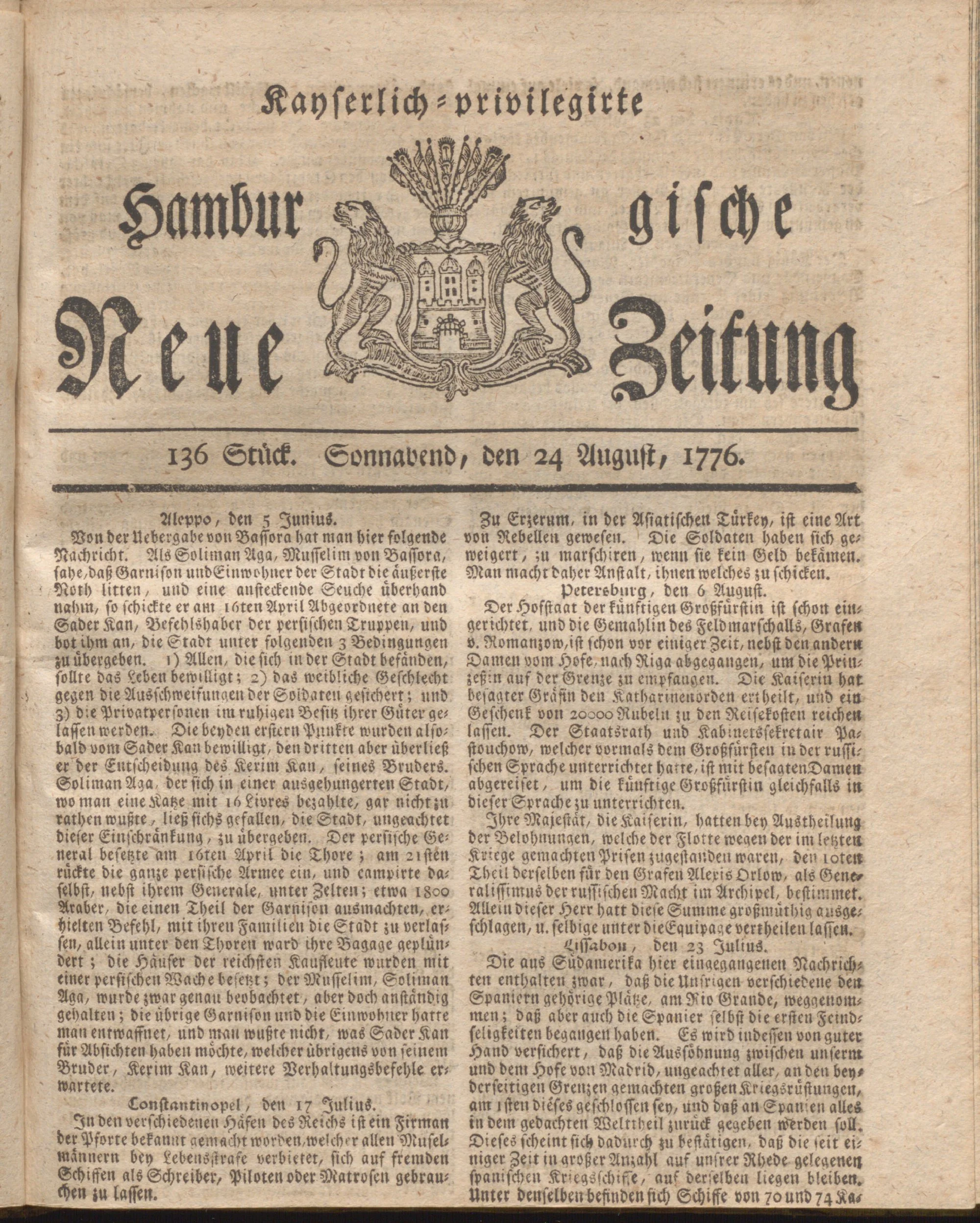
Kayserlich-Privilegirte Hamburgische Neue Zeitung, August 24, 1776, p. 1, Deutsches Zeitungsportal
The Declaration of Independence was printed in German in this Hamburg newspaper on August 24, 1776. The text began, under a London heading, at the bottom of the second page and ran through the middle of the fourth page. In other gazettes printed that same week in Hamburg, the Declaration was excerpted or summarized, but in this newspaper, the full text was given space—even if some other news had to be pushed to a supplement.
Since the news was organized geographically, the Declaration and other news from London followed reports from Aleppo, Constantinople, St. Petersburg, Lisbon, and different cities in Spain and France. The reports from the Ottoman Empire had taken months to reach Hamburg, while the London newspaper this printer relied on for the Declaration of Independence had been printed one week earlier on August 16. In the supplemental pages, there were pieces of even more recent news from closer to Hamburg.
Just as the news under the London heading was dominated by reports from the British colonies, the news under other headings reflected a range of locations and conflicts. The news from Aleppo, dated June 5, was actually about Suleiman Agha’s surrender at Basra in April. Under the Constantinople heading, there was a description of a coup in Erzerum, when soldiers refused to march unless they received pay. Reports from Lisbon described hostilities in South America over control of the Río de la Plata. It was unclear at this moment whether the Portuguese or Spanish forces in the region had initiated the conflict. Letters from Madrid under the Barcelona heading elaborated on the Spanish-Portuguese dispute.
News from Toulon, on the southern coast of France, focused on a Corsican mutiny. A short sentence under the Versailles heading, dated August 14, said the French court would move to Choisy for a week. There was more royal news from Paris just above the updates from London, including the Declaration of Independence.
The Declaration was contextualized in the Hamburgische Neue Zeitung by General William Howe’s correspondence, which mentioned that “der Continentalkongreß,” the Continental Congress, had declared the colonies to be “freye und unabhängige Staaten,” free and independent states. A transcription of the Declaration followed, and the printer copied and translated some of the censorship imposed in the London newspapers to avoid printing that King George III was a tyrant.
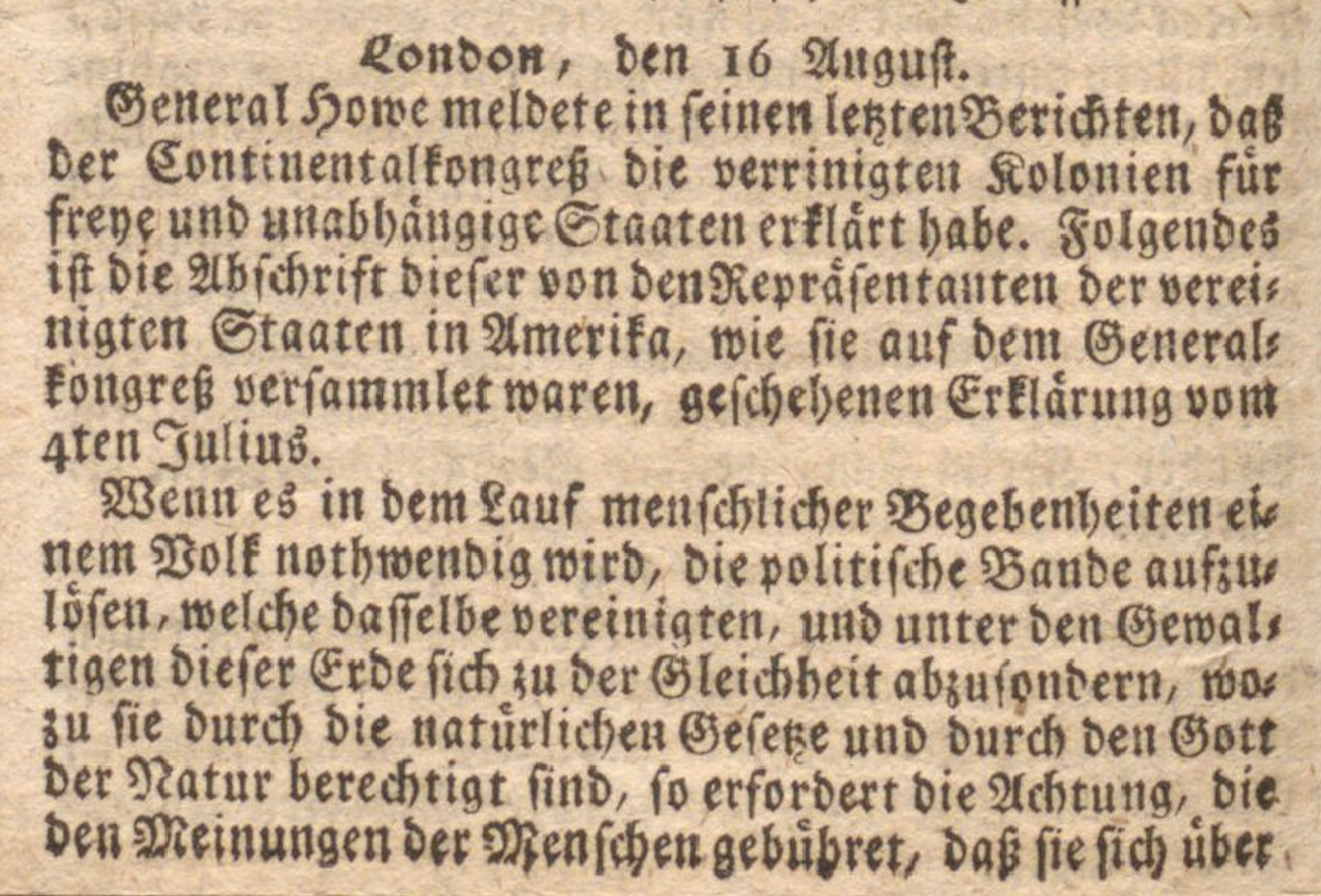
Kayserlich-Privilegirte Hamburgische Neue Zeitung (detail), August 24, 1776, p. 2, Deutsches Zeitungsportal
The Declaration was not the only news from the United States via London. It was followed by reports about the anticipated battle in New York. One particularly interesting piece of false information came from Halifax, on a ship that arrived in Dover in mid-August. An express messenger brought the news that General Howe had taken control of Philadelphia—that he had made himself the “Meister von Philadelphia.” This would not become reality until the fall of 1777.
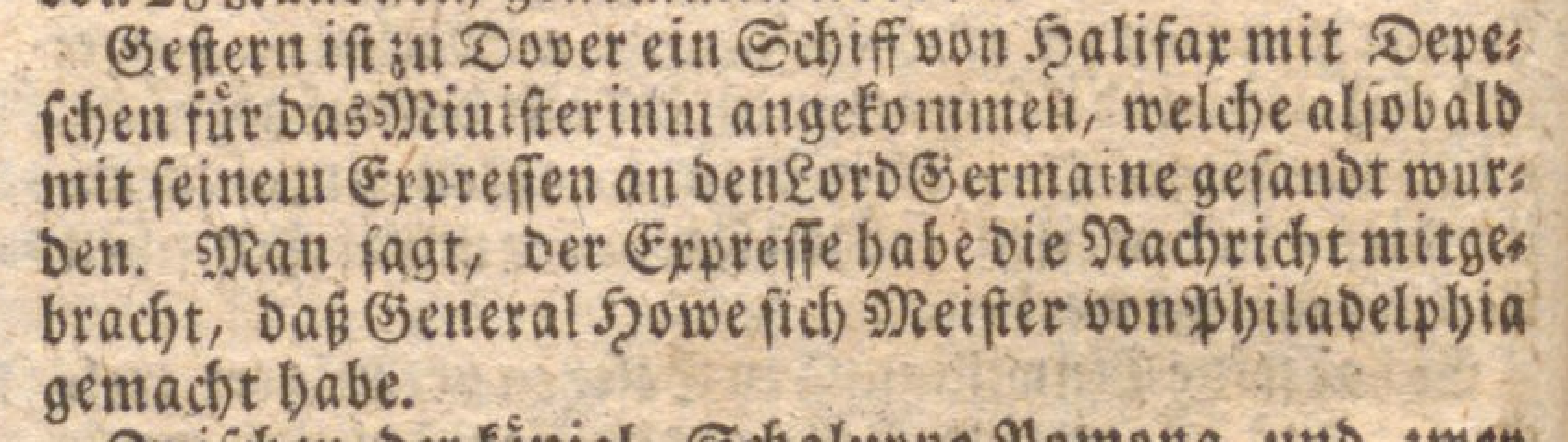
Kayserlich-Privilegirte Hamburgische Neue Zeitung (detail), August 24, 1776, p. 4, Deutsches Zeitungsportal
Because of the length of the Declaration of Independence and the rest of the news from London, news from closer to Hamburg was reserved for supplementary pages. This included paragraphs of information from Copenhagen, The Hague, Vienna, and finally, Regensburg. In this single issue of a newspaper, there was news of military and political developments on four different continents: Asia, South America, Europe, and North America. The Declaration was evidence of one conflict among many in 1776. And, as the “Meister von Philadelphia” report shows, not everything in the pages of a local newspaper was true.
Where to See It Online: Deutsches Zeitungsportal