Free and Independent Sates
Although Isaiah Thomas was one of the most famous pro-independence printers in the colonies, he did not have the opportunity to print the Declaration of Independence
Isaiah Thomas was the definition of a patriot printer. He literally wrote the book on the history of printing in America. And yet, he did not print the Declaration of Independence.
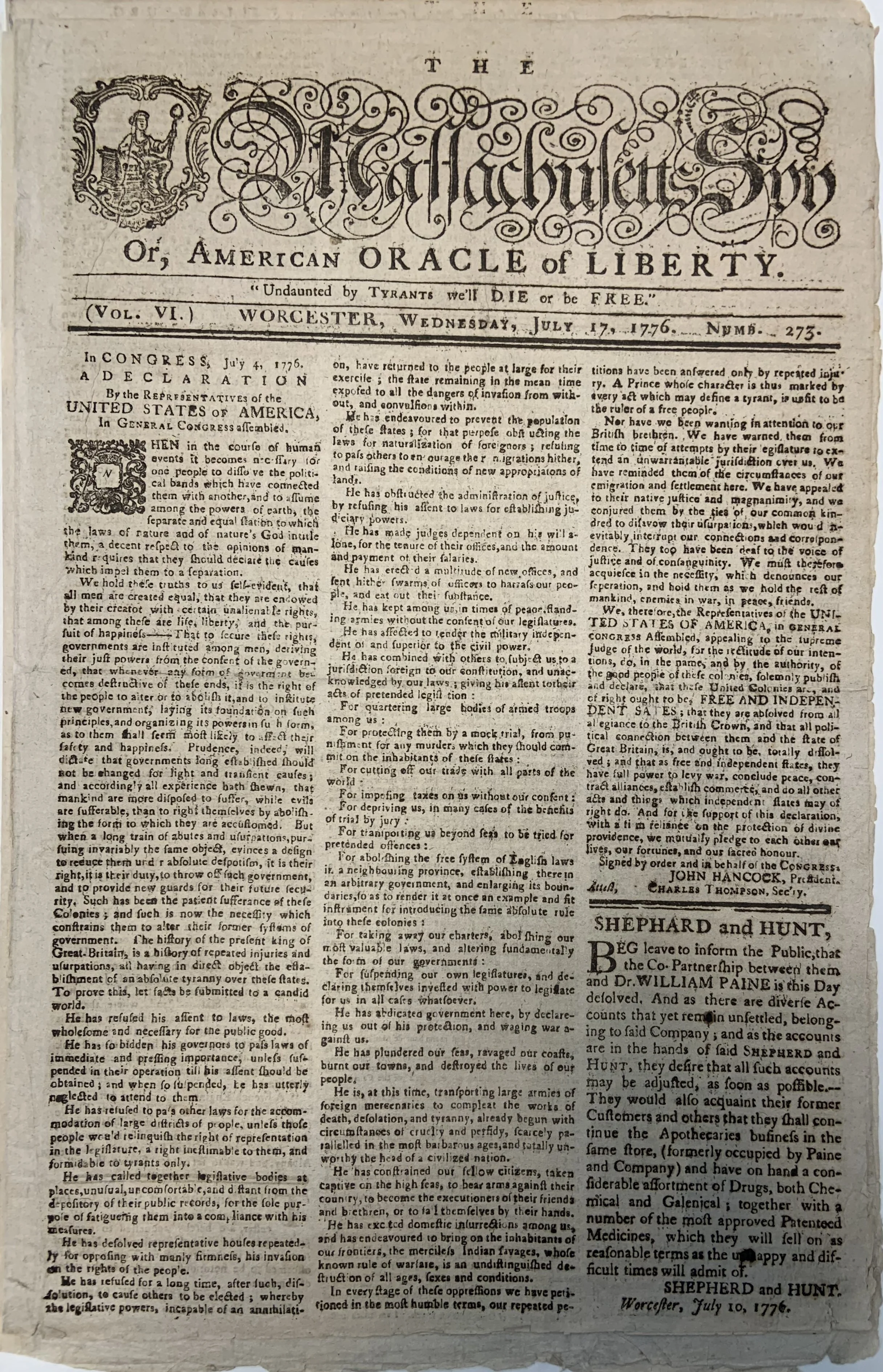
Massachusetts Spy, July 17, 1776, p. 1, American Antiquarian Society
Thomas printed the Massachusetts Spy in Boston. However, in the middle of the night in April 1775, Thomas had to move his press to Worcester, Massachusetts. When he resumed printing his newspaper on May 3, he explained, “I accordingly removed my Printing Utensils to this Place, and escaped myself from Boston on the memorable 19th of April, 1775, which will be remembered in future as the Anniversary of the BATTLE of LEXINGTON!” A year later, after the British evacuation of Boston, Thomas made the decision to keep his business in Worcester.
Then in June 1776, Thomas handed over his Worcester business to William Stearns and Daniel Bigelow. In an advertisement to readers of the Spy, Stearns and Bigelow explained that Thomas had “relinquished the Printing business in Worcester,” and that they were taking over his office and would “perform the various branches of said business with the utmost care and fidelity.” Staking their own claim as patriotic printers, they stated that, “at a time when OUR ALL is at stake, when no less than the fate of the STATES of AMERICA is in agitation, then (of all times) the means of conveying intelligence ought to be encouraged.” Stearns and Bigelow highlighted the importance of the “liberty and free exercise of the PRESS,” which was a “terrific scourge to tyrants.” In short, they tried to present themselves as worthy successors to the firebrand Thomas.
Isaiah Thomas also printed a notice in the Massachusetts Spy, thanking his readers for their support while also demanding payment of all subscription debts. This was the business that kept Thomas occupied at the time that the Continental Congress declared independence. Although Thomas tried to relocate to Boston, he spent weeks traveling back to Worcester to collect payments. On July 24, Stearns and Bigelow printed another advertisement for Thomas, on the front page and surrounded by an ornamental border to catch readers’ attention. Thomas sarcastically wrote that he was “very sorry that so many of his Customers are so unkind as to neglect paying him the several small sums due to him for services already performed.” He explained that he had made “several journeys to Worcester on purpose to receive his just due, but to his surprise, finds the old proverb verified, ‘Out of sight, out of mind.’” In short, Thomas found that his old subscribers thought they could evade him, since he had moved to Boston. He “once more” begged his customers to settle their accounts with him, even “if it is but two-pence.”
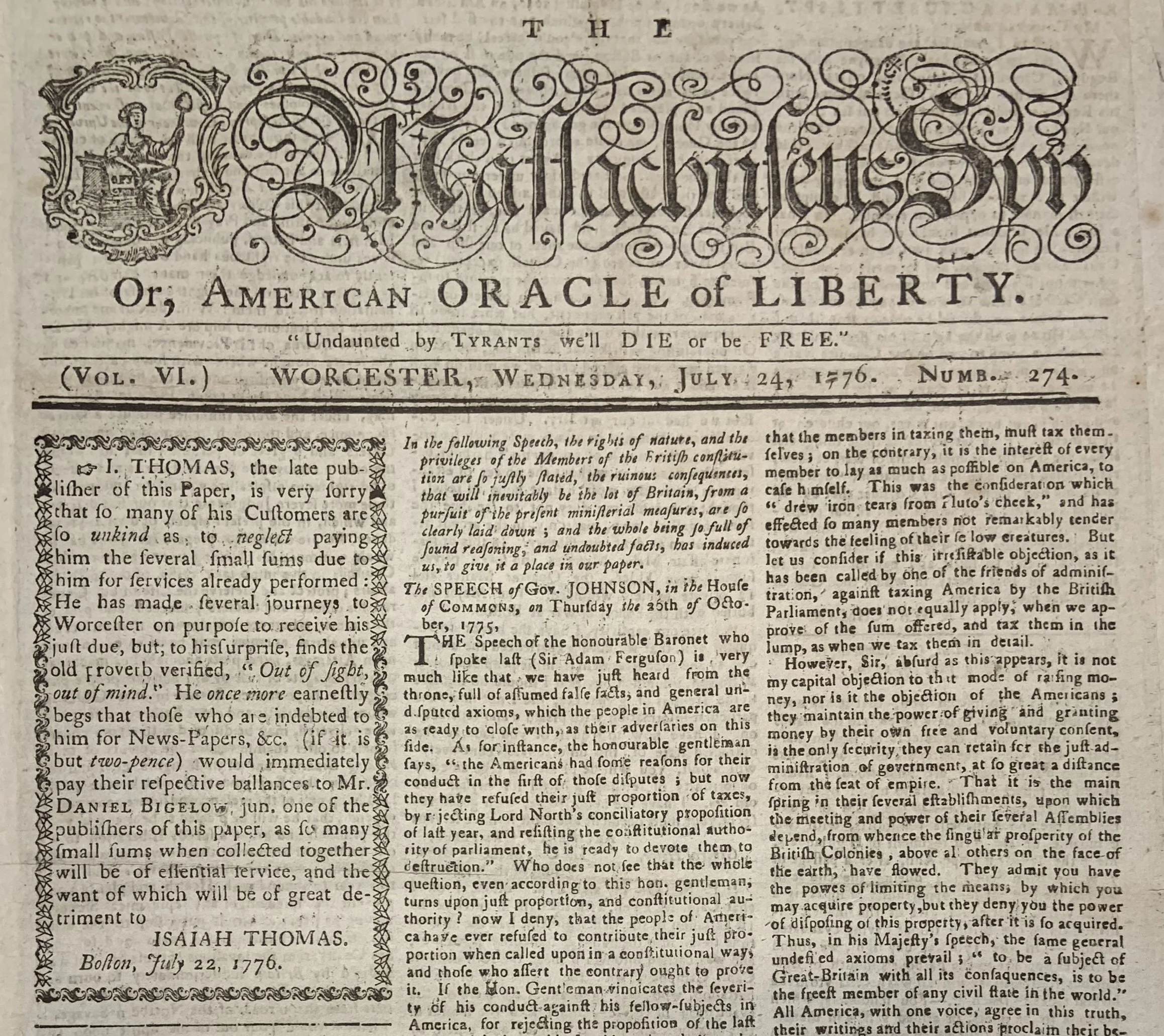
Massachusetts Spy, July 24, 1776, p. 1, American Antiquarian Society
Although Isaiah Thomas was one of the most famous pro-independence printers in the colonies, he did not have the opportunity to print the Declaration of Independence. Instead, Stearns and Bigelow did. And, as Thomas might agree, they squandered the opportunity. When they printed the Declaration on the front page of the Spy on July 17, 1776, Stearns and Bigelow did not take particular care with their typesetting. The iconic opening of the second sentence was rendered as “We hold these truths to us self-evident…” Thanks to either an upside down “r” or a rogue “t,” the word “creator” appeared as “creatot.” Government was spelled “goverment.” And the final paragraph of the Declaration announced that the united colonies were “FREE AND INDEPENDENT SATES.” Other printing offices made errors when typesetting the Declaration of Independence, but nowhere near the number made in Isaiah Thomas’s former office.
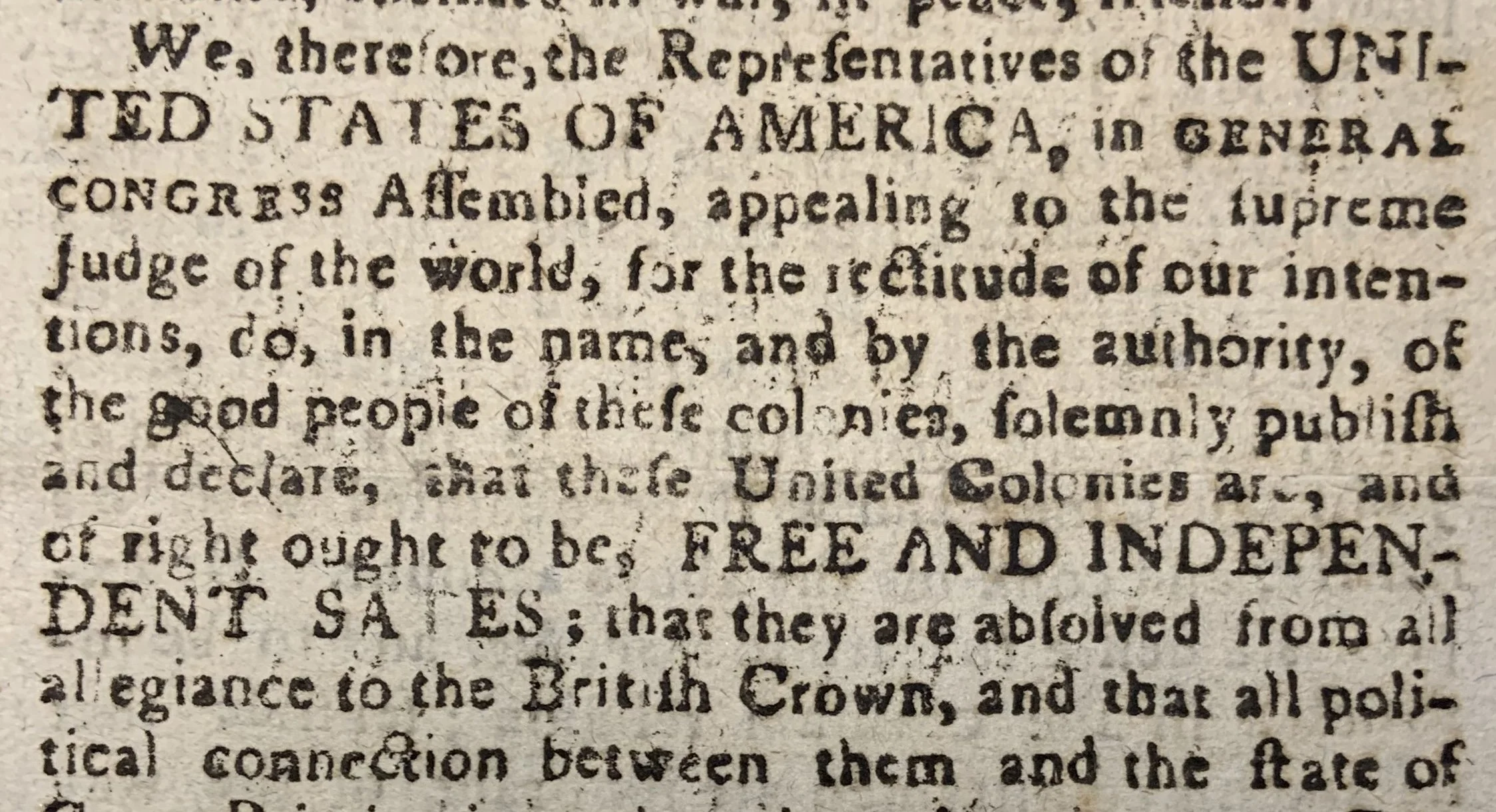
Massachusetts Spy, July 17, 1776, p. 1 (detail), American Antiquarian Society
Where to See It In Person: American Antiquarian Society