Desperado
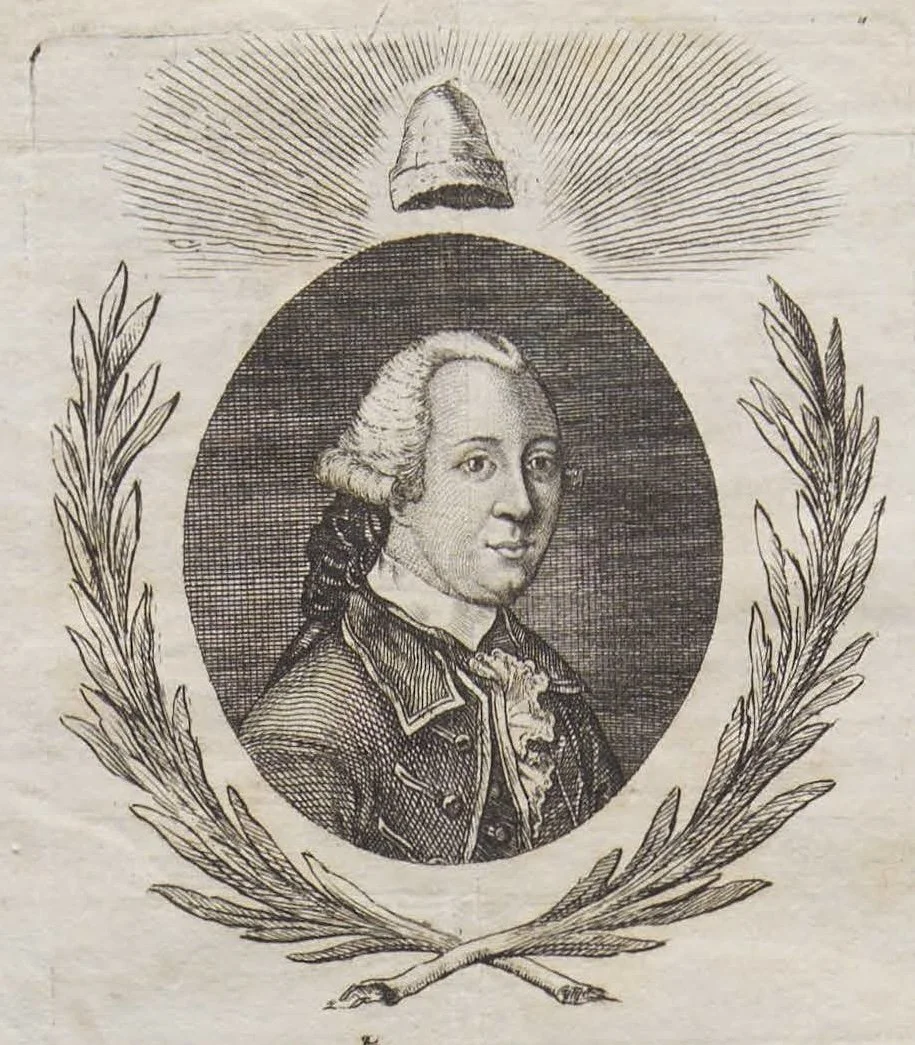
John Hancock, the president of the Continental Congress, sits at the top of this London broadside
Broadsides of the Declaration of Independence were designed for public uses—to be read to crowds, or posted up in public spaces. Most of the broadsides created in 1776 were printed in the United States. But one printing was made on the other side of the Atlantic. This mysterious broadside offers proof that some people in London publicly supported American independence.
It is easy to assume that people in the metropole supported King George III and hoped for a reconciliation with the British North American colonies. However, there were people who sympathized with the colonists’ grievances, and even some who openly backed the rebellion. Sometime after the Declaration was first printed in London newspapers in mid-August 1776, this broadside was created, seemingly, for an audience that respected and perhaps even praised the decision to separate from Great Britain.
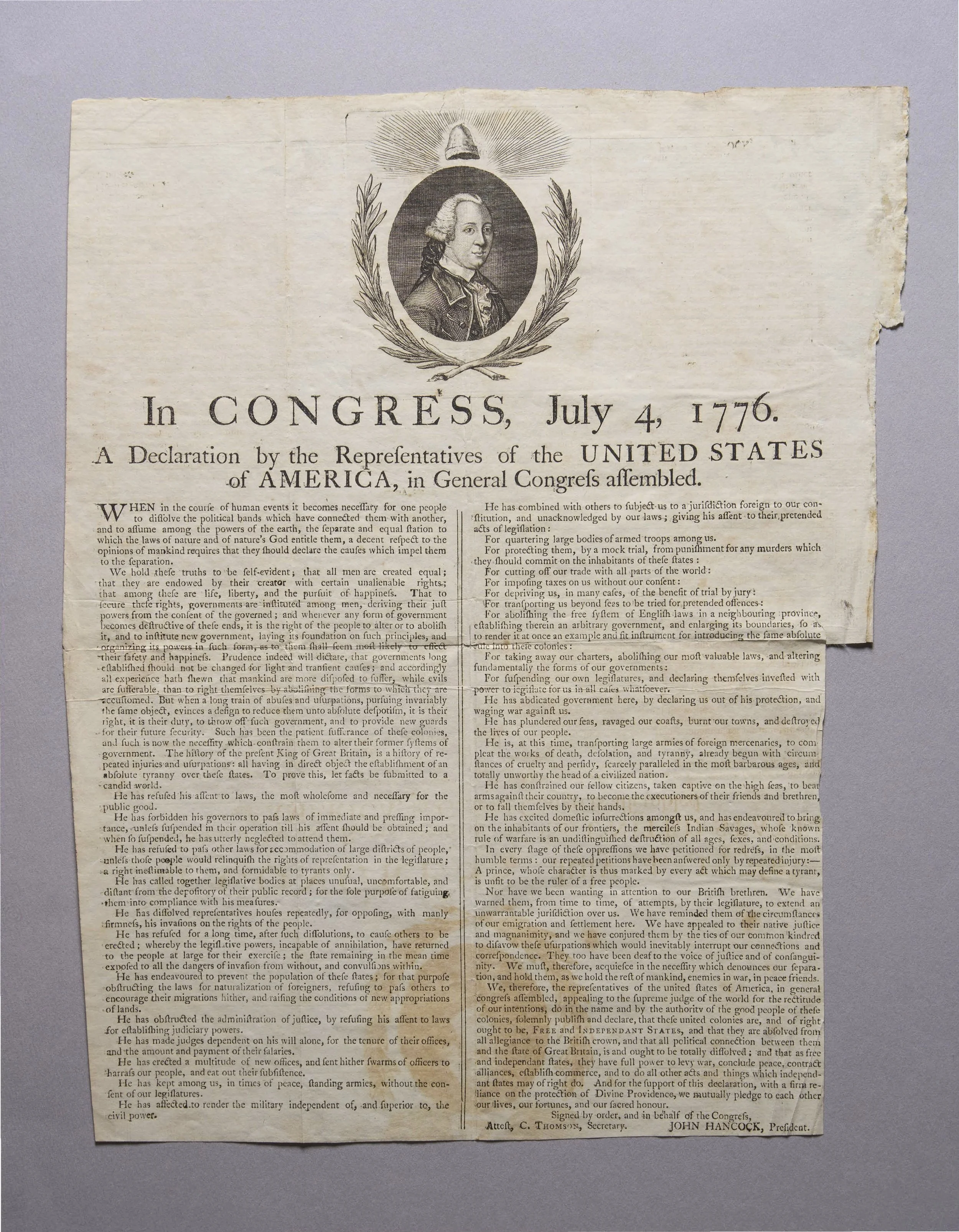
Broadside of the Declaration of Independence, ca. 1776, John Carter Brown Library
The London broadside of the Declaration features the text in two columns, separated by two long lines. The text does not look too different from the broadsides created in the United States. What makes this British printing special is not only where it was printed, but whose portrait was printed alongside the Declaration.
John Hancock, the president of the Continental Congress, sits at the top of this London broadside. Although the portrait was not labeled, it would have been obvious that Hancock—one of only two names within the printed Declaration—was the subject. His oval portrait is surrounded by branches and a radiant liberty cap, symbolizing his leadership in the fight for the colonists’ rights.
Broadside of the Declaration of Independence, ca. 1776, John Carter Brown Library
Hancock had been a subject of curiosity and commentary in the London press, especially after June 1775, when Thomas Gage specifically named him and Samuel Adams as undeserving of a pardon. A letter printed in London newspapers, purportedly written by a Virginian, called Hancock “one of the greatest desperadoes living.” Another report from a correspondent in January 1776 suggested that Hancock, “the American Patriot,” had gone into hiding “in England, and in Lodgings incog. at a Village near this Metropolis.” One week before the Declaration of Independence was printed in London newspapers, some publishers cited a letter from Philadelphia as evidence that “one-third of the Delegates have entirely withdrawn themselves from the Congress, and that the patriotic Mr. Hancock has of late wavered very much in his sentiments.” One day before the Declaration was printed, the Morning Post alleged that “Hancock, the president of the Congress, is a ruined, and therefore a discontented smuggler.”
Engravings of Hancock, printed in London in the fall of 1775, identified him as the president of the American Congress and served as the source for the portrait at the top of this broadside. A report in the Craftsman; or Say’s Weekly Journal and other London newspapers in September 1775 claimed that, “ever since the portrait of the celebrated John Hancock has been exhibited in the print shops, numbers of the ministerial advocates have purchased it; merely for the sake of hanging him up.”
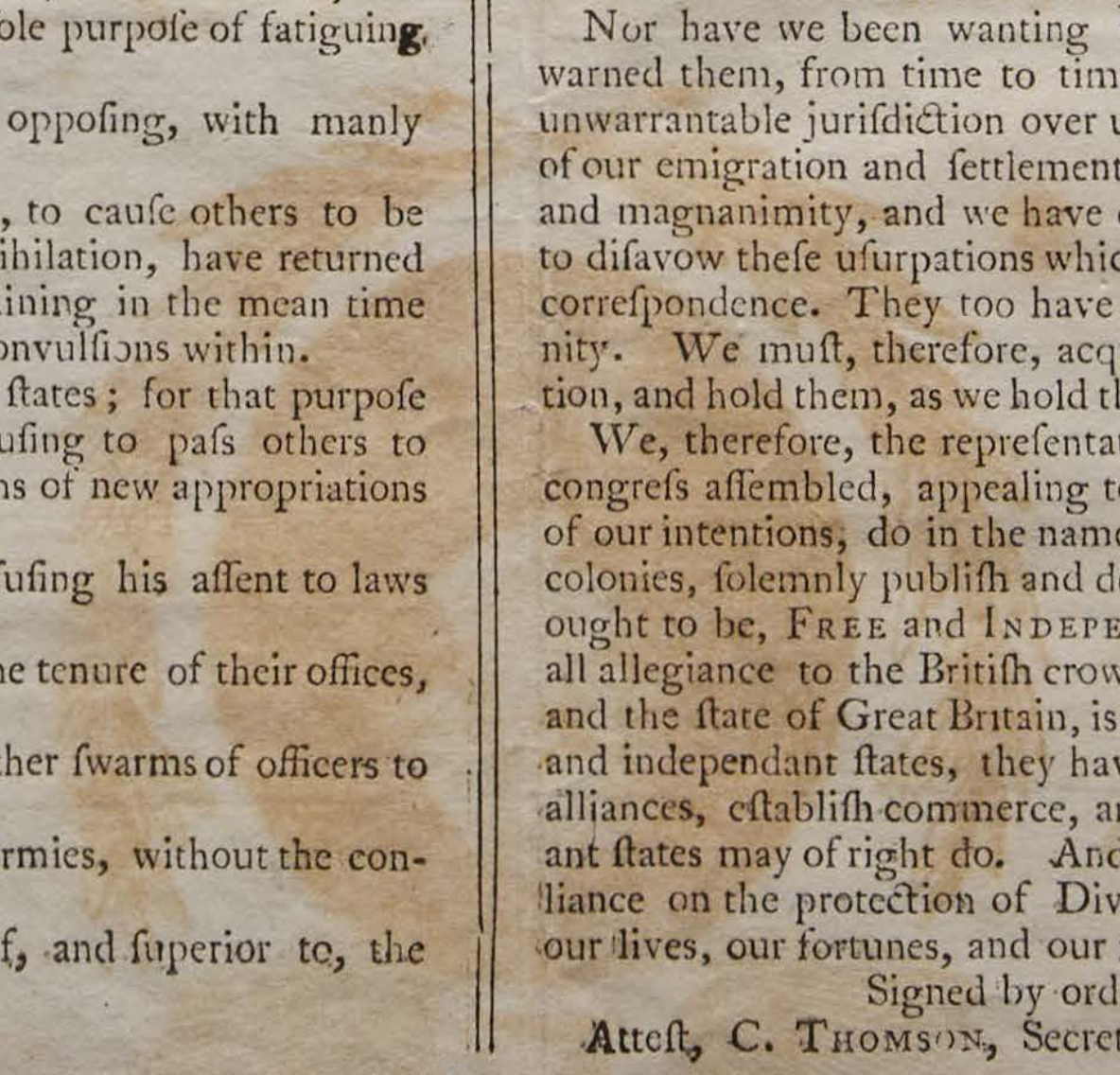
There are two known surviving copies of the London broadside—one intact, at the John Carter Brown Library, and one missing the top part of the sheet, at the Library Company of Philadelphia. The John Carter Brown Library’s copy was, for a time, folded in half and bound into a book. When it was later cut out, the right margin of the document became mutilated. Another remnant of the broadside’s time in binding is the ghostly image of John Hancock reflected on the bottom part of the sheet, where the ink transferred over time.
Broadside of the Declaration of Independence, ca. 1776, John Carter Brown Library
Where to See It In Person: John Carter Brown Library