May 11, 1776
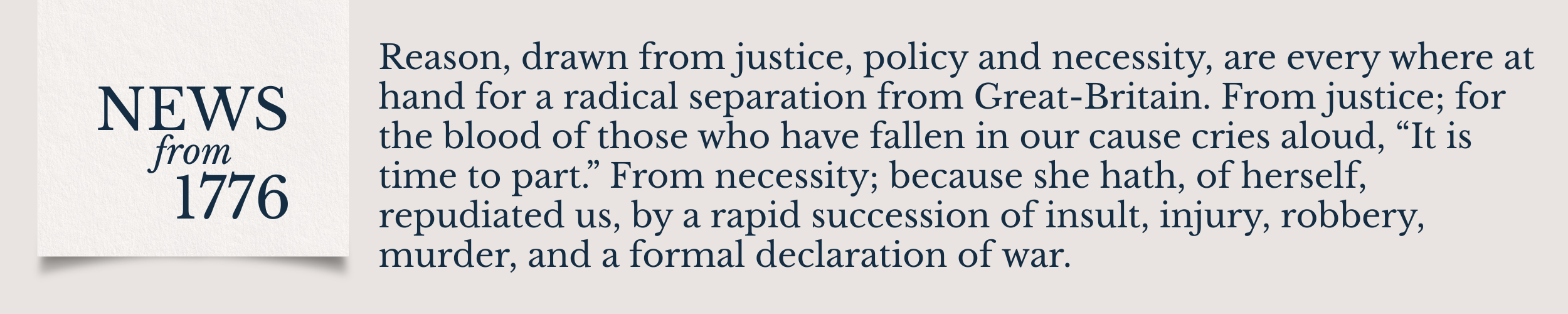
This document—nominally instructions to delegates in the Virginia Convention, but really a call for independence from Great Britain—is one among a number of local-level declarations issued, particularly in the spring of 1776. The freeholders of James City County, Virginia, near Williamsburg, agreed that “reason, drawn from justice, policy and necessity, are every where at hand for a radical separation from Great-Britain.” They cited “groundless hopes of accommodation” which had “deluded the timid” into hanging on for so long. So long as the king refused to provide “just and honorable terms” for a reconciliation with Great Britain, these Virginians instructed their representatives “to exert your utmost abilities, in the next Convention, towards dissolving the connexion between America and Great-Britain, totally, finally, and irrevocably.”
These instructions were agreed to on April 24, and the delegates convened in Williamsburg on May 6. By the time these instructions were printed in Philadelphia on May 11, the Virginia Convention was well on its way toward “dissolving the connexion.”

The Pennsylvania Evening Post
Printed by Benjamin Towne
From the VIRGINIA GAZETTE of April 26.
Mr. Purdie,
The freeholders of James city being desirous of expressing their sentiments on the important subject of independancy, a majority residing in the county assembled at Allen’s ordinary, the twenty-fourth of this instant, for that purpose, and agreed to the following instructions, which you are requested to publish in your next Gazette.
To ROBERT C. NICHOLAS, and WILLIAM NORVELL, Esquires.
Gentlemen,
IN vain do we congratulate ourselves upon the impotency of the minister to divide us, if our union amounts to nothing more than an union in one common lethargy. War hath been brought into our houses, heightened by terrors and cruelties, which the justest cause wants even palliatives for; but faint advances towards peace, insidiously urged, have caught the ear of the credulous, and groundless hopes of accommodation deluded the timid, so that the true military system remains untouched in most essential points. As if our inexperience, poverty in warlike stores, and the infancy of our navy, were of trifling moment, we have ventured to neglect resources, in such difficulties, which heaven hath placed within our attainment.
Alliances may be formed, at an easy price, capable of supplying these disadvantages, but an independant state disdains to humble herself to an equality in treaty with another who cannot call her politics her own; or, to be explicit, she cannot enter into a negotiation with those who denominate themselves rebels, by resistance, and confession of a dependancy.
Reason, drawn from justice, policy and necessity, are every where at hand for a radical separation from Great-Britain. From justice; for the blood of those who have fallen in our cause cries aloud, “It is time to part.” From necessity; because she hath, of herself, repudiated us, by a rapid succession of insult, injury, robbery, murder, and a formal declaration of war. These are but few, and some of the weakest arguments which the great volume of our oppression opens to every spirited American.
It cannot be a violation of our faith, now, to reject the terms, of 1763. They are a qualified slavery at best, and were acceptable to us, not as the extent of our right, but the probable cause of peace; but since the day in which they were most humbly offered, as the end of animosities, an interval hath passed, marked with tyranny intolerable.
We, therefore, whose names are hereunto subscribed, do request and instruct you, our Delegates (provided no just and honorable terms are offered by the King) to exert your utmost abilities, in the next Convention, towards dissolving the connexion between America and Great-Britain, totally, finally, and irrevocably.
*** The above instructions are signed by a majority of the freeholders living in the county.