March 25, 1776
In the spring of 1776, the columns of Philadelphia newspapers were dominated by commentary on Common Sense from a few pseudonymous voices, including “Cato”arguing against independence and “Cassandra” offering a rebuttal. The man behind “Cassandra” seems to have been James Cannon, a professor of mathematics and one of the more radical figures in Pennsylvania politics at this time.
In this issue of Dunlap’s Pennsylvania Packet, the front page had a lengthy letter from Cassandra to Cato, as well as a letter from Cassandra on a different topic: the rumored king’s commissioners. Cassandra’s perspective was that the commissioners were part of a strategy to divide and conquer, splitting the colonists’ attentions between the soldiers on their way to North America to continue the war and the promise of pardons. “Oh foolish Americans!” he wrote, “Who has bewitched you, that you should put any confidence in men who spill your blood with as little ceremony and reluctance, as a butcher would that of an ox. Is this all you know of the King and his Ministers?” Cassandra had a plan for how to deal with the commissioners when they arrived. He suggested sending orders to each colony “to arrest said Commissioners, in the name of the Thirteen United Colonies, as soon as they set foot on shore, and send them, under strong guards, to the Congress, with the strictest injunction they they be permitted to speak with no man, besides the guards and their servants, until they arrive in Philadelphia.” He suggested that the delegates in Congress ask one simple question of the commissioners: “Have you authority to order home your fleets and armies immediately?” If the answer was no—and clearly, Cassandra thought it would be—then the commissioners should be sent “to the enemy’s head-quarters, with this information, That we scorn as much to treat with a dagger at our breasts, as we disregard their forces.”

Dunlap’s Pennsylvania Packet or, the General Advertiser
Printed by John Dunlap
On sending COMMISSIONERS to treat with the CONGRESS.
THE man who would penetrate all the designs, and thoroughly acquaint himself with the several manœuvres of the British government, ought carefully to attend to two objects. The prime minister is always considered as the central wheel of all government movements, and the eyes of every one are fixed upon him, and his motions alone attended to. But in the present case, where he is confessedly ostensible, the affair is quite otherwise, and he who wishes to distinguish between the measures which proceed from the real minister, and will be prosecuted, and those which the ostensible is directed to hold out, as barrels to a whale, may perhaps find the true clue to guide through the labyrinth in the following observations.
Great-Britain has steadily and invariably pursued one course of conduct towards these colonies for the last twelve years, and yet politicians have constantly charged her with fickleness, and a want of a regular plan. He who discerns the true cause of this inconsistent consistency, can point out its nature, end and use, and shew that this fickleness demonstrates the firmest stedfastness, sees into the bottom of the present British policy, and comprehends all her measures. This knowledge I wish every member of the Honorable Continental Congress possessed of, with virtue and spirit sufficient to withstand all their efforts to destroy our liberties.
As soon as the Parliament is called, the King gives certain intimations of his designs, and applies for the approbation and support of the Commons. Here we have a small opening of the designs of the Cabinet, no more being communicated than is absolutely necessary for obtaining a general concurrence and vote of aids from Parliament. This being once obtained by way of Address, a new plan opens, and that spirit, which was roused by this discovery of the real designs of the government, is laid asleep as quickly as possible, and the real minister now retiring behind the curtain, the ostensible one succeeds to his place. You may therefore observe, that as soon as the heads of the secret cabinet are let loose by loyal addresses, things take a new turn in Parliament immediately; and the prime minister, as if totally forsaking the high ground he had lately taken possession of, begins to open new plans of a very different nature from that held out in the speech from the throne, and recommended in the addresses of both Houses of Parliament. The King and his cabal go to work with all the secrecy and vigour they are masters of, and Lord North assumes his new character, which is that of the deceiver of America, and amuser of the nation. And he has hitherto played his part so well, that all has gone on to their mind. He last year rendered them invisible, even to their own party, and had like to lose all by it, so that he was forced to take off the mask and partly discover himself before he could carry matters in the House. Any one, who remembers his motion, will feel the force of what is here related, and he who recollects the said motion arrived but a few weeks before the order for seizing Messieurs Hancock and Adams, which opened the present scene of the war, must perceive that he acted in the capacity I have assigned him. Even they who entertain the most indifferent opinion of the administration, were, by this motion, induced to belivee, for a time, that they meant to give up the matter.
He is now playing the same game over again. Proposals for a reconciliation, Commissioners, and what not, are now held out as the motion was last year, and for the same purposes.
The two parties now divide, each going to his own proper business. The King, and his secret Cabinet, to arraying the greatest military force they can muster, and dispatching them to butcher us with the utmost expedition; Lord North, and the Parliament, to amuse the nation, and distract and divide the Colonies by every hypocritical art in their power. Thus the two plans go hand in hand; the one to divide, the other to conquer. Was it not precisely so last year? Is it not so now? All ye timid, irresolute, terrified and double-faced Whigs, who have, by one means or other, crept into authority, open your mouths wide, and bawl stoutly against every vigorous measure until the Commissioners arrive. They will bring pockets well lined with English guineas; patents for places, pensions, and titles in abundance will attend them. Your palms will be first greased. You are the only men who can compleat the Parliamentary plans for raising an American revenue! Common Sense says this winter is worth an age, rejoice that it is now past, do all in your power to pass the spring in inactivity, and matters may yet go to your minds. Lord North’s motion last winter did much for you; the Commissioners, equally improved, will probably crown your wishes. I shall thank God, and heartily rejoice, if your influence reach not the councils and proceedings of the Congress.
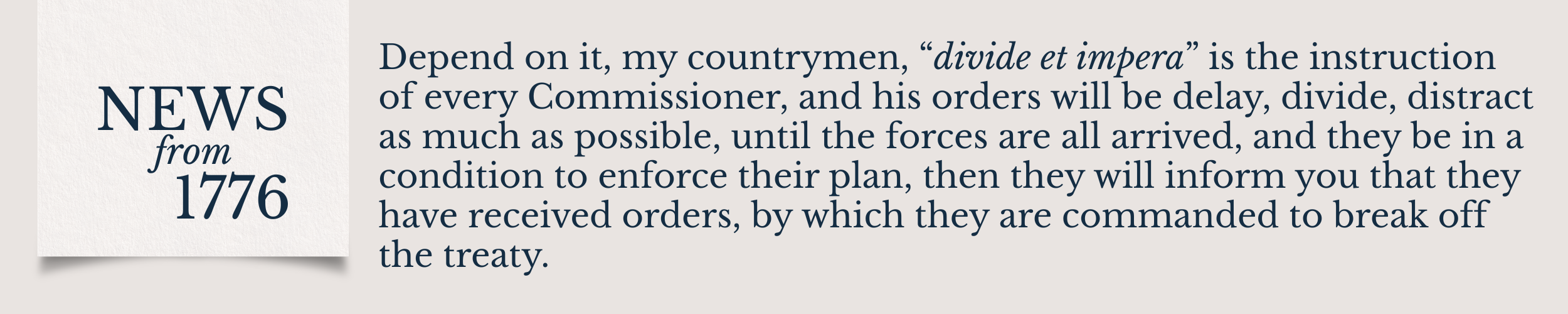
Depend on it, my countrymen, “divide et impera” is the instruction of every Commissioner, and his orders will be delay, divide, distract as much as possible, until the forces are all arrived, and they be in a condition to enforce their plan, then they will inform you that they have received orders, by which they are commanded to break off the treaty.
Too many have already lost sight of the King, and our real enemies, and are so far fascinated with the prospect of Commissioners, that I begin to dread the snare, and cannot help crying out to you, Oh foolish Americans! Who has bewitched you, that you should put any confidence in men who spill your blood with as little ceremony and reluctance, as a butcher would that of an ox. Is this all you know of the King and his Ministers?
I know there is not a Tory now on the Continent but hopes these Commissioners will effect their purpose, and are preparing to give them every possible assistance, and very few Whigs who have not their fears on the occasion. Every thinking man on both sides of the question must, and does believe, that their sole errand is to cajole and deceive, and that large promises, lies, bribery and corruption, are the means they will use.
I beseech you to lend all your spirit and vigour to the Congress on the occasion. Depend on it they will want it. Pray them to take one decisive step. To send orders to the Commander in Chief in each province to arrest said Commissioners, in the name of the Thirteen United Colonies, as soon as they set foot on shore, and send them, under strong guards, to the Congress, with the strictest injunction that they be permitted to speak with no man, besides the guards and their servants, until they arrive in Philadelphia; and that as soon as they arrive, a deputation from Congress wait upon them, and ask them this one plain question: Have you authority to order home your fleets and armies immediately? If they answer in the negative, then to break off all farther conference, and send them off that instant to the enemy’s head-quarters, with this information, That we scorn as much to treat with a dagger at our breasts, as we disregard their forces. If they answer in the affirmative, then to assure them, that as soon as the intelligence of their fleets and armies safe arrival in Great Britain shall have reached America, the conference shall be opened, and not before. That they, in the mean time, shall be kept in safe custody, treated like gentlemen, but not permitted to correspond or converse with the inhabitants before the treaty is compleated. Every hour spent in conference with Commissioners before this takes place, is an hour lost to America and two gained to Great-Britain, besides the immense damages which will arise from the powers of deceit and corruption, English gold, government promises, pensions, titles, and every art which malice, cunning and religious hypocrisy can invent or use, will be played off against our liberties. These, judiciously applied, will convert such among the great as have not virtue and integrity to withstand their force; and you will be sold without pocketing a penny of the price. Without pocketing did I say? Nay, yourselves must pay it. Hard lot indeed! But if you have not virtue and spirit sufficient to support the Congress in executing these measures for your security, you deserve it. I conclude by exhorting you to keep on the watch; lose not sight of the King and the army, by looking at the Prime Minister, Parliament and Commissioners. One bold stroke will effectually defeat the machinations of the latter, and then the former will stand alone and unsupported, and a second vigorous exertion will crush their evil designs against your liberties. Remember these Commissioners are the wooden horse which is to take those by stratagem whom twelve years hostility could not reduce. Act then like Laocoon; strike the dagger into his breast, and never permit your credulity or inactivity to give the perjured Sinon an opportunity of making a worn out, deluded, or corrupted Whig the altar on which to offer up your dear bought privileges.
CASSANDRA.
P.S. I shall be told this would be treating the Commissioners too cavalierly. To this I answer, men coming on such an errand cannot be treated too much so. Let any one shew the least mark of a design in Administration to relinquish their claims, and I will treat them with the utmost ceremony and respect. I will publish an ancient testimony in their own favour, if it can be but considered as doing them honour. For though I trust I shall never prostitute a pure and holy religion to pay my court to men, though they be Kings, yet I will do any right thing for those who come on so good an errand.