June 11, 1776
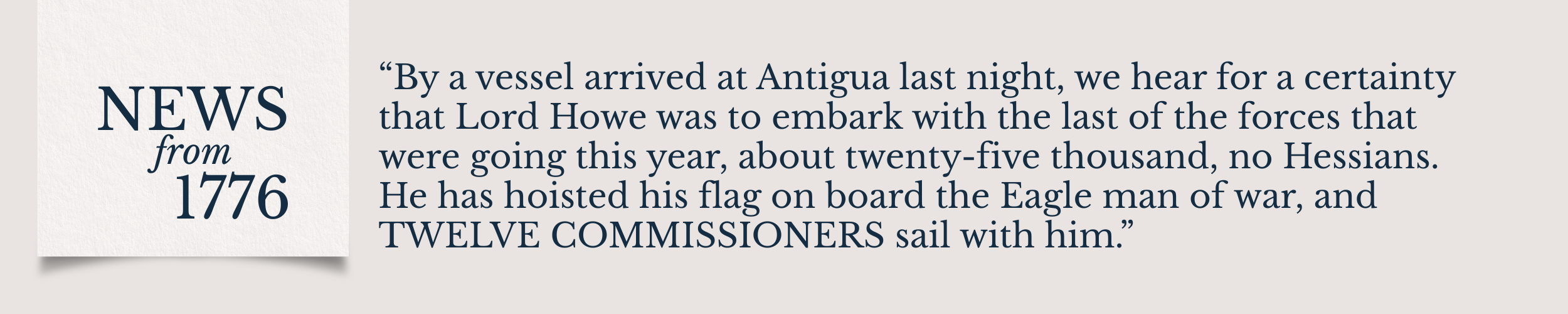
This letter from the Dutch Caribbean island of St. Eustiatia reported “for a certainty” that Vice-Admiral Richard Howe had embarked for North America and had “hoisted his flag on board the Eagle man of war.” This much was true, but other details in the letter were incorrect. The claim that “TWELVE COMMISSIONERS sail with him” gave an expectation that the king had sent a much larger number of commissioners for restoring peace. “This gives me some hopes of a reconciliation taking place,” the letter writer said, “that we may live in quietness again.” In reality, there were only two commissioners, Howe and his brother, General William Howe.

The Pennsylvania Evening Post
Printed by Benjamin Towne
Extract of a letter from St. Eustatia, dated May 22.
“By a vessel arrived at Antigua last night, we hear for a certainty that Lord Howe was to embark with the last of the forces that were going this year, about twenty-five thousand, no Hessians. He has hoisted his flag on board the Eagle man of war, and TWELVE COMMISSIONERS sail with him. This gives me some hopes of a reconciliation taking place, that we may live in quietness again. Flour is scarce among the English islands. They have laid an embargo at Antigua, which example, I suppose, the other islands will follow. Common flour sells for twelve dollars, superfine for fourteen, and corn for thirteen. The men of war, these two months, have taken one prize, which is Capt. David of Wilmington, upon Delaware.”