February 27, 1776
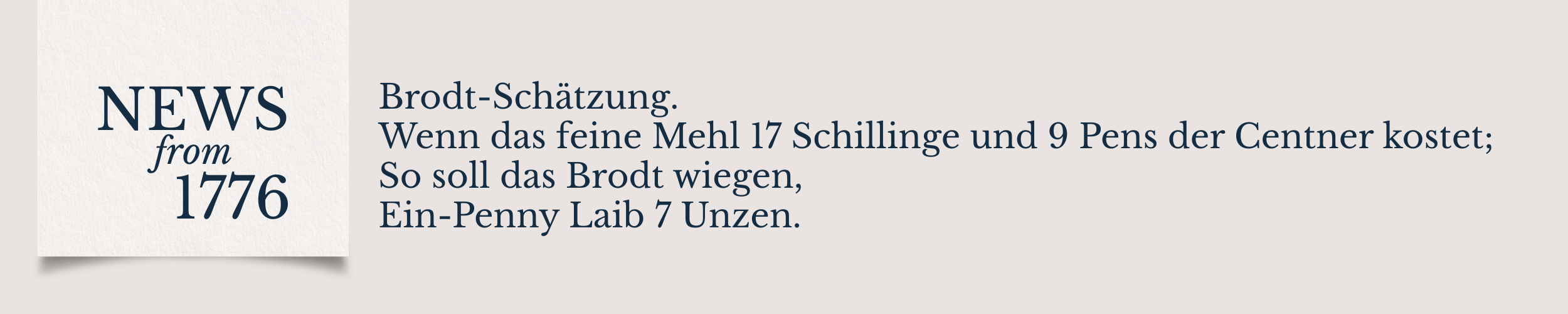
The price of bread has long been an important economic metric. Newspapers printed prices to give consumers a sense of how much they could expect to spend. In the Pennsylvanischer Staatsbote, the “Brodt-Schätzung,” or assize of bread, in February 1776 estimated that fine flour cost 17 shillings and 9 pennies per hundredweight, and the price of bread loaves was calculated from there. One penny would buy a 7-ounce loaf. Two pennies would buy a loaf weighing 15 ¼ ounces. Lesser quality flour was a bit cheaper, at 15 shillings per hundredweight, and rye flour was the least expensive, at 10 shillings per hundredweight. Comparing bread estimates over time shows how this staple could impact a family’s finances. One year earlier, in February 1775, the “Brodt-Schätzung” in the Staatsbote indicated that a one-penny loaf made with fine flour was smaller, at 6 ¾ ounces.

Pennsylvanischer Staatsbote
Printed by Henry Miller
Stadt Philadelphia, den 26sten Februar, 1776.
Brodt-Schätzung.
Wenn das feine Mehl 17 Schillinge und 9 Pens der Centner kostet;
So soll das Brodt wiegen,
Ein-Penny Laib 7 Unzen.
Zwey-Pens Laib 15 Unzen und 1 Viertel.
Vier-Pens Laib. Pfund 14 Unzen und eine halbe.
Acht Pens Laib 3 Pfund 13 Unzen.
Zwölf-Pens Laib 5 Pfund 11 Unzen und eine halbe.
Wenn das Mittel-Mehl 15 Schillinge der Centner gilt;
Ein-Penny Laib 8 Unzen und 3 Viertel.
Zwey-Pens Laib 1 Pfund 1 Unze und 1 Viertel.
Vier-Pens Laib 2 Pfund 2 Unzen und eine halbe.
Acht-Pens Laib 4 Pfund 5 Unzen.
Zwölf-Pens Laib 6 Pfund 7 Unzen und eine halbe.
Wenn das Roggen-Mehl 10 Schillinge der Centner gilt;
Ein-Penny Laib 11 Unzen.
Zwey-Penny Laib 1 Pfund 6 Unzen und 1 Viertel.
Vier-Pens Laib 2 Pfund 12 Unzen und eine halbe.
Acht-Pens Laib 5 Pfund 9 Unzen.
Zwölf-Pens Laib 8 Pfund 5 Unzen und Eine halbe.
Geschätzt von
Samuel Powell. Mayor.
Jacob Duche, Samuel Rhoads, Amos Strettle, } Aldermänner.