February 26, 1776
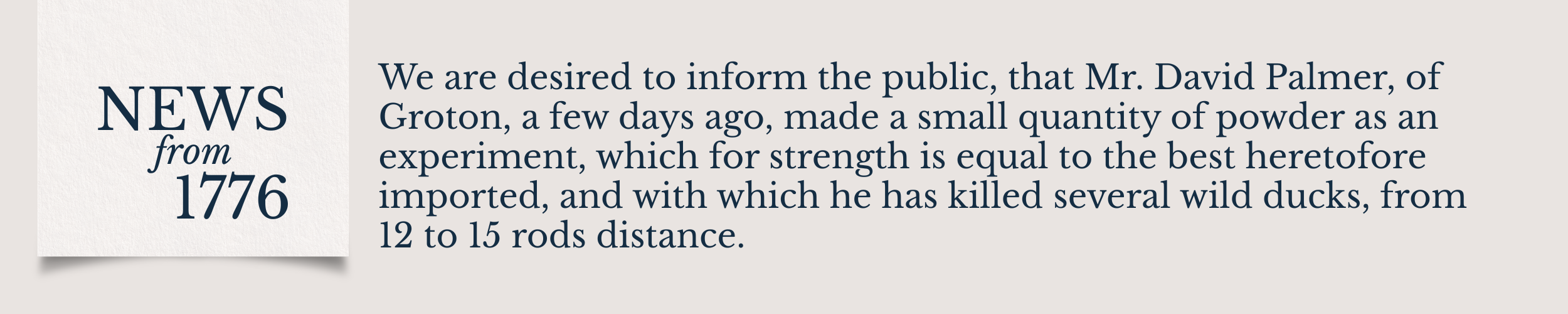
Wartime was also a time for experimentation. This report from New London, Connecticut, shows how one man worked to find a new formula for gunpowder that could measure up to imported powder. David Palmer who lived in Groton, across the river from New London, “made a small quantity of powder as an experiment.” He tested it by firing a distance of “12 to 15 rods.” A rod referred to a British measurement based on surveyor’s tools, the equivalent of 16 ½ feet. In short, Palmer’s powder “killed several wild ducks” from more than 200 feet away.
David Palmer’s commitment to the war effort went beyond testing new powder by shooting at ducks. He joined the 10th Continental Regiment and died defending Groton in 1781 during an attack by British forces led by Benedict Arnold on Fort Griswold.

Dunlap’s Pennsylvania Packet or, the General Advertiser
Printed by John Dunlap
NEW-LONDON, February 16.
[...]
We are desired to inform the public, that Mr. David Palmer, of Groton, a few days ago, made a small quantity of powder as an experiment, which for strength is equal to the best heretofore imported, and with which he has killed several wild ducks, from 12 to 15 rods distance.