April 1, 1776
After a few letters back and forth in Philadelphia newspapers, a new voice entered the conversation between “Cato” and “Cassandra”: “The Forester.” Actually, this was a known voice. The “Forester” letters have been attributed to Thomas Paine, using a different name from “Common Sense.” Some readers picked up on the similarities between Common Sense and The Forester in both message and writing style. Abigail Adams wrote that “Cato shews he has a bad cause to defend whilst the Forester writes with a spirit peculiar to himself,” which led her “to think that he has an intimate acquaintance with Common Sense.”
This letter clearly stated that independence was the only viable path forward for the colonies. The Forester called out Cato’s second letter, which put hope in the king’s commissioners, “whom Cato vainly and ridiculously stiles Ambassadors coming to negotiate a peace.” But The Forester insisted, “No, Sir, they are not the Ambassadors of peace, but the distributors of pardons, mischief and insult.” The Forester had choice words for Cato’s language choices and his overall style. The first Cato letter, for example, was “ insipid in its stile, language and substance” and “crowded with personal and private innuendoes.” A note in this first letter from The Forester suggests that he intended to keep his response to a single letter and then changed his mind. Ultimately, there were multiple Forester letters through the spring of 1776.

Dunlap’s Pennsylvania Packet or, the General Advertiser
Printed by John Dunlap
LETTER I.
To CATO.
TO be nobly wrong is more manly than to be manly right. Only let the error be disinterested—let it wear, not the mask, but the mark of principle and ‘tis pardonable. It is on this large and liberal ground, that we distinguish between men and their tenets, and generously preserve our friendship for theone, while we combat with every prejudice of the other. But let not Cato take this compliment to himself; he stands excluded from the benefit of the distinction; he deserves it not—And if the sincerity of disdain can add a cubit to the stature of my sentiments, it shall not be wanting.
It is indifferent to me who the writers of Cato’s letters are, and sufficient for me to know, that they are gorged with absurdity, confusion, contradiction, and the most notorious and willful falshoods. Let Cato and his faction be against Independance and welcome; their consequence will not now turn the scale: But let them have regard to justice, and pay some attention to the plain doctrine of reason. Where these are wanting, the sacred cause of truth applauds our anger, and dignifies it with the name of Virtue.
Four letters have already appeared under the specious name of Cato. What pretensions the writer of them can have to the signature, the Public will best determine; while, on my own part, I prophetically content myself with contemplating the similarity of their exits. The first of those letters promised a second, the second a third, the third a fourth; the fourth hath since made its appearance and still the writer keeps wide of the question. Why doth he thus loiter in the suburbs of the dispute? Why hath he not shewn us what the numerous blessings of reconciliation are, and proved them practicable? But he cunningly avoids the point. He cannot but discover the rock he is driving on. The face of the Roman Cato is before his eyes: And that the Public may be prepared for his funeral, and for his funeral oration, I will venture to predict the time and the manner of his exit. The moment he explains his terms of reconciliation the typographical Cato dies. If they be calculated to please the Cabinet they will not go down with the Colonies; and if they be suited to the Colonies will be rejected by the Cabinet: The line of no-variation is yet unfound; and, like the philosophers stone, doth not exist. “I am bold,” says Cato, “to declare and yet hope to make it evident to every honest man, that the true interest of America lies in reconciliation with Great-Britain on constitutional principles.”
This is a curious way of lumping the business indeed! And Cato may as well attempt to catch lions in a mouse-trap as to hope to allure the Public with such general and unexplained expressions. It is now a meer bug-bear to talk of reconciliation on constitutional principles, unless the terms of the first be produced and the sense of the other be defined; and unless he does this he does nothing.
To follow Cato through every absurdity and falshood in the compass of a * letter is impossible; neither is it now necessary. Cassandra (and I thank him) hath saved me much trouble; there is a spirit in his remarks which honestly only can inspire, and a uniformity in the conduct of his letter which the want of principle can never arrive at. Mark that, Cato.
One observation which I cannot help making on Cato’s letters, is, that they are addressed “To the People of Pennsylvania” only: In almost any other writer this might have passed unnoticed, but we know it hath mischief in its meaning. The particular circumstance of a Convention is undoubtedly Provincial, but the great business of the day is Continental. And he who dares to endeavour to withdraw this province from the glorious union by which all are supported, deserves the reprobation of all men. It is the true interest of the whole to go hand in hand; and dismal in every instance would be the fate of that Colony which should retreat from the protection of the rest.
The first of Cato’s letters is insipid in its stile, language and substance: crowded with personal and private innuendoes, and directly levelled against “the Majesty of the People of Pennsylvania.” The Committee could only call, propose, or recommend a Convention; but, like all other public measures, it still rested with the people at large, whether they would approve it or not; and Cato’s reasoning on the right or wrong of that choice is contemptible; because, if the body of the people had thought, or should still think, that the Assembly (or any of their Delegates in Congress) by setting under the embarrassment of oaths, and entangled with Government and Governors, are not so perfectly free as they ought to be, they undoubtedly had, and still have, both the right and the power to place even the whole authority of the Assembly in any body of men they please; and whoever is hardy enough to say to the contrary is an enemy to mankind. The constitution of Pennsylvania hath been twice changed through the cunning of former Proprietors; surely, the people, whose right, power and property is greater than that of any single man, may make such alterations in their mode of government as the change of times and things require. Cato is exceedingly fond of impressing us with the importance of our “chartered constitution.” Alas! We are not now, Sir, to be led away by the jingle of a phrase. Had we framed our conduct by the contents of the present charters, we had, ere now, been in a state of helpless misery. That very Assembly you mention hath broken it, and been obliged to break it, in almost every instance of their proceedings. Hold it up to the Public and it is transparent with holes; pierced with as many deadly wounds as the body of McCloed. Disturb not its remains, Cato, nor dishonour it with another funeral oration.
There is nothing in Cato’s first letter worthy of notice but the following insinuating falshood: “Grievous as the least restraint of the press must always be, to a people entitled to freedom, it must be the more so, when it is not only unwarranted by those to whom they have committed the care of their liberties, but cannot be warranted by them, consistent with liberty itself.”—The rude and unscholastical confusion of persons in the above paragraph, thought it throws an obscurity on the meaning, still leaves it discoverable. Who, Sir, hath laid any restraint on the liberty of the press? I know of no instance, in which the press hath been even the object of notice, in this province, except on account of the Tory letter from Kent County which was published last spring in the Pennsylvania Ledger, and which it was the duty of every good man to detect, because the honesty of the press is as great an object to society as the freedom of it. If this is the restraint you complain of we know your true character at once; and that it is so, appears evident from the expression which immediately follows the above quotation; your words are, “Nevertheless, we readily submitted to it, while the least colourable pretence could be offered for requiring such a submission.” Who submitted, Cato? we Whigs or we Tories? Until you clear up this, Sir, you must content yourself with being ranked among the rankest of the writing Tories; because, no other body of men can have any pretence to complain of want of freedom of the press. It is not your throwing out, now and then, a little popular phrase, which can protect you from suspicion; they are only the gildings under which the poison is conveyed, and without which you dared not to renew your attempts on the virtue of the people.
Cato’s second letter, or the greatest part thereof, is taken up with the reverence due from us to the persons and authority of the Commissioners, whom Cato vainly and ridiculously stiles Ambassadors coming to negotiate a peace. How came Cato not to be let a little better into the secret? The act of Parliament which describes the powers of these men, hath been in this city upwards of a month, and in the hands too of Cato’s friends. No, Sir, they are not the Ambassadors of peace, but the distributors of pardons, mischief and insult. Cato discovers a gross ignorance of the British constitution, in supposing that these men can be empowered to act as Ambassadors. To prevent his future errors I will set him right. The present war differs from every other, in this instance, viz. that it is not carried on under the prerogative of the Crown as other wars have always been, but under the authority of the whole legislative power united, and as the barriers which stand in the way of a negotiation, are not proclamations but acts of Parliament, it evidently follows, that were even the King of England here in person, he could not ratify the terms or conditions of a reconciliation; because, in the single character of King he could not stipulate for the repeal of any acts of Parliament, neither can the Parliament stipulate for him. There is no body of men more jealous of their privileges than the Commons: because they sell them. Mark that, Cato.
I have not the least doubt upon me but that their business (exclusive of granting us pardons) is downright bribery and corruption. It is the machine by which they effect all their plans. We ought to view them as enemies of a most dangerous species, and he who means not to be corrupted by them will enter his protest in time. Are they not the very men who are paid for voting in every measure against us, and ought we not to suspect their designs? Can we view the barbarians as friends? Would it be prudent to trust the viper in our very bosoms? Or to suffer them to ramble at large among us while such doubtful characters as Cato have a being upon the Continent? Yet let their persons be safe from injury and outrage—but trust them not. Our business with them is short and explicit, viz. We are desirous of peace, Gentlemen; we are ready to ratify the terms, and will virtuously fulfil the conditions thereof; but we should deserve all and every misery which tyranny can inflict, were we, after suffering such a repetition of savage barbarities, to come under your government again.
Cato, by way of stealing into credit, says, that “the contest we are engaged in is founded on the most noble and virtuous principles which can animate the mind of man. We are contending, (says he) against an arbitrary Ministry for the rights of Englishmen.” No, Cato, we are now contending against an arbitrary King to get clear of his tyranny. While the dispute rested in words only, it might be called “contending with the Ministry,” But since it is broken out into open war, it is high time to have done with such silly and water-gruel definitions. But it suits not Cato to speak the truth. It is his interest to dress up the sceptered savage in the mildest colours. Cato’s patent for a large tract of land is yet unsigned. Alass poor Cato!
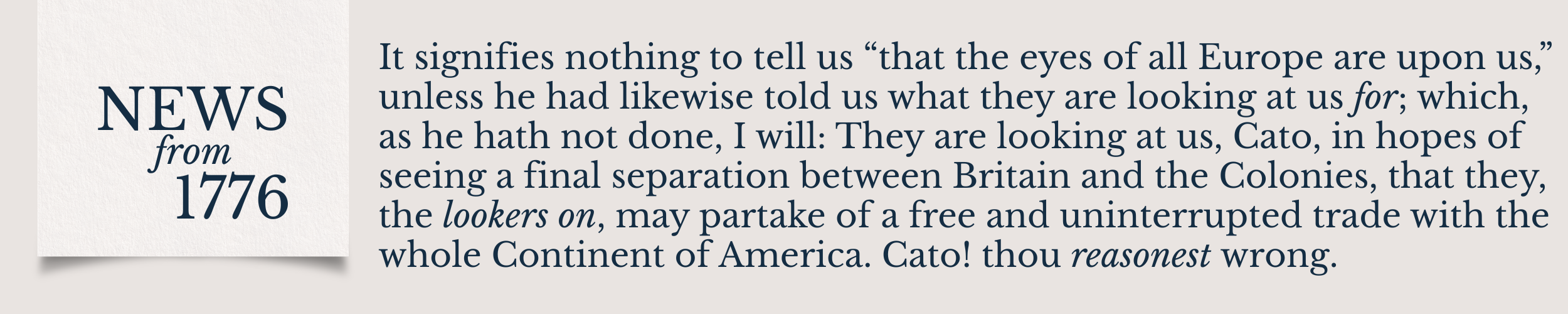
Cato proceeds very importantly to tell us, “that the eyes of all Europe are upon us.” This stale and hackneyed phrase, hath had a regular descent, from many of the King’s speeches down to several of the speeches in Parliament; from thence, it took a turn among the little wits and bucks of St. James’s; till after suffering all the torture of senseless repetition, and being reduced to a state of vagrancy, was charitably picked up to embellish the second letter of Cato. It is truly of the bug-bear kind, contains no meaning, and the very using it discovers a barrenness of invention. It signifies nothing to tell us “that the eyes of all Europe are upon us,” unless he had likewise told us what they are looking at us for; which, as he hath not done, I will: They are looking at us, Cato, in hopes of seeing a final separation between Britain and the Colonies, that they, the lookers on, may partake of a free and uninterrupted trade with the whole Continent of America. Cato! thou reasonest wrong.
For the present, Sir, farewell. I have seen thy soliloquy and despise it. Remember, thou hast thrown me the glove, Cato, and either thee or I must tire. I fear not the field of fair debate, but thou hast stepped aside and made it personal—Thou hast tauntingly called on me by name; and if I cease to hunt thee from every lane and lurking-hole of mischief, and bring thee not a trembling culprit before the public bar, then brand me with reproach, by naming me in the list of your confederates.
The FORESTER.
Philadelphia, March 28, 1776.
* The writer intended at first to have contained his remarks in one letter.