Quietly
The book tour for When the Declaration of Independence Was News is in Rhode Island this week, which makes it the perfect time for a story from Providence.
The Declaration of Independence was printed in the Providence Gazette and Country Journal on Saturday, July 13. A note preceding the text indicated that “The following Declaration of the General Congress was Yesterday received from Philadelphia.”
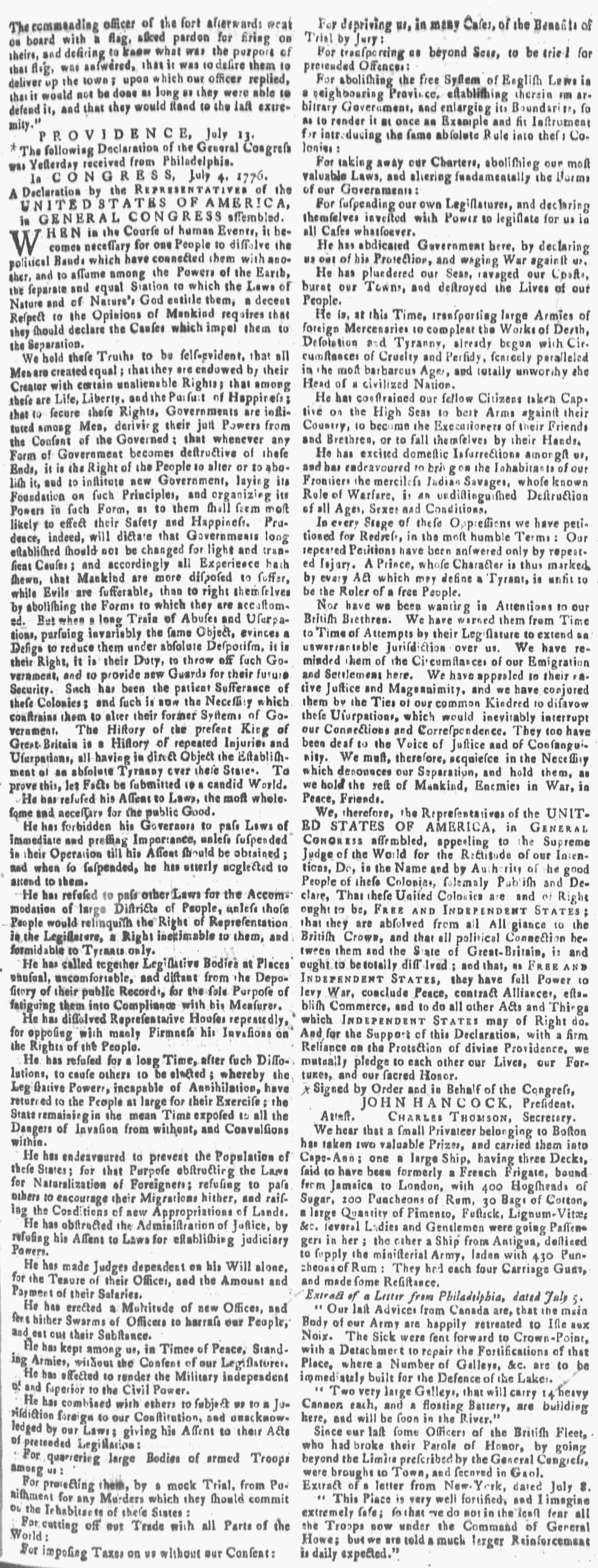
Providence Gazette and Country Journal, July 13, 1776, p. 2
The Rhode Island General Assembly issued a resolution supporting the Declaration, quickly followed by another resolution which they wanted to be printed in both the Newport Mercury and Providence Gazette. It read as follows, in the Providence Gazette on July 27:
It is therefore Voted and Resolved, That if any Person within this State shall, under Pretence of preaching or praying, or in any other Way and Manner whatever, acknowledge or declare the said King to be our rightful Lord and Sovereign, or shall pray for the Success of his Arms, or that he may vanquish or overcome all his Enemies, shall be deemed guilty of a high Misdemeanor, and shall therefor be presented, by the Grand Jury of the County where the Offence shall be committed, to the Superior Court of the same County; and upon Conviction thereof shall forfeit and pay as a Fine, to and for the Use of this State, the Sum of ONE HUNDRED POUNDS Lawful Money, and pay all Costs of Prosecution; and shall stand committed to Gaol until the same be satisfied…
John Graves, the minister of King’s Church in Providence, would not face a fine or jail time. Graves had stopped praying for the king already—but only because his own congregation had threatened him. On July 8, 1776—before anyone in Providence knew about the Declaration of Independence—a group of church wardens wrote a letter to Graves, insisting that “the Prayers now in use” from the Book of Common Prayer were “the most perfect that were ever devised, excepting that we cannot in conscience pray for the King of Great-Britain, as our most Gracious Lord and Sovereign, nor that he may have Success against his Enemies, when he hath declared all the Inhabitants of the United Colonies to be his Enemies.” They “earnestly” requested Graves “to omit all the Prayers for the King of Great Britain, and his Family.” The King’s Church congregation let Graves know what would happen if he refused to comply: “you will forfeit the Respect with which you have been hitherto treated, and draw upon yourself the Indignation of the Country in which you live,” and “your large and promising Family”—a wife and seven children—“instead of being introduced into the World with Reputation and the good Will of their Neighbours, may suffer greatly for the Conduct of the Father.”
Graves responded to this letter on the morning of July 13, the day that the Declaration of Independence was printed in the Providence Gazette. He wrote, “your very full Letter of the 8th instt., signed by 44, I received Yester-Afternoon”—the day the news of independence arrived in Providence. Graves called out the “variety of Motives, Threats, and Promises” that his congregants used to force him to omit the prayers for the king, but said it was not in his power, “as a Minister of that Church over which, under God, he is the Head,” to make such a change. Graves felt particularly persecuting, writing, “I believe no Clergyman in this Government, and I hope none in New England, has been so long and vigorously attacked, by his people, on this head, as I have.” He referred to the book of Acts in the Bible, and a passage where the apostles Peter and John asked the people to judge “Which is right in God’s eyes: to listen to you, or to him.”
Graves planned a long response to his congregation, but changed his mind after learning about the Declaration of Independence. He wrote: “as Independency, I understand, is now proclaim’d, have here to inform you, that I shall quietly lay aside my publick Ministry.” The Declaration quieted this Anglican minister. He refused to “deliberately expose himself and Family to Poverty and Disgrace, to Hardships and Miseries unknown.”
It seems that Graves’s decision calmed his congregation. They continued to provide him with the financial support necessary to support his large family. In a letter to the secretary of the Society for the Propagation of the Gospel in September 1776, John Graves explained that, “since Independency,” he had continued to “baptize their Children, visit their Sick, bury their Dead, & frequent their respective Houses with the same Freedom as usual.” He added that “their Benefactions” were actually “far beyond” what he had experienced before independence, “founded upon their commiserating Sense, that the necessary Means of supporting my large Family, a Wife & 7 Children, &c. were now entirely cut off.”