May 22, 1776
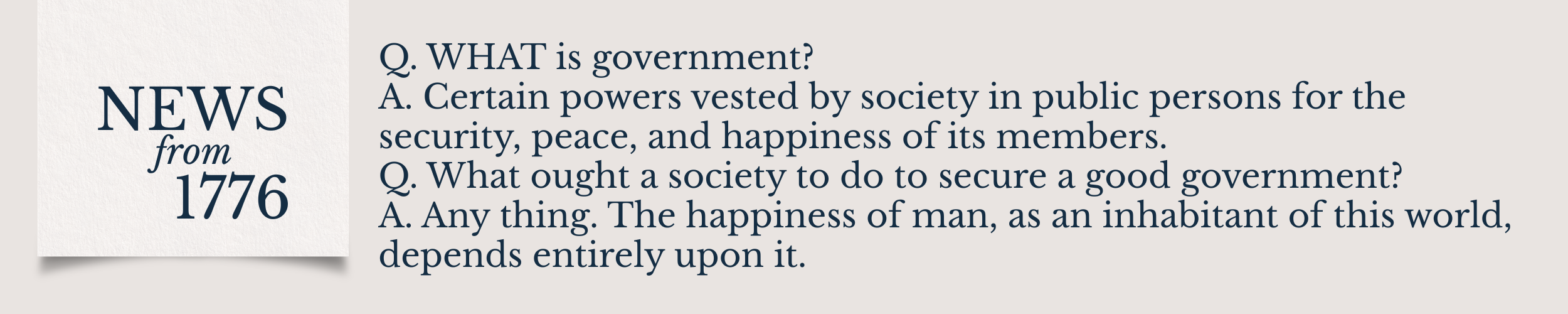
With all of the political change happening in Pennsylvania, newspapers filled up with essays and, in this case, a set of “Serious QUESTIONS proposed to all friends to the rights of mankind in Pennsylvania, with suitable ANSWERS.” The first question, “WHAT is government?” was answered with “Certain powers vested by society in public persons for the security, peace, and happiness of its members.” New governments ought to be established “When the old becomes impracticable, or dangerous to the rights of the people”—and the time had come for new government in Pennsylvania. Some of these questions had straightforward answers. “From whom ought public persons to derive their authority to govern?” Clearly, “from the people whom they are to govern.” But there was more uncertainty with the final question, “Will they be unanimous in establishing a perfectly free government?” The author of these questions was concerned about “royal tyranny” being replaced by an aristocracy or oligarchy, “which is much worse, purely by leaving the business of framing a constitution to the officers of the old government.” “A good precaution,” they offered, would be “to exclude all those who frame the constitution from ever holding any office under it.”

The Pennsylvania Journal; and the Weekly Advertiser
Printed by William and Thomas Bradford
Serious QUESTIONS proposed to all friends to the rights of mankind in Pennsylvania, with suitable ANSWERS.
Q. WHAT is government?
A. Certain powers vested by society in public persons for the security, peace, and happiness of its members.
Q. What ought a society to do to secure a good government?
A. Any thing. The happiness of man, as an inhabitant of this world, depends entirely upon it.
Q. When ought new government to be established?
A. When the old becomes impracticable, or dangerous to the rights of the people.
Q. Is that the present state of our government?
A. Every officer of it is bound by oaths of allegiance and fidelity to our enemies. The chief magistrate is wholly independant of the people both in fortune and authority. The use of our constitution is impracticable in many instances, and dangerous in all, therefore necessity says it ought to be laid aside.
Q. What ought to form a new constitution of government?
A. The people.
Q. From whom ought public persons to derive their authority to govern?
A. From the people whom they are to govern.
Q. What ought to be the object of government?
A. The welfare of the governed.
Q. How is such a government to be obtained?
A. By forming a constitution which regards men more than things, by framing it in such a manner that the interest of the Governors and governed shall ever be the same; and by delegating the powers of government so that the people may always have it in their power to resume them, when abused, without tumult or confusion, and to deliver them to persons more worthy of trust.
Q. Should the officers of the old constitution be entrusted with the power of making a new one when it becomes necessary?
A. No. Bodies of men have the same selfish attachments as individuals, and they will be claiming powers and prerogatives inconsistent with the liberties of the people. Aristocracies will by this means be established, and we will exchange a bad constitution for a worse, or the tyranny of one for the tyranny of many.
Q. Who ought to have such a trust conferred upon them, as it is the highest and most important which man can delegate?
A. First, Men of the greatest wisdom and integrity, who have as much if not more natural than acquired sense and understanding. Secondly, Men who can be under no temptations to frame political distinctions in favour of any class or set of men. Thirdly, Men who the moment the constitution is framed, must descend into the common paths of life, and have as great a chance to feel every defect in the constitution as any man. And lastly, Men who regard not the person of the rich, nor despise the state of the poor, but who prefer justice and equity to all things, and would go any lengths to establish the common rights of mankind on the firmest foundation.
Q. Ought the constitution which a proper number of such persons agree upon to be immediately adopted?
A. No. After agreeing upon a constitution or form of government, they ought to adjourn for six or nine months, publish the plan, request every man to examine it with the utmost seriousness and attention, make remarks upon it, point out any defects which may appear in it, and offer amendments. Then let the same body of men who framed it, joined by an additional number of new members, meet at the time fixed in their adjournment, canvass the whole again, take the defects pointed out, and the amendments proposed into their consideration, and finally agree.—N.B. This frame of government, when agreed upon, should be entitled the Social Compact of the people of —, &c. and should be unalterable in every point, except by a delegation of the same kind of that which originally framed it, appointed for that purpose.
Q. What should be done after this compact is finally agreed upon?
A. The same, or another body of men, should be appointed to draw up what I should call a charter of delegation, being a clear and full description of the quantity and degree of power and authority, with which the society vests the persons intrusted with the powers of the society, whether civil or military, legislative, executive or judicial.
Q. Is this all that is necessary to secure a good government?
A. If the legislative be so constituted as never to be able to form an interest of its own separate from the interest of the community at large; if its branches are independant of and balance each other, and all dependant on the people, and if it has the power of calling the executive and judicial branches to account for mal-administration, it might do; but I should propose the addition of a Committee of Inquiry to be chosen every third year, whose authority should extend to the examination of all laws passed within that space of time, to see if any infringed upon the Social Compact, to inquire into the application of the public money, and the conduct of all officers whether legislative, executive or judicial; particularly to see that no branch of the legislature exceed the bounds prescribed to it in the Charter of Delegation; to sit in judgment on the delinquent, and they, whom the Committee condemned, should be declared incapable of holding any office of power and trust in the society. This Committee should exist only for six months at most, and should have power to recommend any alteration or amendment of any article in the Charter of Delegation, which, by experience, should be found defective or dangerous; which alteration or amendment should be made by a body of men delegated for the purpose, in the same manner as the Original Compact. N.B. One article in the original compact should be, that all virtuous men, who believe in a God, should be equally capable of holding any office, for which he was qualified, when the choice of the people. Nothing but Atheism or open immorality to exclude any man.
Q. Granting the foregoing plan to be just and right, how may it be obtained?
A. By the virtue and unanimity of the people, particularly those who at the hazard of their lives have resolved to support the liberties of their country.
Q. Will they be unanimous in establishing a perfectly free government?
A. The people themselves can best answer this question. They began the contest for the sake of freedom, and it is both their duty and interest. Men of sinister views and designs will endeavour to sow divisions. They will lay hold on the bigotry of some, the religious prejudices of others, and the ignorance of a third sort. A few families will endeavor to get all power into their hands, and form an oligarchy or aristocracy. Most nations, who have shaken off royal tyranny, have been enslaved by an aristocracy or oligarchy,‡ which is much worse, purely by leaving the business of framing a constitution to the officers of the old government. They, setting up an interest of their own in opposition to that of the people, formed an aristocracy. For my part I should think it a good precaution to exclude all those who frame the constitution from ever holding any office under it. This should be esteemed so high and sacred a trust, that the man who was thought worthy to frame it, should be forbid ever to degrade himself by holding any office whatever. These things, next to the salvation of our souls, should engage our attention. The first settlers of this province formed a compact with William Penn nearly of this kind, but he artfully got them to give it up. Their wise and steady opposition to his encroachments cannot be sufficiently commended. I should expect much from the virtue of their descendants, if they could be persuaded to lay aside groundless fears and jealousies, and heartily to join in correcting and reforming a constitution against the defects of which they have long contended. They have now the only opportunity which, perhaps, will ever be offered them.
N.B. As the above concerns all, the several printers are intreated to give it a place in their papers as soon as possible, that all may have an opportunity of answering the questions for themselves.
‡ Aristocracy means the government of the great families of the country; Oligarchy, the government of a few great men, who have by some means or other got possession of the powers of government.