March 19, 1776
What was the anniversary of the Boston “massacre” like on March 5, 1776, when British forces occupied Boston? A commemoration was held in nearby Watertown. Rev.Peter Thacher of Malden, Massachusetts, delivered an “Oration, to commemorate this event, and to impress upon our minds the fatal tendency of standing armies being posted in populous cities, in time of peace.” Thacher’s oration, which was later printed, specifically mentioned that “the past year hath presented us with a Tragedy more striking, because more extensive, than this.” He continued, “we have seen the ground crimsoned with the gore of hundreds of our fellow-citizens.—we have seen the first city in America for wealth and extent, depopulated, we have seen others destroyed, and heard our savage enemies breathing out thirstings for our blood.” Thacher concluded with a prayer: “O GOD, LET AMERICA BE FREE!”
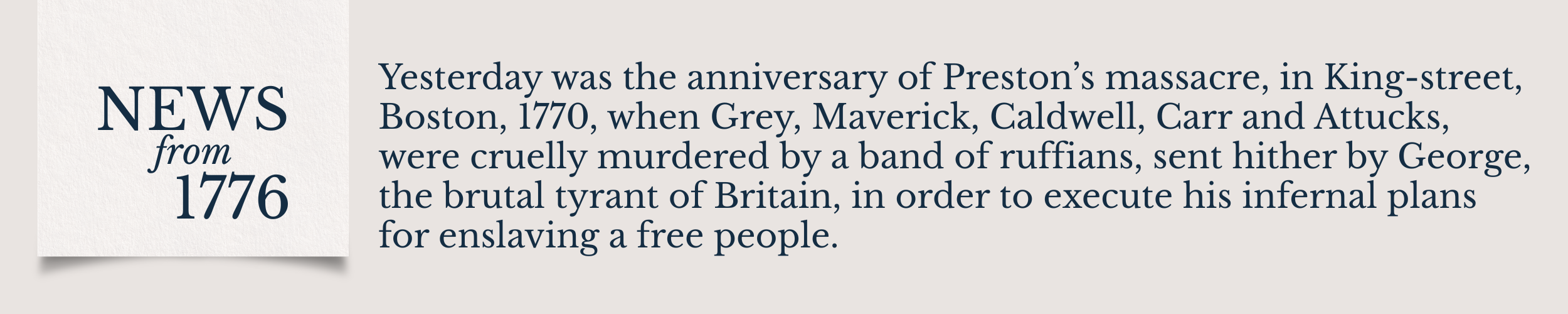
The account of this commemoration of the anniversary, printed in the newspaper in Cambridge, had a decidedly bias view of the “massacre, in King-street, Boston, 1770, when Grey, Maverick, Caldwell, Carr and Attucks, were cruelly murdered by a band of ruffians, sent hither by George, the brutal tyrant of Britain, in order to execute his infernal plans for enslaving a free people.” Mentioned among the men was Crispus Attucks, a man of Wampanoag and African descent, traditionally described as the first man killed on March 5.

The Pennsylvania Evening Post
Printed by Benjamin Towne
CAMBRIDGE, March 6.
Yesterday was the anniversary of Preston’s massacre, in King-street, Boston, 1770, when Grey, Maverick, Caldwell, Carr and Attucks, were cruelly murdered by a band of ruffians, sent hither by George, the brutal tyrant of Britain, in order to execute his infernal plans for enslaving a free people. An Oration, to commemorate this event, and to impress upon our minds the fatal tendency of standing armies being posted in populous cities, in times of peace, was pronounced at the meeting-house in Watertown, by the Rev. Mr. Thatcher of Malden, preceded by a prayer by the Rev. Doctor Cooper.