June 29, 1776
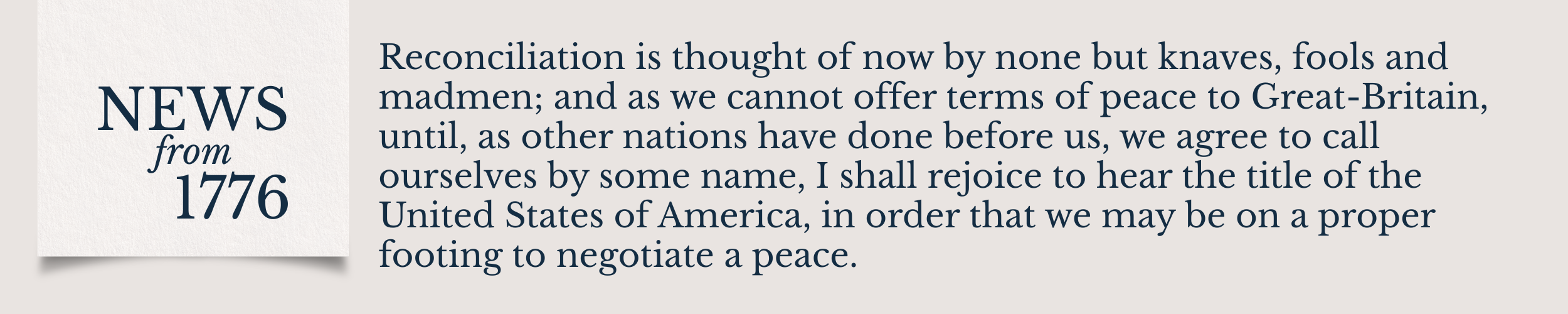
This short and timely essay in the Pennsylvania Evening Post by “Republicus” has been attributed to the pamphleteer Thomas Paine. In Common Sense, Paine argued “that nothing can settle our affairs so expeditiously as an open and determined declaration for independence.” On June 29, Republicus wrote that “EVERY moment that I reflect on our affairs, the more am I convinced of the necessity of a formal Declaration of Independance.” Paine was involved enough with the delegates in the Continental Congress to know that a formal Declaration had been prepared in anticipation of the Congress’s vote on whether or not to declare independence from Great Britain. Republicus also used the “title of the United States of America,” which was used in the draft Declaration, as well.
Republicus asserted that only “knaves, fools and madmen” supported a reconciliation with Great Britain. This essay was intended to build public support for independence as the only viable path forward for the colonies and to cast anyone who did not want the colonies to be independent as “a traitor.” Republicus said, “I would, for my own part, choose rather to be conquered as an independant state than as an acknowledged rebel.”

The Pennsylvania Evening Post
Printed by Benjamin Towne
For the PENNSYLVANIA EVENING POST.
EVERY moment that I reflect on our affairs, the more am I convinced of the necessity of a formal Declaration of Independance. Reconciliation is thought of now by none but knaves, fools and madmen; and as we cannot offer terms of peace to Great-Britain, until, as other nations have done before us, we agree to call ourselves by some name, I shall rejoice to hear the title of the United States of America, in order that we may be on a proper footing to negotiate a peace.
Besides, the condition of those brave fellows who have fallen into the enemy’s hands as prisoners, and the risk which every man runs, who bears arms either by land or sea in the American cause, makes a declaration of independance absolutely necessary, because no proper cartel for an exchange of prisoners can take place while we remain dependants. It is some degree of comfort to a man, taken prisoner, that he belongs to some national power, is the subject of some state that will see after him. Oliver Cromwell would have sent a memorial as powerful as thunder to any King on earth, who dared to have used prisoners in the manner which ours have been. What is it that we have done in this matter? Nothing. We were subjects of Great-Britain, and must not do these things. Shame on your cowardly souls that do them not! You are not fit to govern.
Were Britain to make a conquest of America, I would, for my own part, choose rather to be conquered as an independant state than as an acknowledged rebel. Some foreign powers might interpose for us in the first case, but they cannot in the latter, because the law of all nations is against us. Besides, the foreign European powers will not be long neutral, and unless we declare an independance, and send embassies to seek their friendship, Britain will be beforehand with us; for the moment that she finds that she cannot make a conquest of America by her own strength, she will endeavour to make an European affair of it. Upon the whole, we may be benefited by independance, but we cannot be hurt by it, and every man that is against it is a traitor.
REPUBLICUS.