January 31, 1776
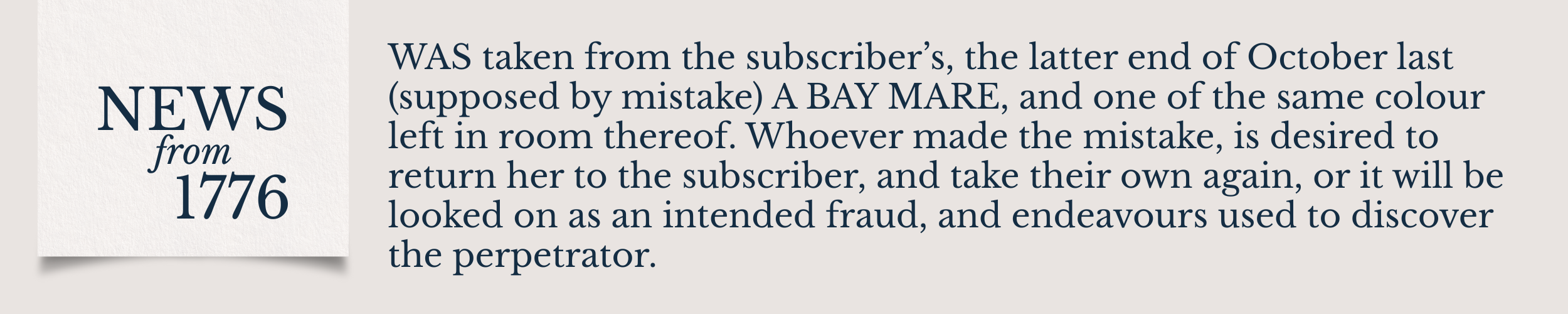
In January 1776, William Hugg submitted an advertisement to the Pennsylvania Gazette about something that had occurred three months earlier. In October 1775, someone, “(supposed by mistake),” took a bay mare from his property, “one of the same colour left in room thereof.” Perhaps this horse swap evaded Hugg’s notice. Hugg’s father, William Sr., died in 1775 and he and his siblings inherited different parts of their father’s property. Nevertheless, after three months, Hugg gave notice that, if the correct horse was not returned, it would be “looked on as an intended fraud.”
William Hugg, Sr. was an innkeeper in Gloucester, New Jersey, and a longtime advertiser in the Pennsylvania Gazette. In 1771, he gave notice that a grey horse had been left in his pasture, and a few months later, he sought the return of a “Mulattoe servant man, named CORNELIUS GALLAGHAN.” A 1767 advertisement in the Gazette shows that Gallaghan had fled from Hugg before. A decade earlier, another servant named Thomas Lewis had run away, and a decade before that, in 1746, Hugg advertised the escape of a Bermudian-born enslaved laborer named William Colson.

The Pennsylvania Gazette
Printed by Hall and Sellers
Gloucester, January 26, 1776.
WAS taken from the subscriber’s, the latter end of October last (supposed by mistake) A BAY MARE, and one of the same colour left in room thereof. Whoever made the mistake, is desired to return her to the subscriber, and take their own again, or it will be looked on as an intended fraud, and endeavours used to discover the perpetrator.
WILLIAM HUGG.