January 13, 1776
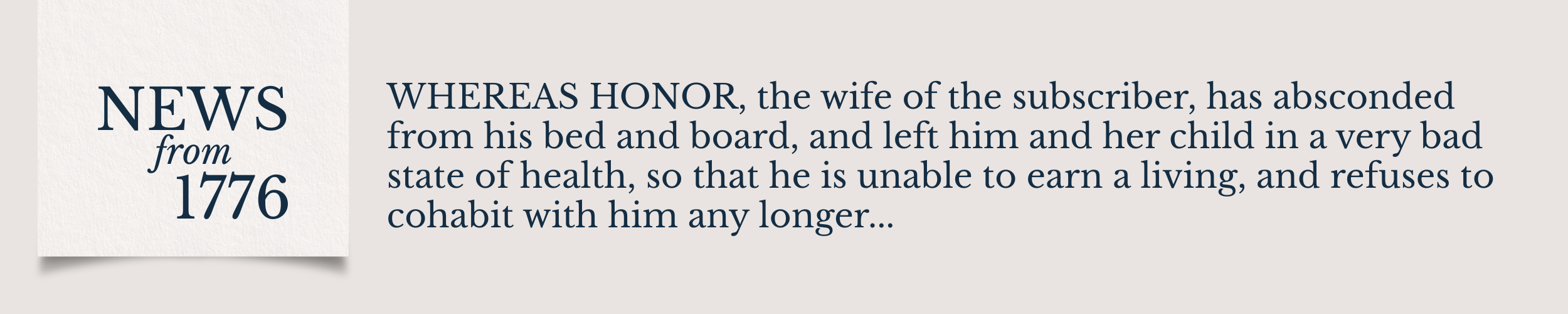
In January 1776, Edward Powers gave notice to the readers of the Pennsylvania Evening Post that his wife, Honor, had left him. This may seem like a personal matter, but these types of advertisements can be seen in many colonial newspapers, and it relates to the restricted rights of women at this time. Honor Powers “absconded” from Edward’s home and refused to live with him. But, coverture laws meant that married women were “covered” by their husbands—that married men held financial authority. If Honor Powers made any transactions or did any shopping, the accounts were in her husband’s name. The purpose of Edward Powers’s advertisement about Honor is the second half of the lengthy sentence. He wanted “to forewarn all persons from harbouring or crediting her on his account, as he is resolved to pay no debts of her contracting after this date.”
What happened next for Edward and Honor Powers is unclear, at least from the Philadelphia newspapers. Edward’s advertisement only appeared in this issue of the Pennsylvania Evening Post. Perhaps the two reconciled. Perhaps she moved away or entered into a new relationship. Perhaps he could not afford to place a repeating advertisement. Or perhaps the “very bad state of health” he mentioned impacted what he was able to do to impede his estranged wife.

The Pennsylvania Evening Post
Printed by Benjamin Towne
Philadelphia, January 13, 1776.
WHEREAS HONOR, the wife of the subscriber, has absconded from his bed and board, and left him and her child in a very bad state of health, so that he is unable to earn a living, and refuses to cohabit with him any longer; this is to forewarn all persons from harbouring or crediting her on his account, as he is resolved to pay no debts of her contracting after this date.
EDWARD POWERS.