February 7, 1776
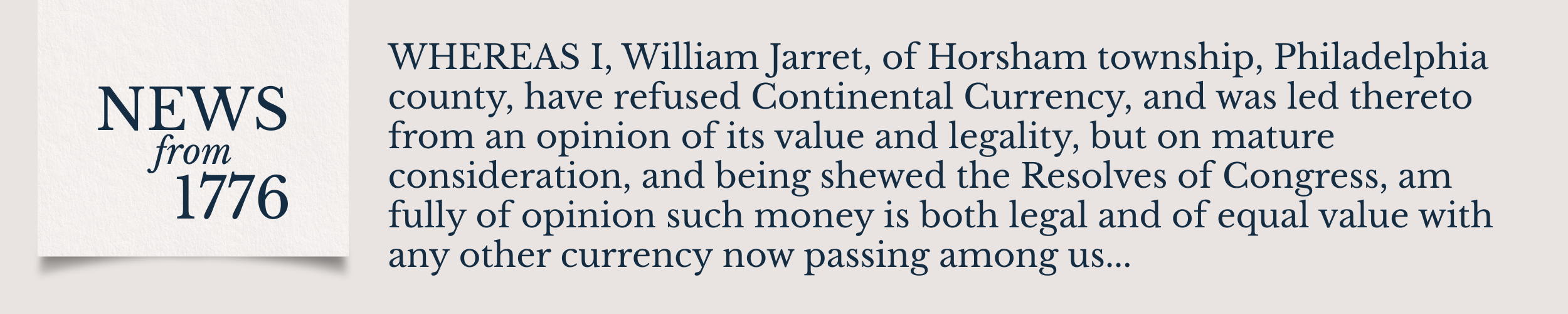
Several men in Philadelphia County came to the attention of the Committee of Inspection and Observation for their failure to accept Continental money, including William Jarret, who lived in Horsham Township. On January 11, 1776, the Continental Congress had resolved, “that if any person shall hereafter be so lost to all virtue and regard for his country, as to ‘refuse to receive said bills in payment,’ or obstruct or discourage the currency or circulation thereof,” they would be “duly convicted” by their local committee, and “deemed, published, and treated as an enemy of his country, and precluded from all trade or intercourse with the inhabitants of these colonies.”
To avoid condemnation, Jarret had to issue a public apology, which he did in the Pennsylvania Gazette. He explained that he had refused Continental currency “from an opinion of its value and legality”—essentially, he thought that this new money printed in the colonies was not as valuable as the British money he was used to using. But, after “mature consideration,” and “being shewed the Resolves” of the Continental Congress, he changed his mind. In Jarret’s apology, he tried to save his public reputation by stating that he was “heartily sorry” for refusing to accept Continental currency in the past, and would accept it in the future.

The Pennsylvania Gazette
Printed by Hall and Sellers
Philadelphia, January 31, 1776.
WHEREAS I, William Jarret, of Horsham township, Philadelphia county, have refused Continental Currency, and was led thereto from an opinion of its value and legality, but on mature consideration, and being shewed the Resolves of Congress, am fully of opinion such money is both legal and of equal value with any other currency now passing among us, and that I shall in future receive such money, and am heartily sorry for my past refusal of it.
WILLIAM JARRET.