August 5, 1776
On July 18, 1776, the Declaration of Independence was proclaimed in Boston from the balcony of the Old State House. The crowd that gathered for this public reading were in the same spot on King Street where the Boston “Massacre” had occurred six years earlier. They received the news of independence “with great joy, expressed by three huzzas.” Inside the State House after the reading, local officials offered celebratory toasts, including to the “American Congress,” to George Washington, and to the “downfall of tyrants and tyranny.” That evening, the royal coat of arms and other symbols of the king were taken down all over Boston, “together with every sign that belonged to a tory,” and burned in bonfires on King Street. Eventually, King Street was renamed State Street.

Dunlap’s Pennsylvania Packet or the General Advertiser
Printed by John Dunlap
BOSTON, July 25.
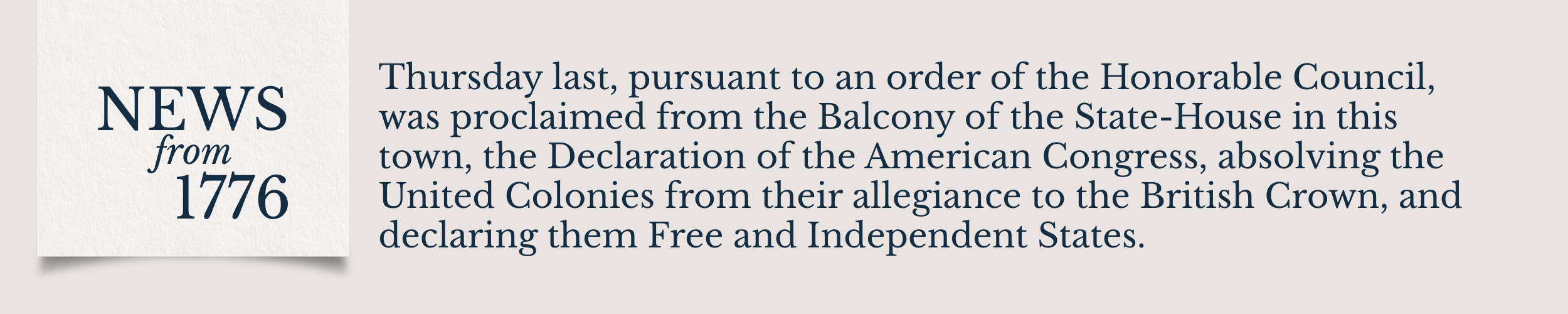
Thursday last, pursuant to an order of the Honorable Council, was proclaimed from the Balcony of the State-House in this town, the Declaration of the American Congress, absolving the United Colonies from their allegiance to the British Crown, and declaring them Free and Independent States. There were present on the occasion, in the Council Chamber, the Committee of Council, a number of the Honorable House of Representatives, the Magistrates, Ministers, Selectmen, and other Gentlemen of Boston and the neighbouring towns; also the commission officers of the Continental Regiments stationed here, and other officers. Two of those regiments were under arms in King-street, formed into three lines on the north side of the street, and in thirteen divisions; and a detachment from the Massachusetts Regiment of artillery, with 2 pieces of cannon, was on their right wing. At one o’clock the Declaration was proclaimed by Colonel Thomas Crafts, which was received with great joy, expressed by three huzzas from a great concourse of people assembled on the occasion. After which, on a signal given, thirteen pieces of cannon were fired from the fort on Fort-hill, the forts at Dorchester Neck, the Castle, Nantasket, and Point Alderton, likewise discharged their cannon: Then the detachment of Artillery fired their cannon thirteen times, which was followed by the two regiments giving their fire from the thirteen divisions in succession. These fires corresponded to the number of the American States United. The ceremony was closed with a proper collation to the Gentlemen in the Council Chamber; during which the following toasts were given by the President of the Council, and heartily pledged by the Company, viz.
Prosperity and perpetuity to the United States of America.
The American Congress.
The General Court of the State of Massachusetts-Bay.
General WASHINGTON, and success to the Arms of the United States.
The downfall of tyrants and tyranny.
The universal prevalence of civil and religious liberty.
The friends of the United States in all quarters of the globe.
The bells in town were rung on the occasion, and undissembled festivity cheered and brightened every face.
On the same evening the King’s arms, and every sign with any resemblance of it, whether lion and crown, pestle and mortar and crown, heart and crown, &c. together with every sign that belonged to a tory was taken down, and the latter made a general conflagration of in King street.