August 29, 1776
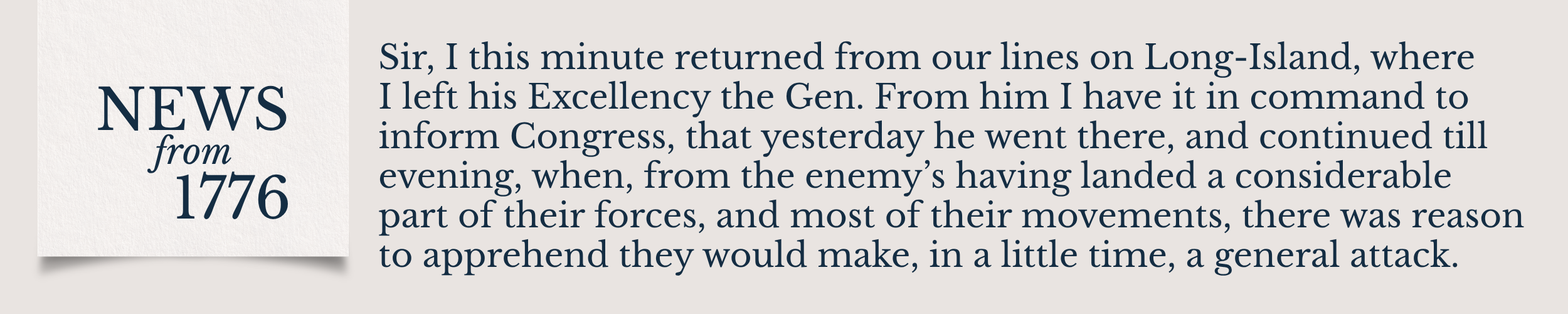
By printing his paper in the evening, Benjamin Towne was able to publish news that had reached Philadelphia that same day, including on August 29, when he printed a letter which had “arrived between eight and nine o’clock” that morning by an express rider from New York. The letter was dated eight o’clock in the evening on August 27, which means less than 48 hours passed between when it was written in New York and when it was printed in the Pennsylvania Evening Post. The letter was written by someone who had just returned from Long Island, where he had been with “his Excellency the Gen.”—George Washington. Although neither the author nor the recipient of the letter were published in the newspaper, archival evidence shows that the letter writer was Robert Hanson Harrison, and his audience was the president of the Continental Congress, John Hancock.
Harrison described how the British had “landed a considerable part of their forces” on Long Island, and “there was reason to apprehend they would make, in a little time, a general attack.” Early on the morning of August 27, there was a “smart engagement” in which the Continental Army “sustained a pretty considerable loss.” Many men were missing, including Major General John Sullivan and Major General William Alexander, known as Lord Stirling. Harrison concluded his letter with some intelligence from a British deserter, who said that “they design, as soon as the wind will permit them, to come up” and “silence” the American batteries.

The Pennsylvania Evening Post
Printed by Benjamin Towne
An express, which arrived between eight and nine o’clock this morning from New-York, brought the following letter.
“New-York, August 27, 1776, eight o’clock, P.M.
“Sir, I this minute returned from our lines on Long-Island, where I left his Excellency the Gen. From him I have it in command to inform Congress, that yesterday he went there, and continued till evening, when, from the enemy’s having landed a considerable part of their forces, and most of their movements, there was reason to apprehend they would make, in a little time, a general attack.
“As they would have a wood to pass through, before they could approach the lines, it was thought expedient to place a number of men there, on the different roads leading from whence they were stationed, in order to harass and annoy them in their march. This being done, early this morning a smart engagement ensued between the enemy and our detachments, which, being unequal to the force they had to contend with, have sustained a pretty considerable loss; at least many of our men are missing. Among those that have not returned are Gen. Sullivan and Lord Sterling.
“The enemy’s loss is not known certainly, but we are told by such of our troops that were in the engagement, and what have come in, that they had many killed and wounded. Our party brought off a Lieutenant, Serjeant, and Corporal, with twenty privates, prisoners.
“While these detachments were engaged, a column of the enemy descended from the woods, and marched towards the center lines, with a design to make an impression, but were repulsed.
“This evening they appeared very numerous about the skirts of the woods, where they have pitched several tents; and his Excellency inclines to think they mean to attack and force us from our lines by way of regular approaches rather than in any other manner.
“Today five ships of the line came up towards the town, where they seemed desirous of getting, as they turned a long time against an unfavourable wind. And on my return this evening, I found a deserter from the twenty-third regiment, who informed me that they design, as soon as the wind will permit them, to come up, give us a severe cannonade, and to silence our batteries, if possible. I am, &c.”